Japanese
English
- 有料閲覧
PPV購入案内
1,320円 (1,200円+税10%) こちらは、43ページから49ページの文献です。購入には医書.jp本会員登録が必要です。
会員登録完了後に改めて上記「購入サイトへ」を選択してください。
または「購入サイトへ」選択後に「購入ログイン」、「新規会員登録」の順に進んでください。
会員登録について詳しくはをご確認ください。
- Abstract 文献概要
- 1ページ目 Look Inside
I.はじめに
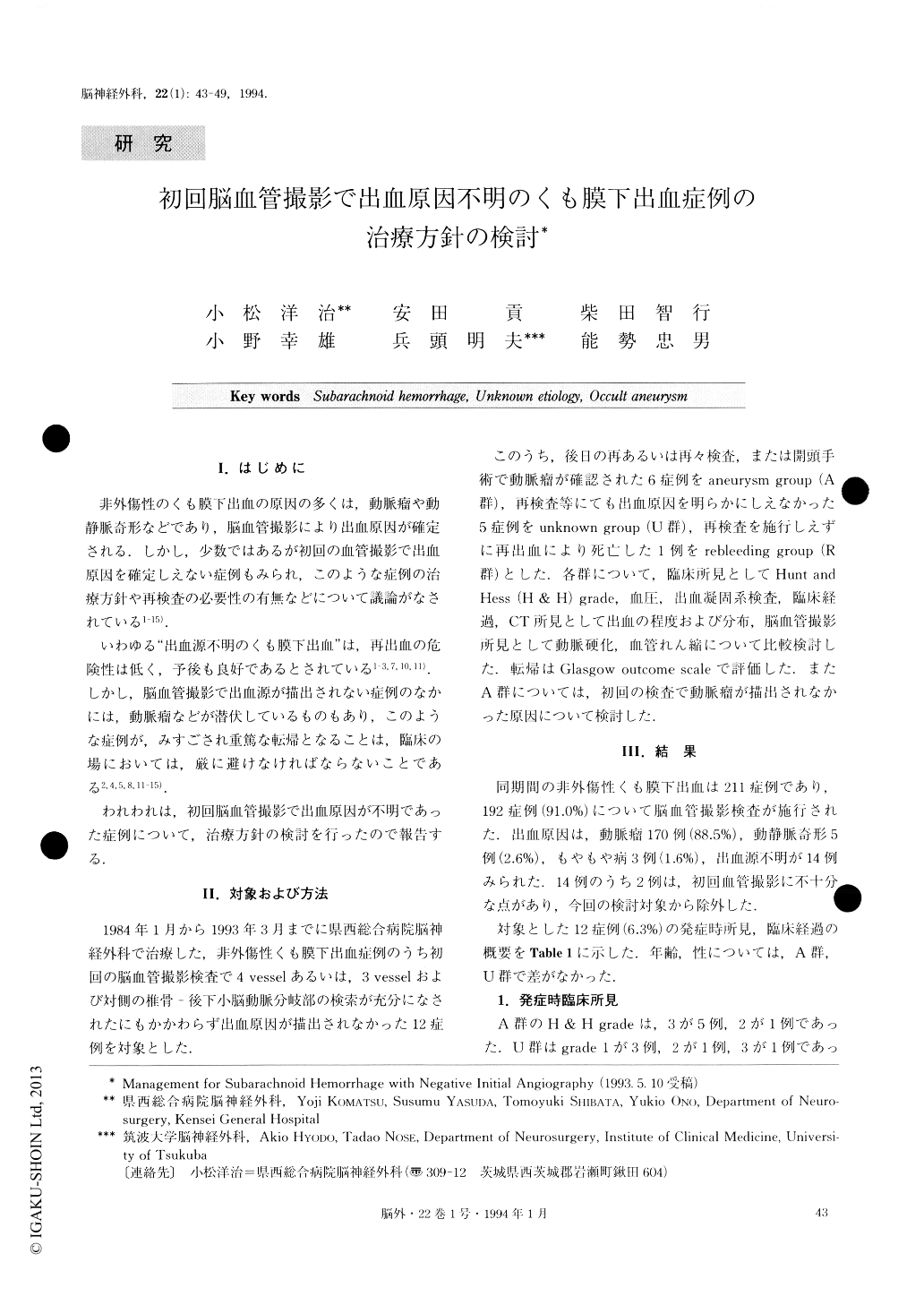
非外傷性のくも膜下出血の原因の多くは,動脈瘤や動静脈奇形などであり,脳血管撮影により出血原因が確定される.しかし,少数ではあるが初回の血管撮影で出血原因を確定しえない症例もみられ,このような症例の治療方針や再検査の必要性の有無などについて議論がなされている1-15).
いわゆる“出血源不明のくも膜下出血”は,再出血の危険性は低く,予後も良好であるとされている1-3,7,10,11).しかし,脳血管撮影で出血源が描出されない症例のなかには,動脈瘤などが潜伏しているものもあり,このような症例が,みすごされ重篤な転帰となることは,臨床の場においては,厳に避けなければならないことである2,4,5,8,11-15).
Subarachnoid hemorrhage (SAH) is commonly caused by ruptured aneurysm or arteriovenous mal-formation which is detected by cerebral angiogram. However, since angiograms sometimes cannot show the origin of SAH, we review 12 cases (6.3% of total SAH) to assess the management of these cases.
We divided the 12 cases into three groups. Group A (occulted aneurysm group) consisted of six cases of which aneurysms were detected by repeated angio-graphies in four, and by surgical procedures in two. Group U (unknown etiology group) consisted of five cases. Their follow up periods varied from 7 months to 7 years 11 months, and all of them recovered well and had no episode of rebleeding. Group R (rebleeding group) consisted of one case which fatally re-bled on the second day.
Group A tended to be Hunt and Hess grade 3, and Fisher group 3 or 4. In contrast, group U tended to be H and H grade 1 or 2, and Fisher group 2. However by their clinical and neuroradiological findings alone, it was not possible to distinguish the two groups certain-ly. This means that the patients whose initial angiogra-phy does not show the origin of bleeding must be cared for as an occult aneurysm case. Twice repeated angio-grams should be programmed. In our cases the first was carried out on the seventh day in the hope that the reason for vasospasm of the parent artery might be shown to be a hidden aneurysm. The second was car-ried out sometime between the 14th and 21st day be-cause of thrombolysis in the aneurysm, and because it was necessary to relieve vasospasm. The occulted aneurysm is commonly sited on the anterior communicating artery or in the posterior cir-culation of the Willis ring.
Copyright © 1994, Igaku-Shoin Ltd. All rights reserved.