Japanese
English
- 有料閲覧
PPV購入案内
1,320円 (1,200円+税10%) こちらは、525ページから530ページの文献です。購入には医書.jp本会員登録が必要です。
会員登録完了後に改めて上記「購入サイトへ」を選択してください。
または「購入サイトへ」選択後に「購入ログイン」、「新規会員登録」の順に進んでください。
会員登録について詳しくはをご確認ください。
- Abstract 文献概要
- 1ページ目 Look Inside
I.はじめに
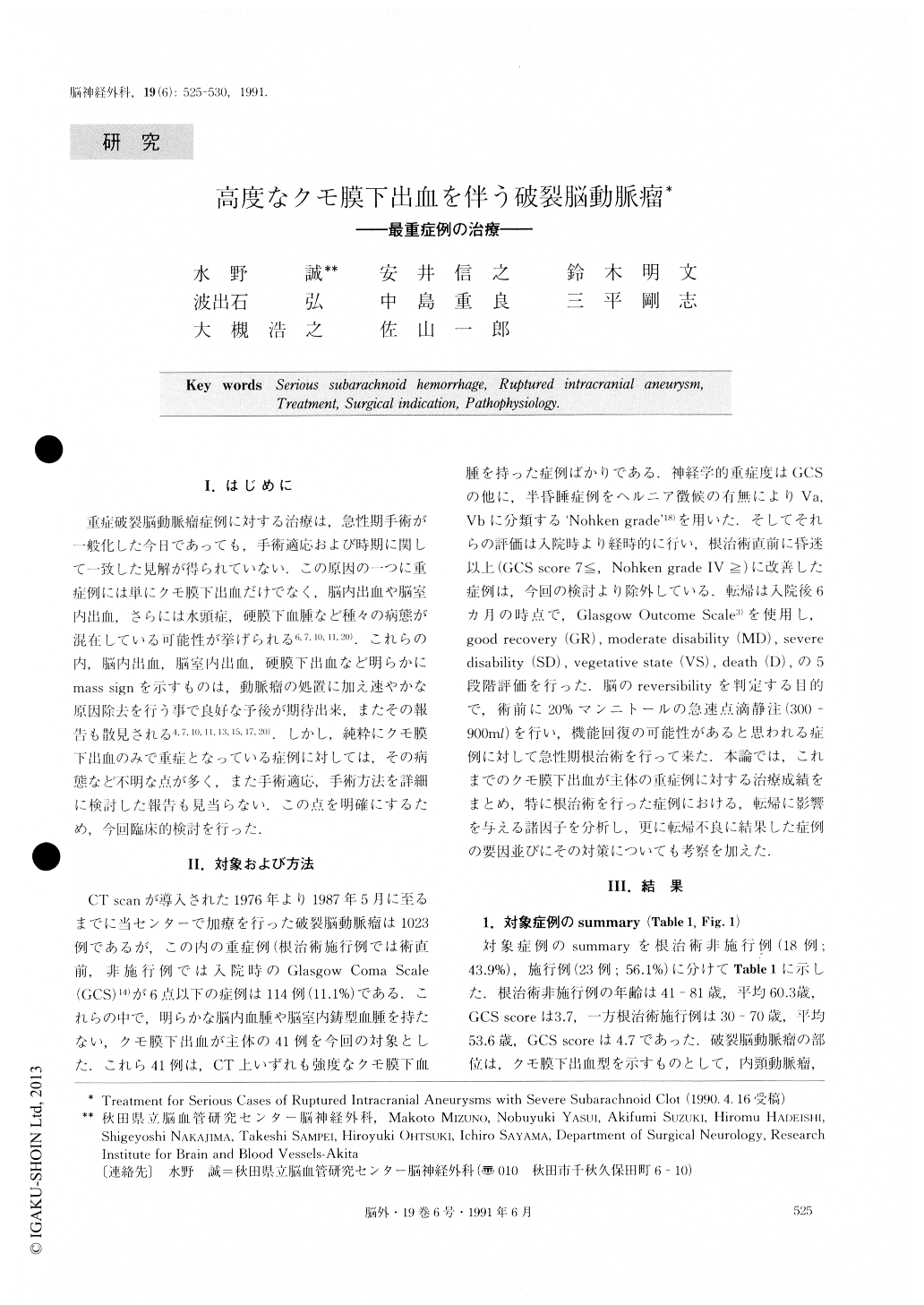
重症破裂脳動脈瘤症例に対する治療は,急性期手術が一般化した今日であっても,手術適応および時期に関して一致した見解が得られていない.この原因の一つに重症例には単にクモ膜下出血だけでなく,脳内出血や脳室内出血,さらには水頭症,硬膜下血腫など種々の病態が混在している可能性が挙げられる6,7,10,11,20).これらの内,脳内出血,脳室内出血,硬膜下出血など明らかにmass signを示すものは,動脈瘤の処置に加え速やかな原因除去を行う事で良好な予後が期待出来,またその報告も散見される4,7,10,11,13,15,17,20).しかし,純粋にクモ膜下出血のみで重症となっている症例に対しては,その病態など不明な点が多く,また手術適応,手術方法を詳細に検討した報告も見当らない.この点を明確にするため,今回臨床的検討を行った.
Abstract
Forty-one serious cases of ruptured intracranial aneurysms with severe subarachnoid clot were clinical-ly analyzed, with special emphasis on the prognosis, pa-thophysiology, and surgical indications. All cases had thick subarachnoid clot without concurrent intracere-bral hematoma and/or intraventricular hematoma caus-ing mass signs on the CT scan. In this series, 23 cases underwent radical surgery while in the acute stage, 18 cases were treated conservatively (including 5 cases tre-ated only by continuous ventricular drainage) . The criterion for determining the degree of severity was de-fined as either a “semicoma” or “coma” state just prior to radical surgery for the radically-operated group, with the same designations for the conservative group at their time of admission.
All patients except two in the conservatively-treated group died clue to primary brain damage caused by massive subarachnoid hemorrhage. The two remaining cases died from other complications. On the other hand, the outcome for the 23 surgically-treated patients was as follows : Three (13%) fully recovered ; three (13%) were capable of self-management ; eight (34.8%) were partially or fully dependent. Nine (39.1%) , died. In the radically-treated group, pre-operative factors that might predict clinical outcome were investigated. Those fac-tors were the neurological grade, the brain-stem re-sponse, the response after the rapid administration of 20% Mannitol (300 - 900 ml) , and the length of time from the last bleeding episode to the time that radical surgery was performed. It was recognized that there was no relationship between the neurological grade just prior to radical surgery and the outcomes in the serious cases. Results were good for patients in the following subgroups : 1) In which neurological symptoms im-proved after the rapid administration of 20% Mannitol, even though the patient was still comatose ; 2) In which brain-stem responses such as the ciliospinal re-flex were preserved ; 3) In which radical surgery could be performed within four hours of the last bleeding epi-sode.
If early surgery is performed when any of the above three conditions exist, a completely successful surgery can be expected. In addition, it is important to empha-size that our experience shows that most unfavorable results can be eliminated by the evacuation of the sub-arachnoid clot, especially in the perimesencephalic cist-ern. This treatment could prevent the occurrence of vasospasm and release pressure to the brain-stem.
Copyright © 1991, Igaku-Shoin Ltd. All rights reserved.