Japanese
English
- 有料閲覧
PPV購入案内
1,320円 (1,200円+税10%) こちらは、788ページから796ページの文献です。購入には医書.jp本会員登録が必要です。
会員登録完了後に改めて上記「購入サイトへ」を選択してください。
または「購入サイトへ」選択後に「購入ログイン」、「新規会員登録」の順に進んでください。
会員登録について詳しくはをご確認ください。
- Abstract 文献概要
- 1ページ目 Look Inside
Point
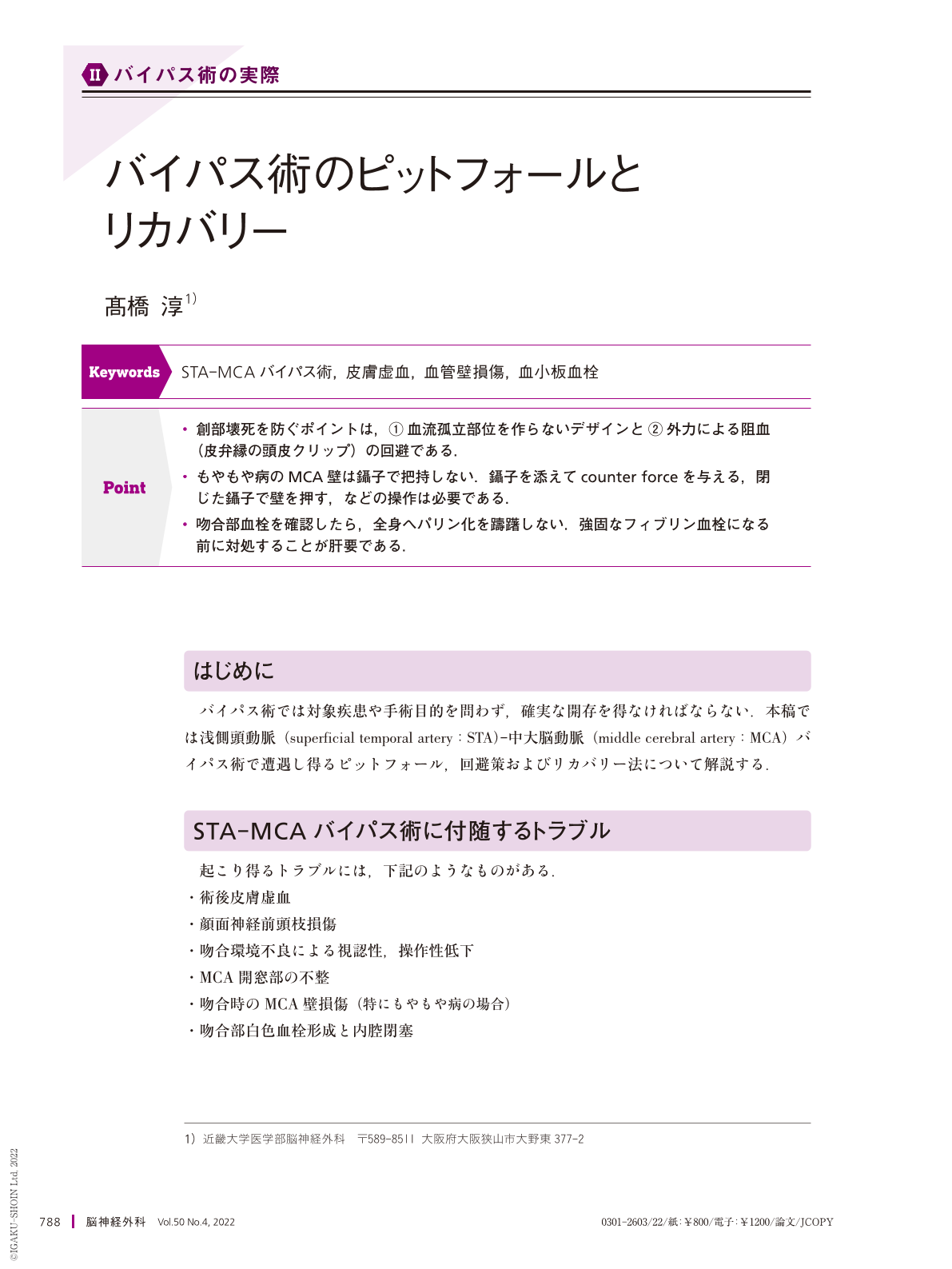
・創部壊死を防ぐポイントは,① 血流孤立部位を作らないデザインと ② 外力による阻血(皮弁縁の頭皮クリップ)の回避である.
・もやもや病のMCA壁は鑷子で把持しない.鑷子を添えてcounter forceを与える,閉じた鑷子で壁を押す,などの操作は必要である.
・吻合部血栓を確認したら,全身ヘパリン化を躊躇しない.強固なフィブリン血栓になる前に対処することが肝要である.
Complications of the superficial temporal artery-middle cerebral artery(STA-MCA)bypass procedure include skin necrosis, MCA vessel wall injury, and thrombotic occlusion of the anastomotic site. First, deprivation of the STA per se induces ischemia of the skin flap. Skin incisions must be designed carefully to avoid isolating some areas from the blood supply. Secondly, the MCA walls can be extremely thin in moyamoya disease; therefore, the fragile vascular walls must be manipulated gently. The MCA walls should not be grasped directly by forceps. Thirdly, intraluminal thrombi can develop after the completion of the anastomosis. Heparin should be administered intravenously as soon as possible when intraluminal thrombi are detected, followed by aspirin loading via a nasogastric tube. Platelet(white)thrombi are fragile and easily disrupted with mechanical vibration. It is essential to treat them before they develop into a large, firm fibrin thrombus that completely occludes the anastomotic site, which would require suture cutting and surgical thrombus removal.
Copyright © 2022, Igaku-Shoin Ltd. All rights reserved.