Japanese
English
- 有料閲覧
PPV購入案内
1,320円 (1,200円+税10%) こちらは、162ページから170ページの文献です。購入には医書.jp本会員登録が必要です。
会員登録完了後に改めて上記「購入サイトへ」を選択してください。
または「購入サイトへ」選択後に「購入ログイン」、「新規会員登録」の順に進んでください。
会員登録について詳しくはをご確認ください。
- Abstract 文献概要
- 1ページ目 Look Inside
- 参考文献 Reference
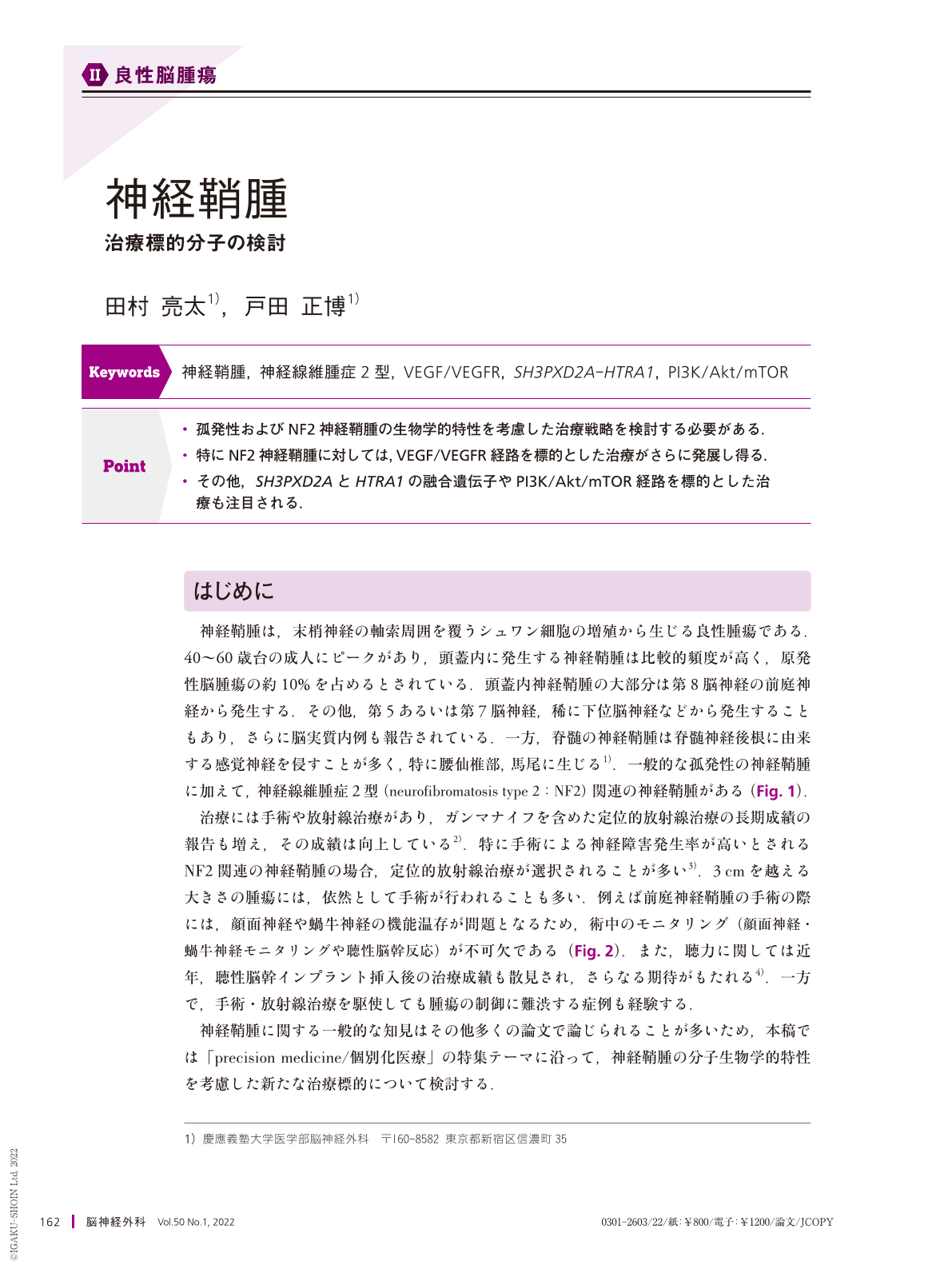
Point
・孤発性およびNF2神経鞘腫の生物学的特性を考慮した治療戦略を検討する必要がある.
・特にNF2神経鞘腫に対しては,VEGF/VEGFR経路を標的とした治療がさらに発展し得る.
・その他,SH3PXD2AとHTRA1の融合遺伝子やPI3K/Akt/mTOR経路を標的とした治療も注目される.
Schwannoma is a tumor that develops from the Schwann cells in the peripheral nervous system or cranial nerves. Gamma Knife radiosurgery has become an accepted treatment for schwannoma, with a high rate of tumor control. For sporadic or neurofibromatosis type 2-associated schwannoma resistant to radiotherapy, vascular endothelial growth factor(VEGF)-A/VEGF receptor(VEGFR)-targeted therapy(e.g., bevacizumab)may become the first-line therapy. However, some aspects of treatment with bevacizumab are problematic, such as the need for frequent parenteral administration, side effects, apparent drug resistance, and rebound tumor progression after cessation. In these situations, the gene product of the SH3PXD2A-HTRA1 fusion and several protein tyrosine kinase inhibitors may be supportive in preventing tumor progression because merlin inhibits signaling by tyrosine receptor kinases and there is activation of downstream pathways, including the Ras/Raf/MEK/ERK and PI3K/Akt/mTORC1 pathways. Although the tumor-microenvironment(TME)plays a key role in tumor growth, this physiological state is unclear in schwannoma. Tumor-associated macrophages may be a major component of the immunosuppressive cells in the TME of schwannoma. To impede tumor growth, the TME is also explored as a potential therapeutic target. Multimodal therapy is required to manage patients with refractory schwannoma. Furthermore, basic scientific research may be essential in achieving a novel treatment strategy.
Copyright © 2022, Igaku-Shoin Ltd. All rights reserved.