Japanese
English
- 有料閲覧
PPV購入案内
1,320円 (1,200円+税10%) こちらは、1246ページから1256ページの文献です。購入には医書.jp本会員登録が必要です。
会員登録完了後に改めて上記「購入サイトへ」を選択してください。
または「購入サイトへ」選択後に「購入ログイン」、「新規会員登録」の順に進んでください。
会員登録について詳しくはをご確認ください。
- Abstract 文献概要
- 1ページ目 Look Inside
- 参考文献 Reference
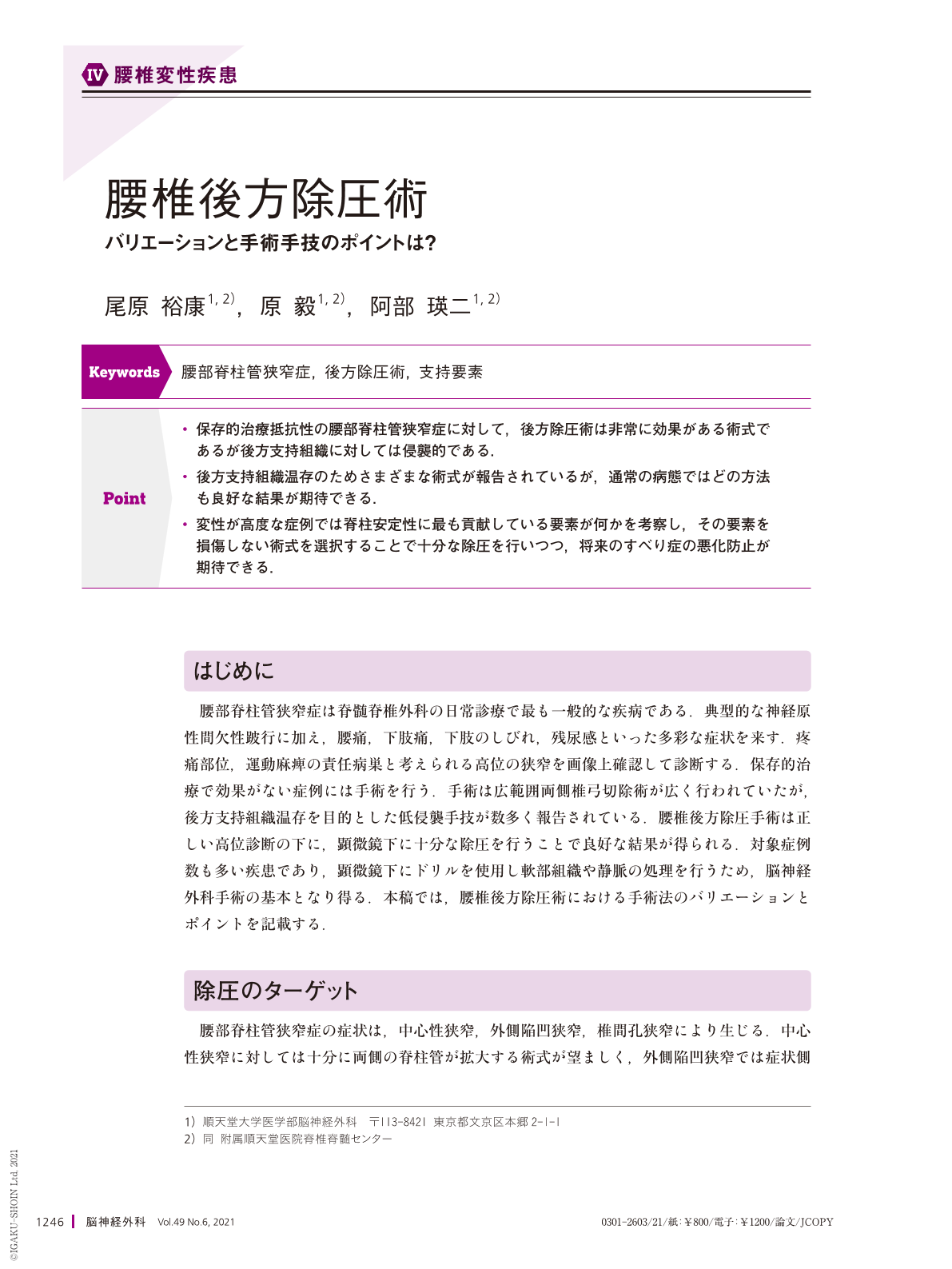
Point
・保存的治療抵抗性の腰部脊柱管狭窄症に対して,後方除圧術は非常に効果がある術式であるが後方支持組織に対しては侵襲的である.
・後方支持組織温存のためさまざまな術式が報告されているが,通常の病態ではどの方法も良好な結果が期待できる.
・変性が高度な症例では脊柱安定性に最も貢献している要素が何かを考察し,その要素を損傷しない術式を選択することで十分な除圧を行いつつ,将来のすべり症の悪化防止が期待できる.
Lumbar canal stenosis is the most common pathological condition causing spinal degeneration. Symptomatic patients who fail conservative treatment are considered candidates for surgical treatment. Many types of minimally invasive procedures for lumbar decompression have been proposed, most of which are effective and have shown good long-term results. However, in special cases, a second operation may be needed for spondylolisthesis caused by degeneration of the same segment. Two major minimally invasive approaches are available for bilateral decompression of lumbar canal stenosis: unilateral approach and midline approach. The unilateral approach is used to preserve midline structures, the contralateral facet joint, and the contralateral paravertebral muscle. The midline approach is used to preserve the left and right facet joints and the enthesis of the paravertebral muscle. These two approaches are suitable for specific situations based on their own concepts. Nevertheless, it is important to understand the advantages and disadvantages of each procedure. In this article, the varieties of lumbar decompressive methods and the pitfalls of decompression procedures will be discussed.
Copyright © 2021, Igaku-Shoin Ltd. All rights reserved.