Japanese
English
- 有料閲覧
PPV購入案内
1,320円 (1,200円+税10%) こちらは、977ページから985ページの文献です。購入には医書.jp本会員登録が必要です。
会員登録完了後に改めて上記「購入サイトへ」を選択してください。
または「購入サイトへ」選択後に「購入ログイン」、「新規会員登録」の順に進んでください。
会員登録について詳しくはをご確認ください。
- Abstract 文献概要
- 1ページ目 Look Inside
- 参考文献 Reference
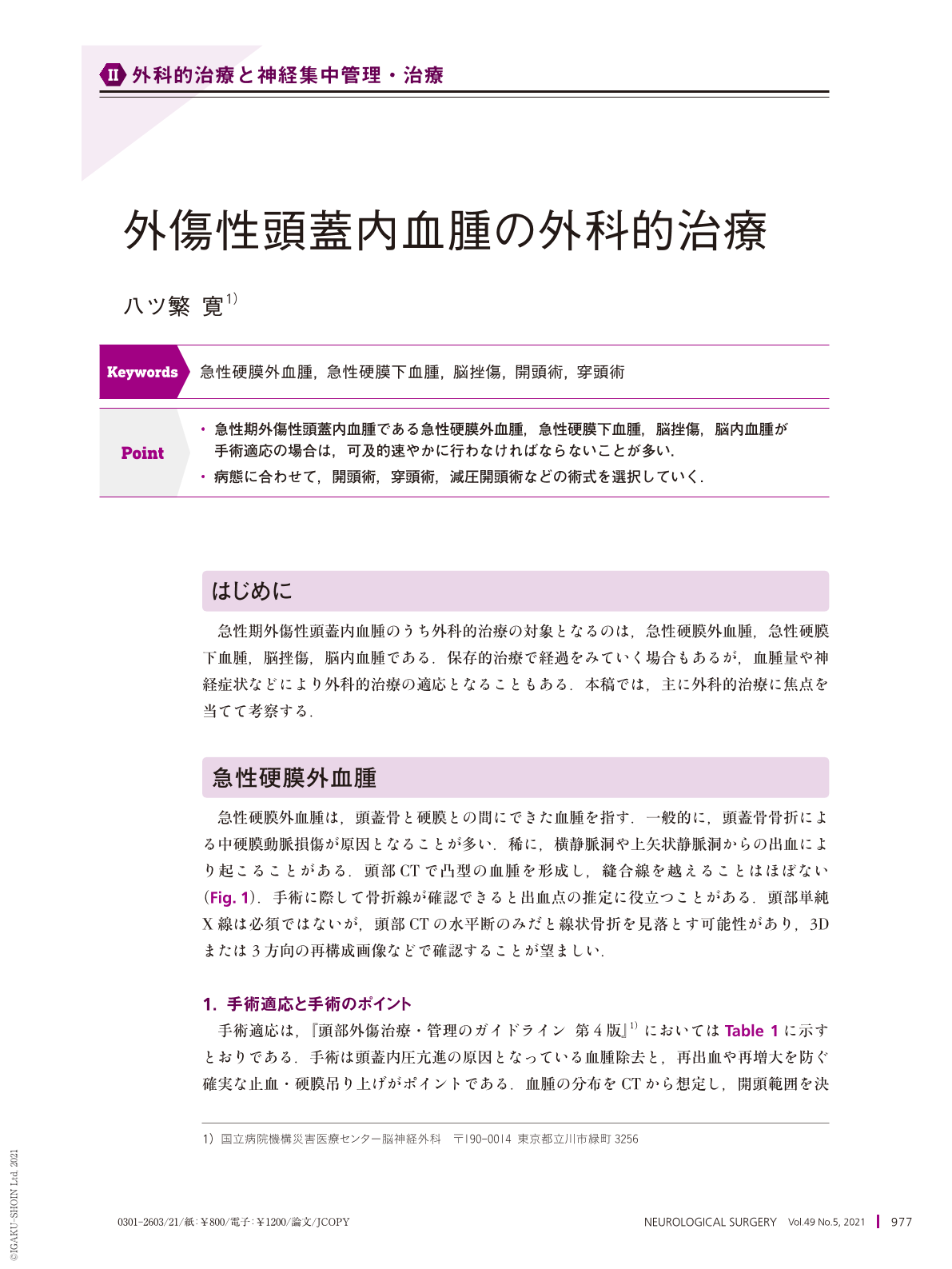
Point
・急性期外傷性頭蓋内血腫である急性硬膜外血腫,急性硬膜下血腫,脳挫傷,脳内血腫が手術適応の場合は,可及的速やかに行わなければならないことが多い.
・病態に合わせて,開頭術,穿頭術,減圧開頭術などの術式を選択していく.
Surgery is one of the primary options for the management of traumatic brain injury(TBI). We focused on operative techniques, additional options, and potential pitfalls of surgical intervention for intracranial hematomas, such as acute subdural hematoma(ASDH), acute epidural hematoma(AEDH), cerebral contusion, and intracerebral hematoma.
A wide craniotomy covering the hematoma was recommended for a case of AEDH to evacuate the hematoma, control bleeding, and prevent blood reaccumulation. Combined multiple craniotomies leaving a bone bridge over the sinus for dural tenting sutures enabled safe surgical intervention in a case of AEDH with sinus injuries.
Different surgical techniques have been advocated for the evacuation of ASDH. Large craniotomy is often chosen as it can easily be shifted to decompressive craniectomy in case of brain swelling. It is important to pay attention to injuries of dural sinuses and bridging veins, and to expose the floor of the middle cranial fossa. Small craniotomy or endoscopic burr-hole evacuation of ASDH has been accepted as a way to avoid large craniotomies and additional morbidity, particularly for patients who are poor surgical candidates.
Contusion necrotomy is performed for satisfactory control of progressive elevation in intracranial pressure and clinical deterioration.
Copyright © 2021, Igaku-Shoin Ltd. All rights reserved.