Japanese
English
- 有料閲覧
PPV購入案内
1,320円 (1,200円+税10%) こちらは、888ページから897ページの文献です。購入には医書.jp本会員登録が必要です。
会員登録完了後に改めて上記「購入サイトへ」を選択してください。
または「購入サイトへ」選択後に「購入ログイン」、「新規会員登録」の順に進んでください。
会員登録について詳しくはをご確認ください。
- Abstract 文献概要
- 1ページ目 Look Inside
- 参考文献 Reference
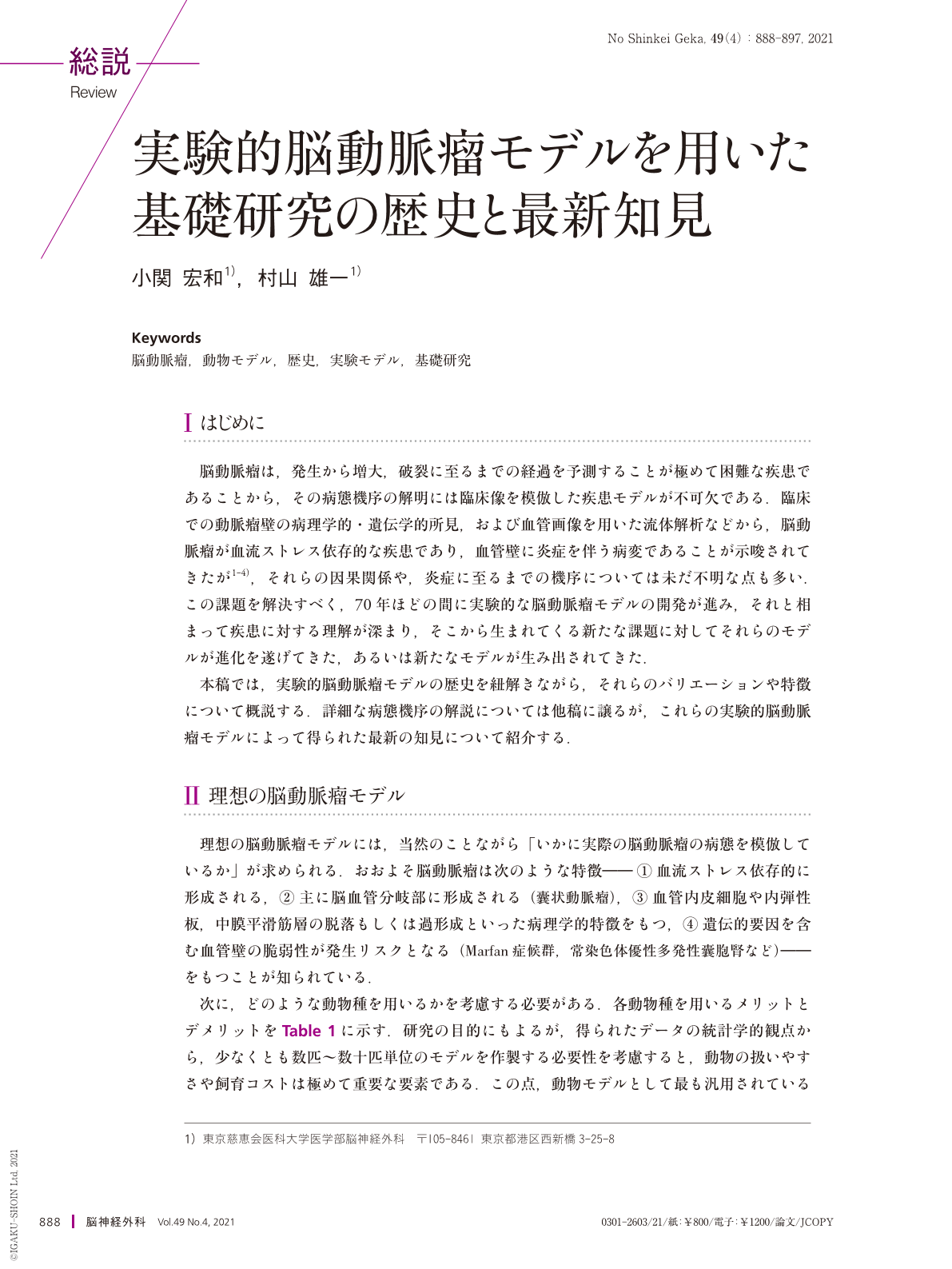
Ⅰ はじめに
脳動脈瘤は,発生から増大,破裂に至るまでの経過を予測することが極めて困難な疾患であることから,その病態機序の解明には臨床像を模倣した疾患モデルが不可欠である.臨床での動脈瘤壁の病理学的・遺伝学的所見,および血管画像を用いた流体解析などから,脳動脈瘤が血流ストレス依存的な疾患であり,血管壁に炎症を伴う病変であることが示唆されてきたが1-4),それらの因果関係や,炎症に至るまでの機序については未だ不明な点も多い.この課題を解決すべく,70年ほどの間に実験的な脳動脈瘤モデルの開発が進み,それと相まって疾患に対する理解が深まり,そこから生まれてくる新たな課題に対してそれらのモデルが進化を遂げてきた,あるいは新たなモデルが生み出されてきた.
本稿では,実験的脳動脈瘤モデルの歴史を紐解きながら,それらのバリエーションや特徴について概説する.詳細な病態機序の解説については他稿に譲るが,これらの実験的脳動脈瘤モデルによって得られた最新の知見について紹介する.
Since intracranial aneurysm(IA)is a disease that follows an extremely unpredictable course, from initiation to rupture, experimental models have greatly contributed to a better understanding of IA pathophysiology. This article aims to review the history of IA models through the pivotal theme of the ideal IA model. In addition, this article introduces updated findings from the application of these experimental models.
Though the first IA model, known as a venous pouch model, was reported in 1954, it mimicked only the shape of the IA, without reproducing its pathological structure or blood-flow characteristics. Currently, two models are generally applied: the “Hashimoto model,” produced by unilateral common carotid artery(CCA)ligation followed by systemic hypertension and weakening of the vascular wall, and the “elastase injection model,” induced by intraventricular elastase injection and also followed by systemic hypertension. In addition, other models, including a rabbit basilar top IA, developed after bilateral CCA ligation, and an artificial bifurcation model, generated by an anastomosis between the CCAs, have been found to be valuable for computational fluid dynamics analysis.
Through this advancement, the IA model has gradually elucidated the pathophysiology of IA as a flow-induced inflammatory disease. Nowadays, vascular inflammation is suggested to be regulated by bacterial flora. Further development of IA models and a better understanding of IA pathophysiology are expected in the future.
Copyright © 2021, Igaku-Shoin Ltd. All rights reserved.