Japanese
English
- 有料閲覧
PPV購入案内
1,320円 (1,200円+税10%) こちらは、799ページから809ページの文献です。購入には医書.jp本会員登録が必要です。
会員登録完了後に改めて上記「購入サイトへ」を選択してください。
または「購入サイトへ」選択後に「購入ログイン」、「新規会員登録」の順に進んでください。
会員登録について詳しくはをご確認ください。
- Abstract 文献概要
- 1ページ目 Look Inside
- 参考文献 Reference
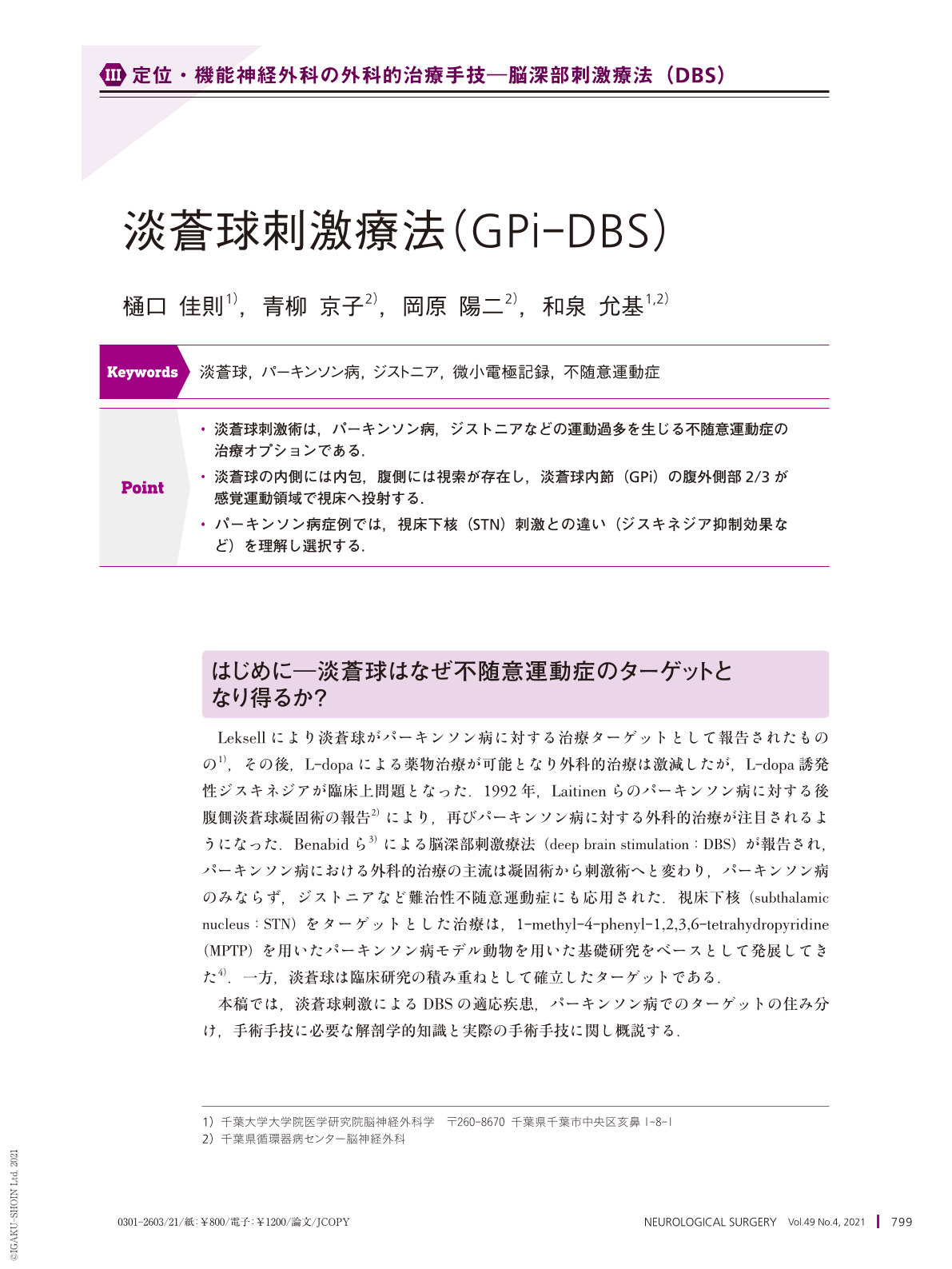
Point
・淡蒼球刺激術は,パーキンソン病,ジストニアなどの運動過多を生じる不随意運動症の治療オプションである.
・淡蒼球の内側には内包,腹側には視索が存在し,淡蒼球内節(GPi)の腹外側部2/3が感覚運動領域で視床へ投射する.
・パーキンソン病症例では,視床下核(STN)刺激との違い(ジスキネジア抑制効果など)を理解し選択する.
The globus pallidus internus(GPi)has evolved as a potential target for deep brain stimulation(DBS)in patients with advanced Parkinson's disease(PD). GPi stimulation has a significant impact on intractable hyperkinetic movement disorders. Optimal surgical procedures require a combination of image-based targeting and intraoperative microelectrode recording(MER)strategies. Provocation with stimulation through microelectrode or a DBS electrode is also crucial for refining the appropriate electrode position and obtaining a wide therapeutic window of stimulation parameters.
In patients with PD, the best target for deep brain stimulation, whether subthalamic nucleus(STN)or the GPi, has been a subject of interest in recent medical literature. STN remains the preferred target for DBS in patients with advanced PD worldwide. In postoperative medication reduction, numerous data support that STN stimulation reduces the total dose of anti-parkinsonian drugs compared to GPi stimulation. However, GPi stimulation has shown a direct anti-dyskinetic effect, without reducing levodopa. Thus, GPi stimulation might be recommended for patients with neurocognitive or neuropsychiatric issues.
GPi stimulation has a potential for treating hyperkinetic movement disorders. In patients with PD, STN stimulation is preferred worldwide; however, GPi stimulation has a clinical advantage only for select patients.
Copyright © 2021, Igaku-Shoin Ltd. All rights reserved.