Japanese
English
- 有料閲覧
PPV購入案内
1,320円 (1,200円+税10%) こちらは、941ページから947ページの文献です。購入には医書.jp本会員登録が必要です。
会員登録完了後に改めて上記「購入サイトへ」を選択してください。
または「購入サイトへ」選択後に「購入ログイン」、「新規会員登録」の順に進んでください。
会員登録について詳しくはをご確認ください。
- Abstract 文献概要
- 1ページ目 Look Inside
- 参考文献 Reference
Ⅰ.はじめに
びまん性星細胞腫(diffuse astrocytoma:DA)は成人の大脳半球に好発する髄内腫瘍で,World Health Organization(WHO)脳腫瘍病理分類ではgrade Ⅱに分類される.近年の分子生物学的研究により,DAを含む星細胞腫系腫瘍(astrocytic tumors:AT)は,「IDH(isocitrate dehydrogenase)1/2変異あり」かつ「1p/19q共欠失なし」という2つの遺伝子的特徴を有することが明らかとなり,2016年に改訂されたWHO脳腫瘍病理分類(WHO 2016)7)では,本特徴が診断基準として明記された.一方,WHO 2016以前では顕微鏡検査に基づいて病理診断が行われていたことから,過去にDAと診断された症例群の中には組織所見が類似するIDH野生型神経膠腫あるいは乏突起膠腫(oligodendroglioma:OD, IDH1/2変異および1p/19q共欠失あり)が含まれ,したがってDAに関する従来の臨床研究は,遺伝子診断に基づいた純粋なDAの治療成績を反映していないとされる2,9,10,14).WHO 2016以降,DAの長期的な転機に関する報告は未だ少なく,的確な治療を行うためには多くの症例の蓄積が望まれる.
今回,初回摘出術後にテモゾロミド(temozolomide:TMZ)単独療法が行われ,11年の経過で再増大および悪性転化したDAの1例を経験したので,文献的考察を含めて報告する.
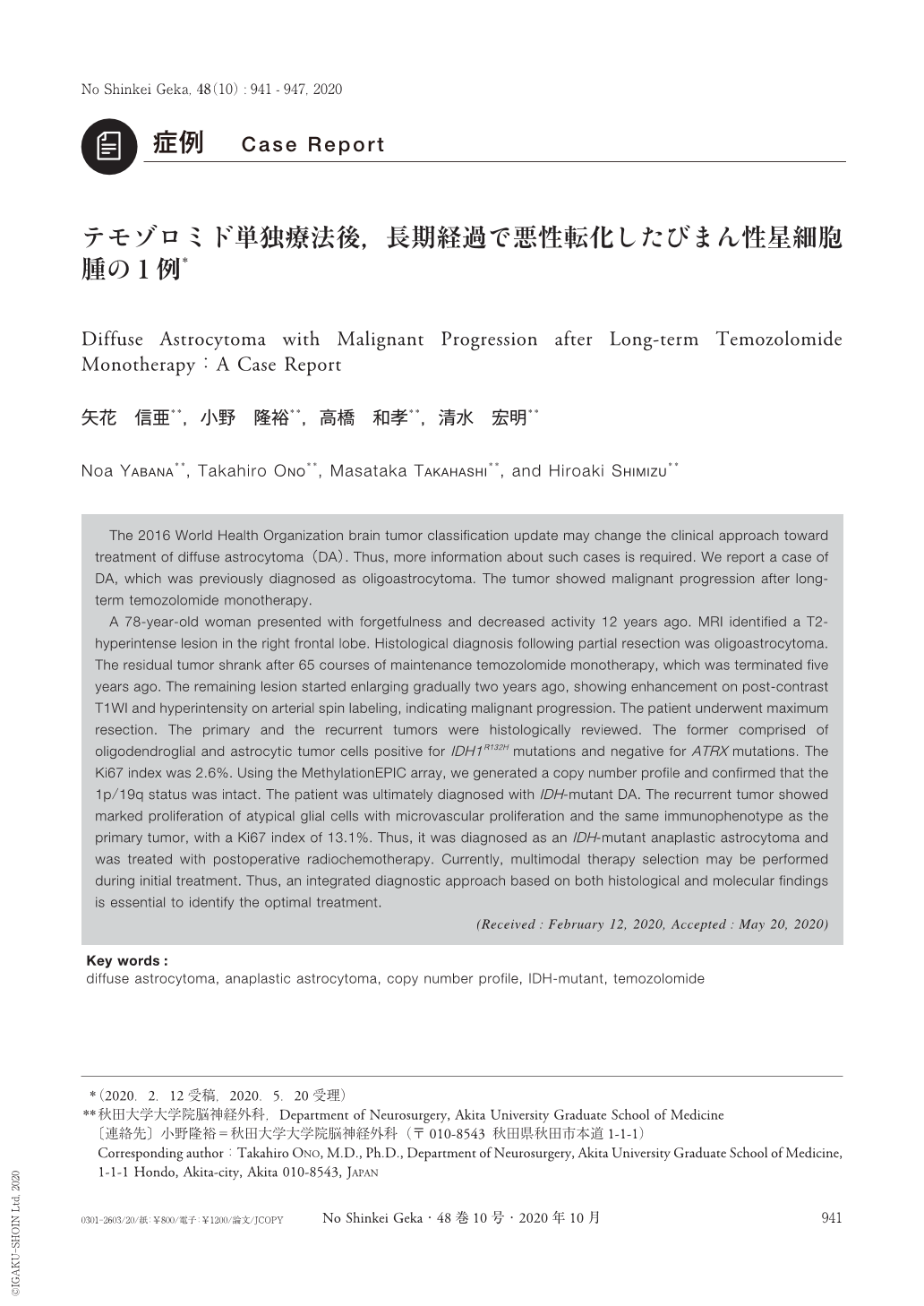
The 2016 World Health Organization brain tumor classification update may change the clinical approach toward treatment of diffuse astrocytoma(DA). Thus, more information about such cases is required. We report a case of DA, which was previously diagnosed as oligoastrocytoma. The tumor showed malignant progression after long-term temozolomide monotherapy.
A 78-year-old woman presented with forgetfulness and decreased activity 12 years ago. MRI identified a T2-hyperintense lesion in the right frontal lobe. Histological diagnosis following partial resection was oligoastrocytoma. The residual tumor shrank after 65 courses of maintenance temozolomide monotherapy, which was terminated five years ago. The remaining lesion started enlarging gradually two years ago, showing enhancement on post-contrast T1WI and hyperintensity on arterial spin labeling, indicating malignant progression. The patient underwent maximum resection. The primary and the recurrent tumors were histologically reviewed. The former comprised of oligodendroglial and astrocytic tumor cells positive for IDH1R132H mutations and negative for ATRX mutations. The Ki67 index was 2.6%. Using the MethylationEPIC array, we generated a copy number profile and confirmed that the 1p/19q status was intact. The patient was ultimately diagnosed with IDH-mutant DA. The recurrent tumor showed marked proliferation of atypical glial cells with microvascular proliferation and the same immunophenotype as the primary tumor, with a Ki67 index of 13.1%. Thus, it was diagnosed as an IDH-mutant anaplastic astrocytoma and was treated with postoperative radiochemotherapy. Currently, multimodal therapy selection may be performed during initial treatment. Thus, an integrated diagnostic approach based on both histological and molecular findings is essential to identify the optimal treatment.
Copyright © 2020, Igaku-Shoin Ltd. All rights reserved.