Japanese
English
- 有料閲覧
PPV購入案内
1,320円 (1,200円+税10%) こちらは、259ページから264ページの文献です。購入には医書.jp本会員登録が必要です。
会員登録完了後に改めて上記「購入サイトへ」を選択してください。
または「購入サイトへ」選択後に「購入ログイン」、「新規会員登録」の順に進んでください。
会員登録について詳しくはをご確認ください。
- Abstract 文献概要
- 1ページ目 Look Inside
- 参考文献 Reference
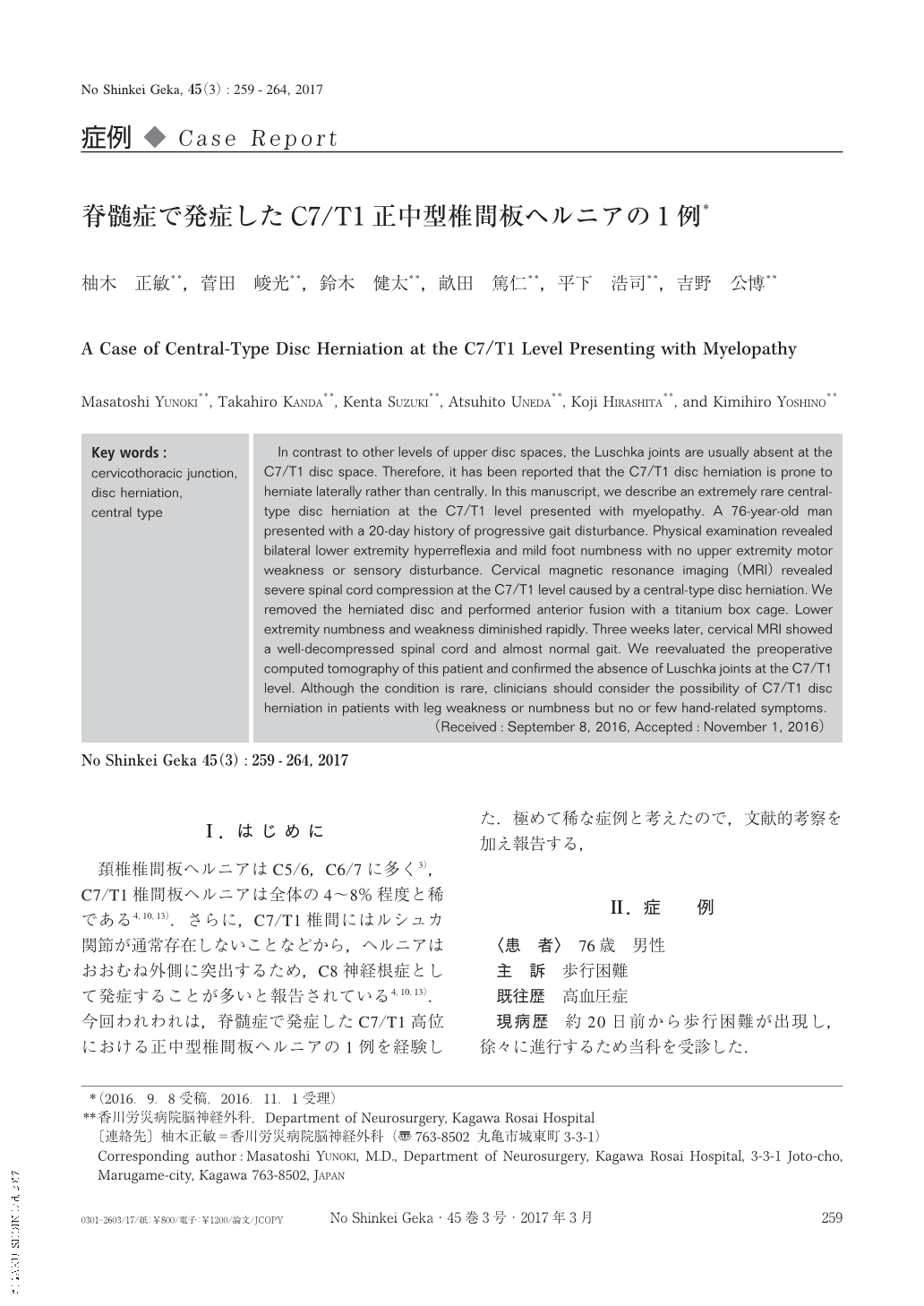
Ⅰ.はじめに
頚椎椎間板ヘルニアはC5/6,C6/7に多く3),C7/T1椎間板ヘルニアは全体の4〜8%程度と稀である4,10,13).さらに,C7/T1椎間にはルシュカ関節が通常存在しないことなどから,ヘルニアはおおむね外側に突出するため,C8神経根症として発症することが多いと報告されている4,10,13).今回われわれは,脊髄症で発症したC7/T1高位における正中型椎間板ヘルニアの1例を経験した.極めて稀な症例と考えたので,文献的考察を加え報告する,
In contrast to other levels of upper disc spaces, the Luschka joints are usually absent at the C7/T1 disc space. Therefore, it has been reported that the C7/T1 disc herniation is prone to herniate laterally rather than centrally. In this manuscript, we describe an extremely rare central-type disc herniation at the C7/T1 level presented with myelopathy. A 76-year-old man presented with a 20-day history of progressive gait disturbance. Physical examination revealed bilateral lower extremity hyperreflexia and mild foot numbness with no upper extremity motor weakness or sensory disturbance. Cervical magnetic resonance imaging(MRI)revealed severe spinal cord compression at the C7/T1 level caused by a central-type disc herniation. We removed the herniated disc and performed anterior fusion with a titanium box cage. Lower extremity numbness and weakness diminished rapidly. Three weeks later, cervical MRI showed a well-decompressed spinal cord and almost normal gait. We reevaluated the preoperative computed tomography of this patient and confirmed the absence of Luschka joints at the C7/T1 level. Although the condition is rare, clinicians should consider the possibility of C7/T1 disc herniation in patients with leg weakness or numbness but no or few hand-related symptoms.
Copyright © 2017, Igaku-Shoin Ltd. All rights reserved.