Japanese
English
- 有料閲覧
PPV購入案内
1,320円 (1,200円+税10%) こちらは、315ページから321ページの文献です。購入には医書.jp本会員登録が必要です。
会員登録完了後に改めて上記「購入サイトへ」を選択してください。
または「購入サイトへ」選択後に「購入ログイン」、「新規会員登録」の順に進んでください。
会員登録について詳しくはをご確認ください。
- Abstract 文献概要
- 1ページ目 Look Inside
- 参考文献 Reference
Ⅰ.はじめに
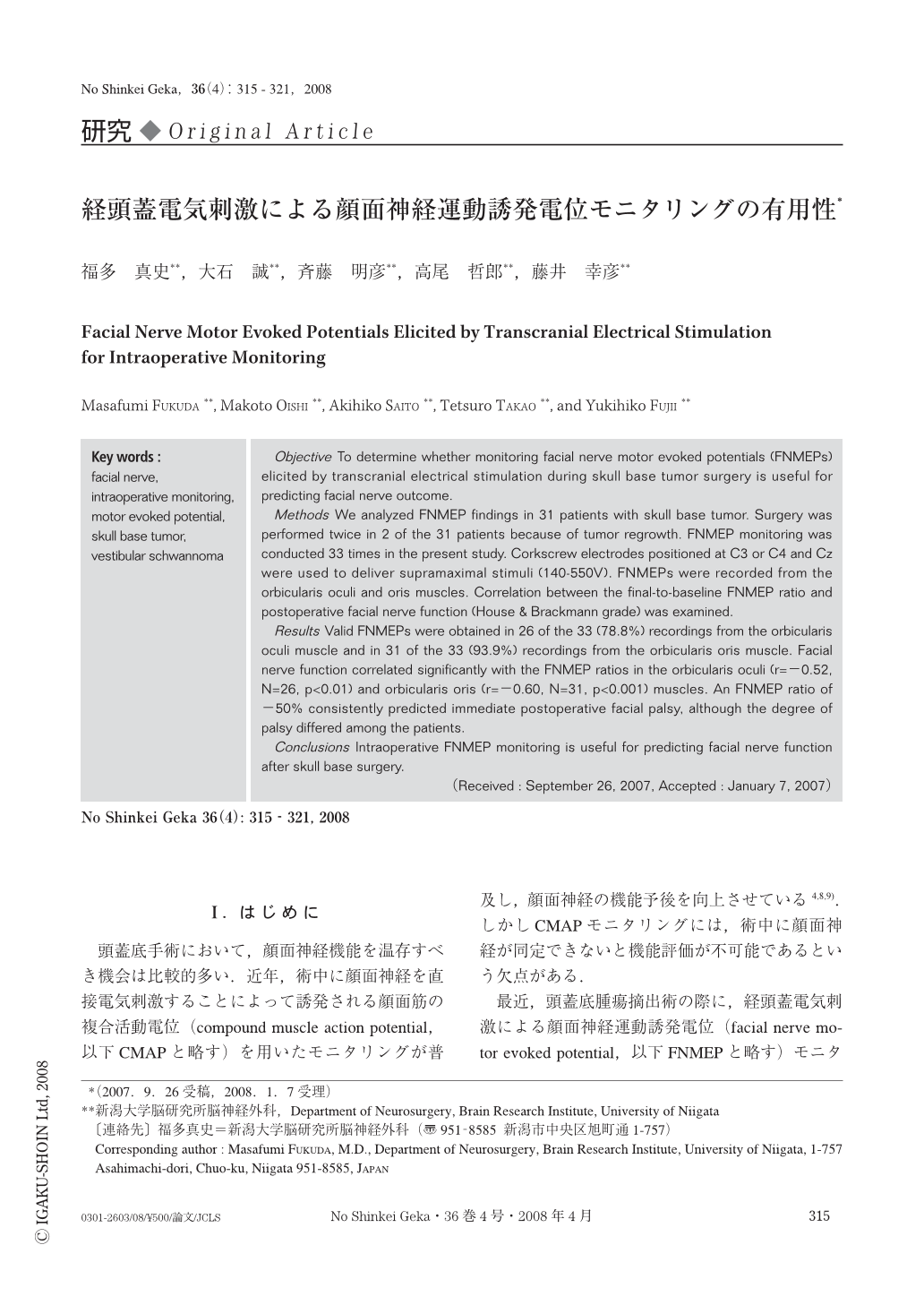
頭蓋底手術において,顔面神経機能を温存すべき機会は比較的多い.近年,術中に顔面神経を直接電気刺激することによって誘発される顔面筋の複合活動電位(compound muscle action potential,以下CMAPと略す)を用いたモニタリングが普及し,顔面神経の機能予後を向上させている4,8,9).しかしCMAPモニタリングには,術中に顔面神経が同定できないと機能評価が不可能であるという欠点がある.
最近,頭蓋底腫瘍摘出術の際に,経頭蓋電気刺激による顔面神経運動誘発電位(facial nerve motor evoked potential,以下FNMEPと略す)モニタリングを行い,特に大きな聴神経腫瘍摘出術のように,顔面神経が確認されない腫瘍摘出早期の段階においても顔面神経機能が評価可能であり,術後機能を予測する上で有用であったという論文が散見される1,3).われわれも,以前より頭蓋底手術の際に顔面神経のCMAPモニタリングを行ってきたが,2005年7月よりこのFNMEPモニタリングも同時に行い,術中の顔面神経機能評価および術後の機能予後について検討してきた.今回は,頭蓋底手術におけるFNMEPモニタリングの有用性と限界について考察した.
Objective To determine whether monitoring facial nerve motor evoked potentials (FNMEPs) elicited by transcranial electrical stimulation during skull base tumor surgery is useful for predicting facial nerve outcome.
Methods We analyzed FNMEP findings in 31 patients with skull base tumor. Surgery was performed twice in 2 of the 31 patients because of tumor regrowth. FNMEP monitoring was conducted 33 times in the present study. Corkscrew electrodes positioned at C3 or C4 and Cz were used to deliver supramaximal stimuli (140-550V). FNMEPs were recorded from the orbicularis oculi and oris muscles. Correlation between the final-to-baseline FNMEP ratio and postoperative facial nerve function (House & Brackmann grade) was examined.
Results Valid FNMEPs were obtained in 26 of the 33 (78.8%) recordings from the orbicularis oculi muscle and in 31 of the 33 (93.9%) recordings from the orbicularis oris muscle. Facial nerve function correlated significantly with the FNMEP ratios in the orbicularis oculi (r=-0.52, N=26, p<0.01) and orbicularis oris (r=-0.60, N=31, p<0.001) muscles. An FNMEP ratio of -50% consistently predicted immediate postoperative facial palsy, although the degree of palsy differed among the patients.
Conclusions Intraoperative FNMEP monitoring is useful for predicting facial nerve function after skull base surgery.
Copyright © 2008, Igaku-Shoin Ltd. All rights reserved.