Japanese
English
- 有料閲覧
PPV購入案内
1,320円 (1,200円+税10%) こちらは、644ページから652ページの文献です。購入には医書.jp本会員登録が必要です。
会員登録完了後に改めて上記「購入サイトへ」を選択してください。
または「購入サイトへ」選択後に「購入ログイン」、「新規会員登録」の順に進んでください。
会員登録について詳しくはをご確認ください。
- Abstract 文献概要
- 1ページ目 Look Inside
- 参考文献 Reference
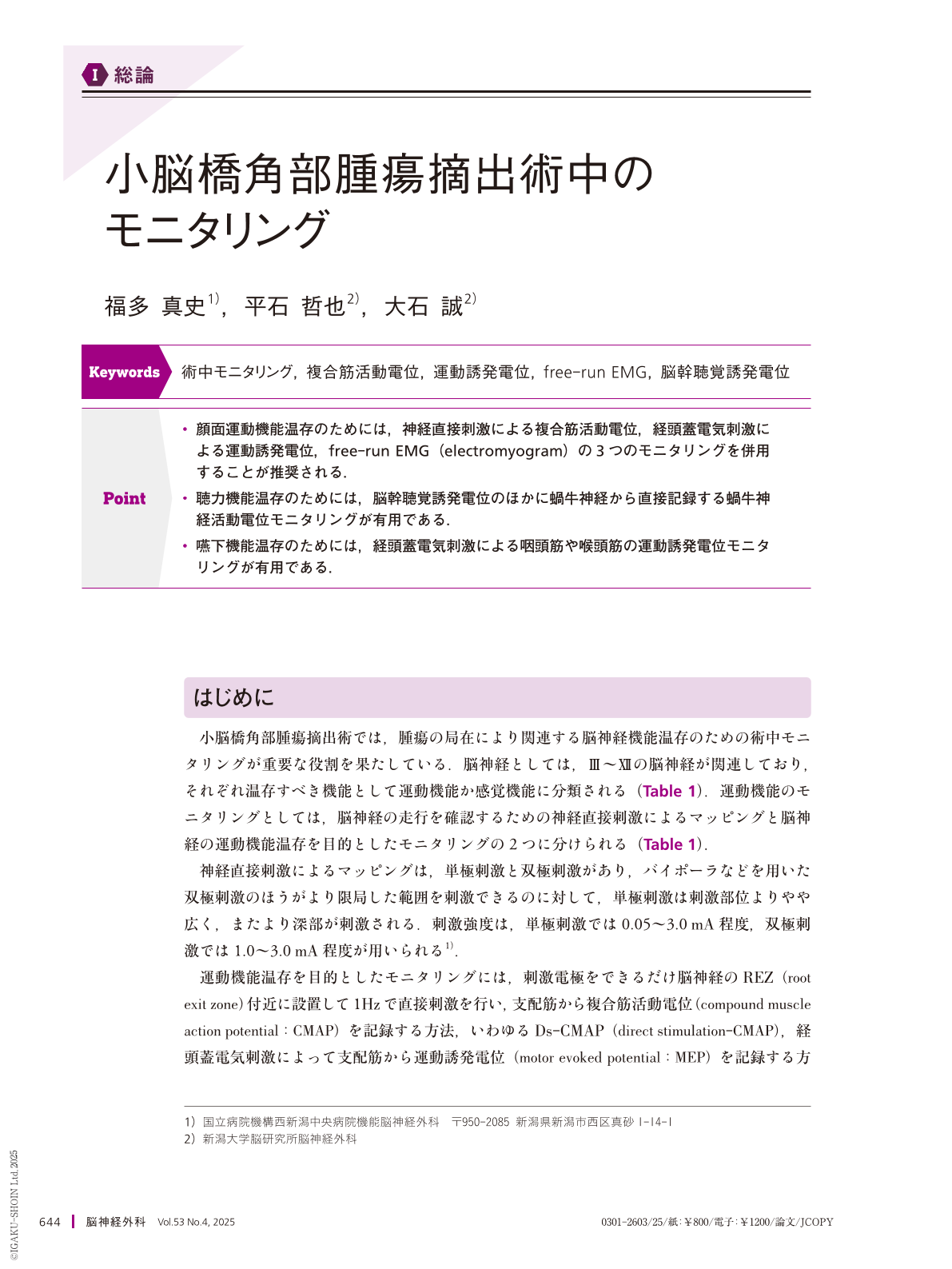
Point
・顔面運動機能温存のためには,神経直接刺激による複合筋活動電位,経頭蓋電気刺激による運動誘発電位,free-run EMG(electromyogram)の3つのモニタリングを併用することが推奨される.
・聴力機能温存のためには,脳幹聴覚誘発電位のほかに蝸牛神経から直接記録する蝸牛神経活動電位モニタリングが有用である.
・嚥下機能温存のためには,経頭蓋電気刺激による咽頭筋や喉頭筋の運動誘発電位モニタリングが有用である.
Two types of intraoperative monitoring of the cranial nerve motor function have been widely used during the removal of cerebellopontine angle tumors. The first type involves anatomical mapping through directly stimulating the cranial nerve to confirm its location. The second type involves monitoring motor function preservation through direct stimulation-compound muscle action potential (Ds-CMAP), motor-evoked potential (MEP) using transcranial electrical stimulation, and free-run electromyography (EMG).
Particularly for patients with vestibular schwannomas, anatomical mapping is important to confirm the location of the facial nerve, which is likely to be deviated or compressed by a tumor. Ds-CMAP monitoring adjacent to the root exit zone of the facial nerve is useful for detecting facial nerve damage. Monitoring facial MEP, induced using transcranial electrical stimulation, is also useful in predicting postoperative facial motor function. Free-run electromyography EMG provides real-time monitoring of facial motor function; however, objective evaluation is challenging intraoperatively.
Brainstem auditory evoked potential monitoring has been widely used to preserve hearing during the removal of cerebellopontine angle tumors. Cochlear nerve action potentials recorded directly from the cochlear nerve provide more useful monitoring for predicting postoperative hearing function.
To preserve the motor function of the glossopharyngeal and vagus nerves, both pharyngeal MEP recorded from the swallowing muscle and vagus nerve MEP recorded from the vocal cord using transcranial electrical stimulation are useful in predicting postoperative swallowing function.
A clear understanding of the purposes, methods, and evaluations of various types of cranial nerve monitoring during the removal of cerebellopontine angle tumors is essential.
Copyright © 2025, Igaku-Shoin Ltd. All rights reserved.