Japanese
English
- 有料閲覧
PPV購入案内
1,320円 (1,200円+税10%) こちらは、130ページから138ページの文献です。購入には医書.jp本会員登録が必要です。
会員登録完了後に改めて上記「購入サイトへ」を選択してください。
または「購入サイトへ」選択後に「購入ログイン」、「新規会員登録」の順に進んでください。
会員登録について詳しくはをご確認ください。
- Abstract 文献概要
- 1ページ目 Look Inside
はじめに
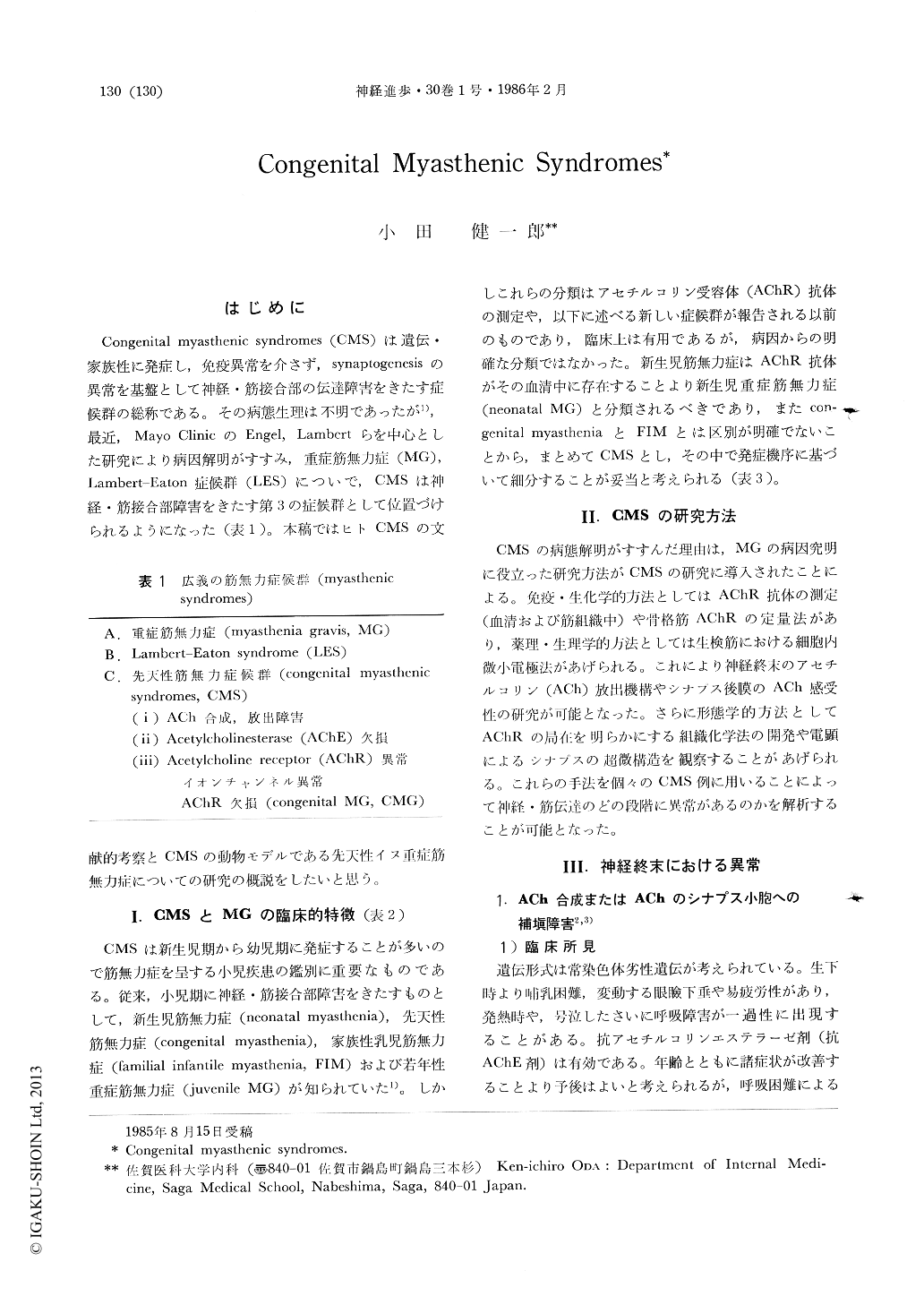
Congenital myasthenic syndromes(CMS)は遺伝・家族性に発症し,免疫異常を介さず,synaptogencsisの異常を基盤として神経・筋接合部の伝達障害をきたす症候群の総称である。その病態生理は不明であったが1),最近,Mayo ClinicのEngel,Lambertらを中心とした研究により病因解明がすすみ,重症筋無力症(MG),Lambert-Eaton症候群(LES)についで,CMSは神経・筋接合部障害をきたす第3の症候群として位置づけられるようになった(表1)。本稿ではヒトCMSの文献的考察とCMSの動物モデルである先天性イヌ重症筋無力症についての研究の概説をしたいと思う。
Recently congenital myasthenic syndromes(CMS) have been adequately characterized by clinical, morphological and electrophysiological criteria. These syndromes are attributed to genetic disorders of synaptogenesis, and are different from two acquired autoimmune diseases, myasthenia gravis and Lambert-Eaton syndrome. Four types of CMS have been reported ; (i) disorders in ACh synthesis, mobilization or release, (ii) endplate AChE deficiency, (iii) slow-channel syndrome and (iv) endplate AChR deficiency (congenital myasthenia gravis, CMG).
Congenital canine myasthenia gravis is a model of human CMG. From the experimental study, it has been determined that canine CMG is characterized by the selective deficiency of junctional AChR with preservation of extrajunctional AChR synthesis. Preliminary experiment of muscle cell culture indicated that the process of AChR clustering at neuromuscular junction might be disturbed in canine CMG.
Copyright © 1986, Igaku-Shoin Ltd. All rights reserved.