Japanese
English
- 有料閲覧
PPV購入案内
1,320円 (1,200円+税10%) こちらは、935ページから937ページの文献です。購入には医書.jp本会員登録が必要です。
会員登録完了後に改めて上記「購入サイトへ」を選択してください。
または「購入サイトへ」選択後に「購入ログイン」、「新規会員登録」の順に進んでください。
会員登録について詳しくはをご確認ください。
- Abstract 文献概要
- 1ページ目 Look Inside
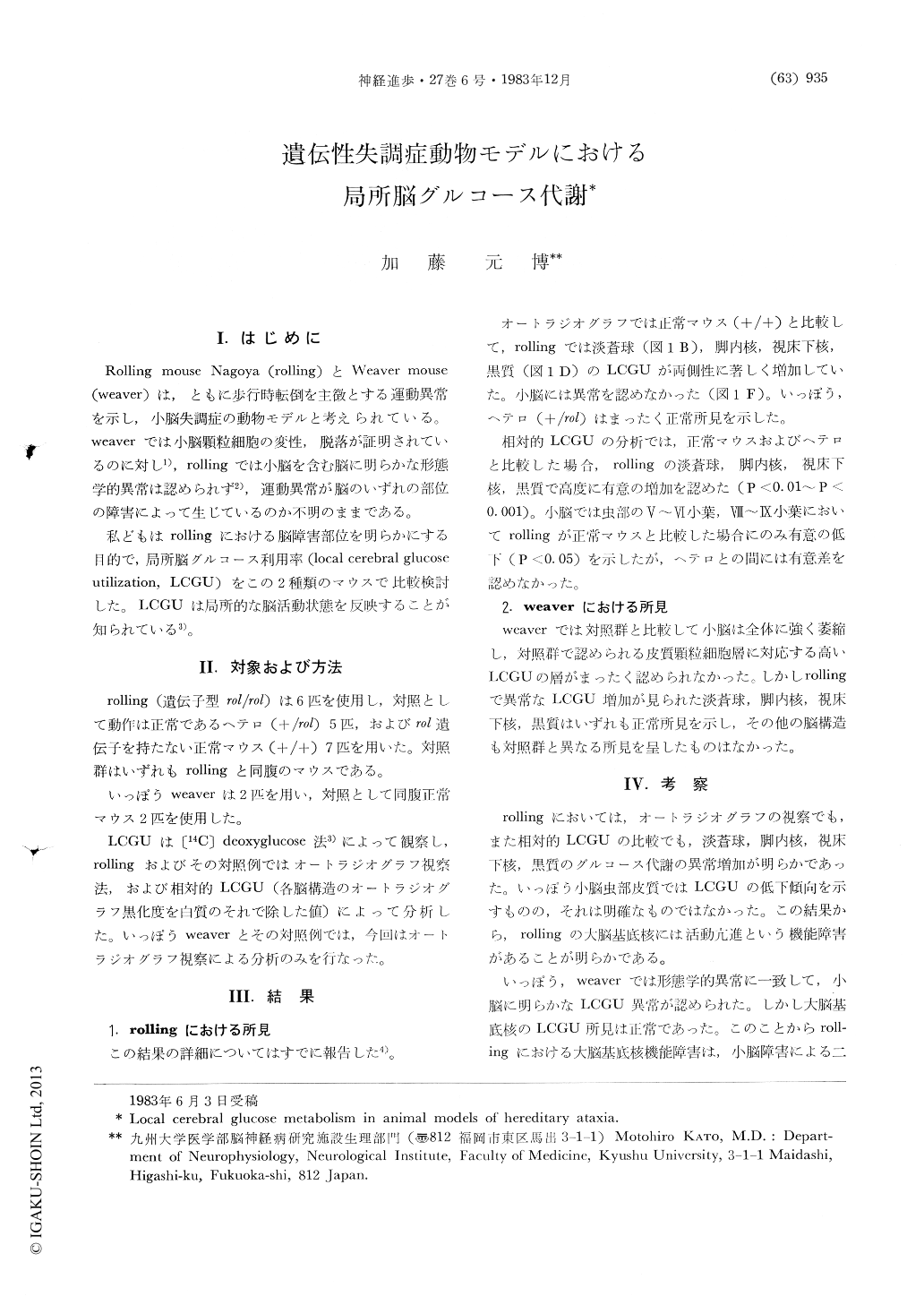
I.はじめに
Rolling mouse Nagoya(rolling)とWeaver mouse(weaver)は,ともに歩行時転倒を主徴とする運動異常を示し,小脳失調症の動物モデルと考えられている。weaverでは小脳顆粒細胞の変性,脱落が証明されているのに対し1),rollingでは小脳を含む脳に明らかな形態学的異常は認められず2),運動異常が脳のいずれの部位の障害によって生じているのか不明のままである。
私どもはrollingにおける脳障害部位を明らかにする目的で,局所脳グルコース利用率(local cerebral glucose utilization, LCGU)をこの2種類のマウスで比較検討した。LCGUは局所的な脳活動状態を反映することが知られている3)。
Abstract
Local cerebral glucose utilization was observed in the Rolling mouse Nagoya (rolling) and the Weaver mouse (weaver). Although both of them have been regarded as animal models of cerebellar ataxia, rolling shows no definite morphological abnormality in the brain including the cerebellum, whereas weaver has the conspicuous degeneration of the granule cells of the cerebellum. A remarkable increase in glucose metabolism was found in the basal ganglia of rolling indicating hyperactive state of these structures.
Copyright © 1983, Igaku-Shoin Ltd. All rights reserved.