Japanese
English
- 有料閲覧
PPV購入案内
1,320円 (1,200円+税10%) こちらは、1145ページから1157ページの文献です。購入には医書.jp本会員登録が必要です。
会員登録完了後に改めて上記「購入サイトへ」を選択してください。
または「購入サイトへ」選択後に「購入ログイン」、「新規会員登録」の順に進んでください。
会員登録について詳しくはをご確認ください。
- Abstract 文献概要
- 1ページ目 Look Inside
1.序
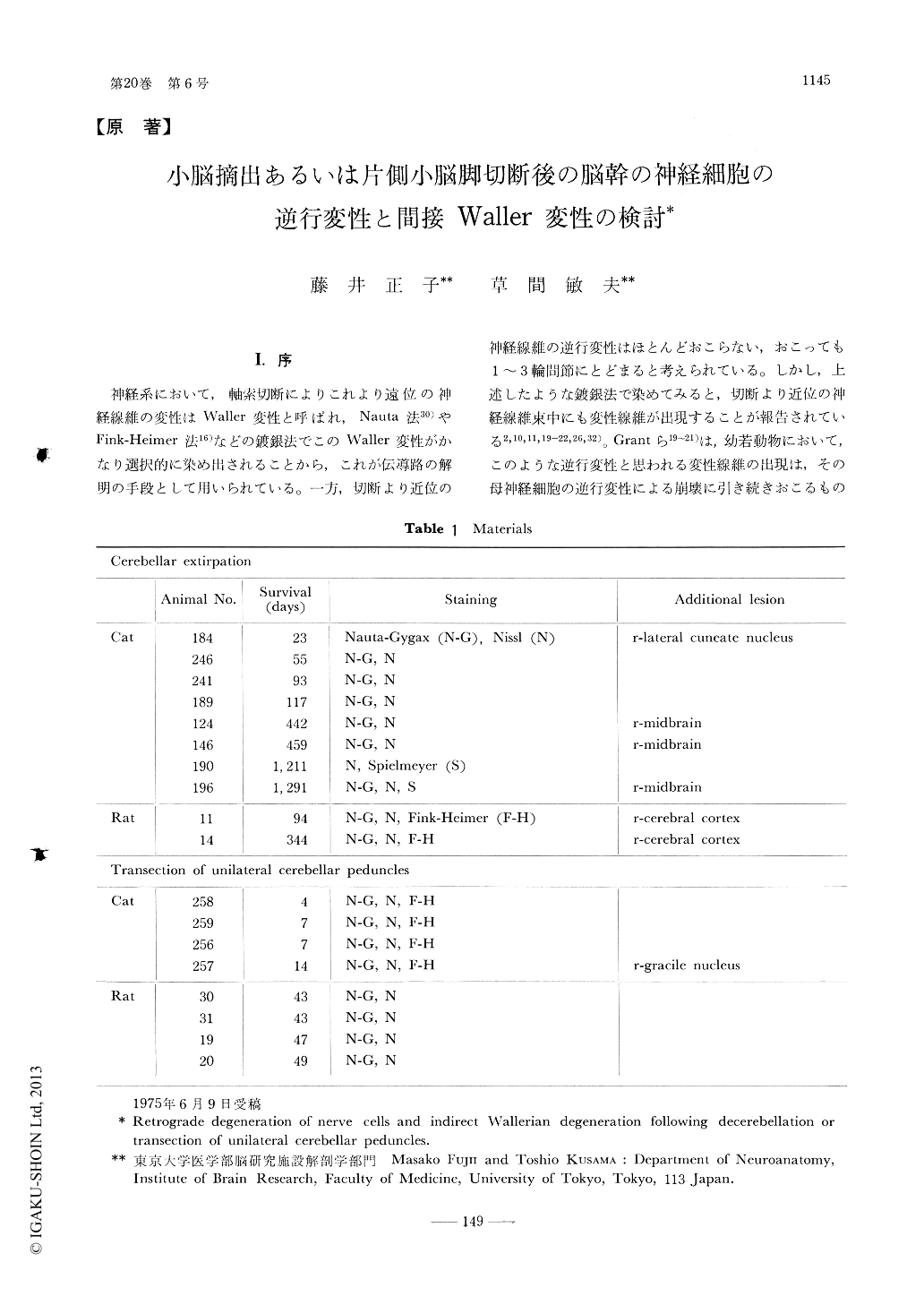
神経系において,軸索切断によりこれより遠位の神経線維の変性はWaller変性と呼ばれ,Nauta法30)やFink-Heimer法16)などの鍍銀法でこのWaller変性がかなり選択的に染め出されることから,これが伝導路の解明の手段として用いられている。一方,切断より近位の神経線維の逆行変性はほとんどおこらない,おこっても1〜3輪間節にとどまると考えられている。しかし,上述したような鍍銀法で染めてみると,切断より近位の神経線維束中にも変性線維が出現することが報告されている2,10,11,19-22,26,32)。Grantら19〜21)は,幼若動物において,このような逆行変性と思われる変性線維の出現は,その母神経細胞の逆行変性による崩壊に引き続きおこるものであることを観察し,これは逆行変性というよりvan Gehuchten17)のいう間接Waller変性という方が適していると述べている。Cupědo13)はさらに,この間接Waller変性を指標にして,三叉神経中脳路核に体部位局在があることを証明している。
In 12 adult cats and 6 adult rats with decerebellation or transection of the cerebellar peduncles the direct and the indirect Wallerian degeneration were impregnated with the Nauta-Gygax or the Fink-Heimer method. The indirect Wallerian degeneration occurred in the animals survived for 23 to 344 days and it was most prominent in those of 55 to 117 days survivals. In the latter animals almost all the nerve cells of the precerebellar nuclei had disappeared with a exception of the inferior olive.
Copyright © 1976, Igaku-Shoin Ltd. All rights reserved.