Japanese
English
原著
Mechanism of Pathological Changes of Cells Induced by Organic Mercury Compound in Minamata Disease
Taihei Miyakawa
1
1Department of Neuropsychiatry, Kumamoto University School of Medicine
pp.745-752
発行日 1973年8月10日
Published Date 1973/8/10
DOI https://doi.org/10.11477/mf.1431903539
- 有料閲覧
PPV購入案内
1,320円 (1,200円+税10%) こちらは、745ページから752ページの文献です。
PPV(ペイ・パー・ビュー)とは、論文(記事)単位で購入・閲覧ができるサービスです。
購入には医書.jp本会員登録が必要です。
会員登録完了後に改めて上記「購入サイトへ」を選択してください。
または「購入サイトへ」選択後に「購入ログイン」、「新規会員登録」の順に進んでください。
会員登録について詳しくはをご確認ください。
購入には医書.jp本会員登録が必要です。
会員登録完了後に改めて上記「購入サイトへ」を選択してください。
または「購入サイトへ」選択後に「購入ログイン」、「新規会員登録」の順に進んでください。
会員登録について詳しくはをご確認ください。
- Abstract 文献概要
- 1ページ目 Look Inside
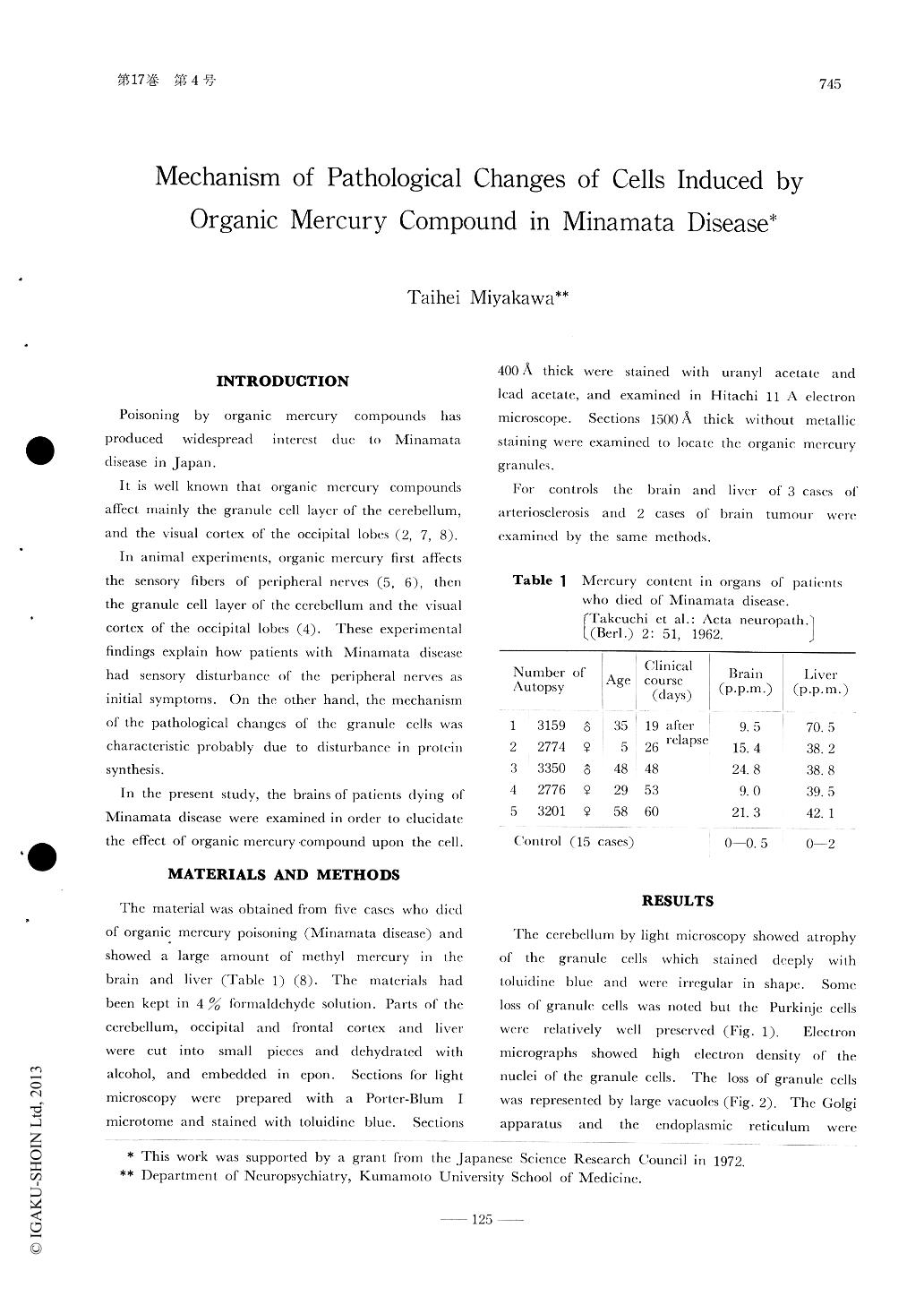
The brain and liver of patients who died of organic mercury poisoning (Minamata disease) were examined by electron microscopy. To observe organic mercury granules, osmium tetroxide, uranyl acetate and lead acetate were not used for fixation and staining. In the granule cells of the cerebellum, the Golgi apparatus and endoplasmic reticulum degenerated or disappeared but mitochondria were well preserved. The organic mercury granules were highly electron dense and were found at the site of the degenerated membrane which may be derived from the Golgi system, and at the site of lysosomes of the liver cells.
Copyright © 1973, Igaku-Shoin Ltd. All rights reserved.