Japanese
English
- 有料閲覧
PPV購入案内
1,320円 (1,200円+税10%) こちらは、505ページから515ページの文献です。購入には医書.jp本会員登録が必要です。
会員登録完了後に改めて上記「購入サイトへ」を選択してください。
または「購入サイトへ」選択後に「購入ログイン」、「新規会員登録」の順に進んでください。
会員登録について詳しくはをご確認ください。
- Abstract 文献概要
- 1ページ目 Look Inside
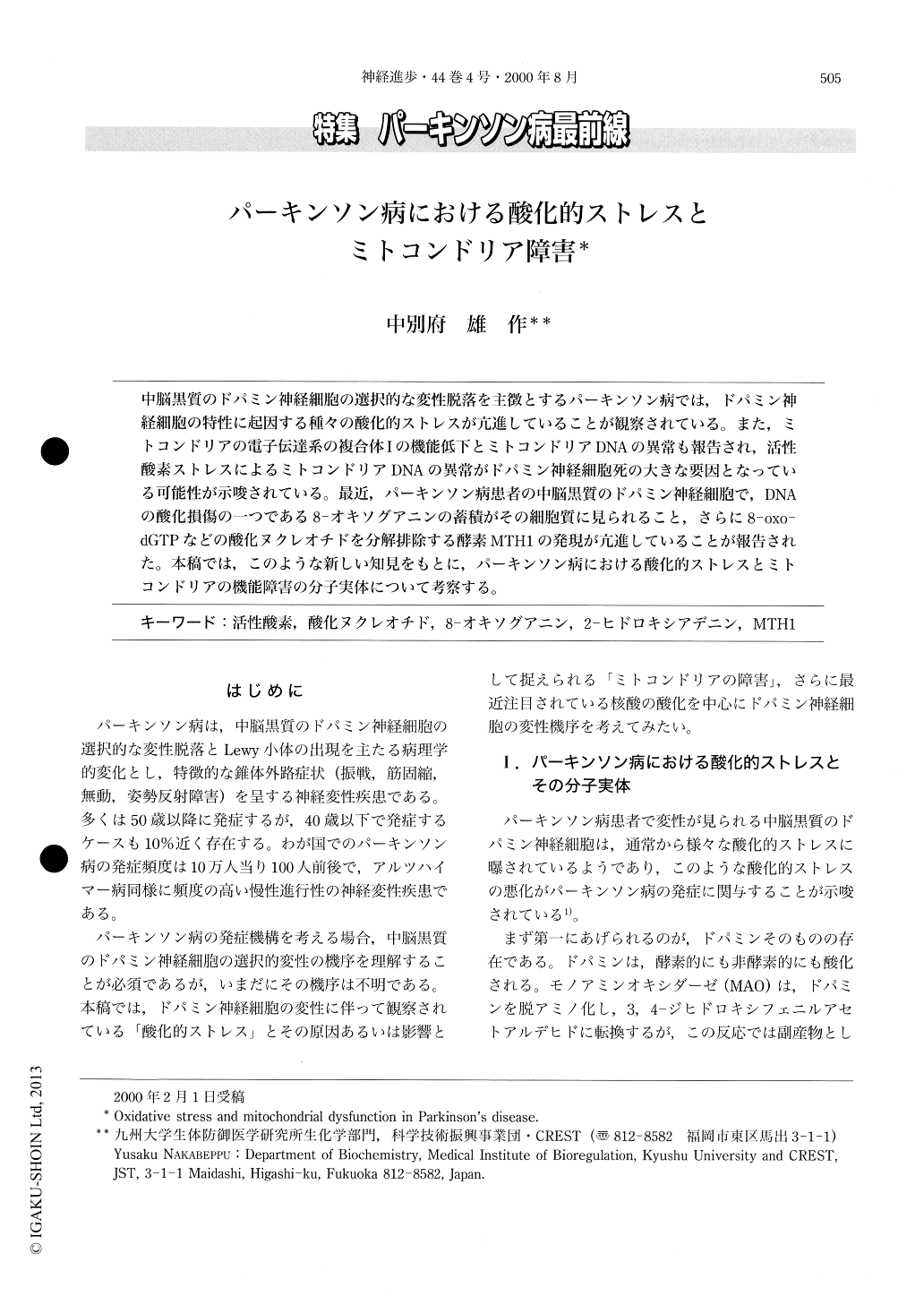
中脳黒質のドパミン神経細胞の選択的な変性脱落を主徴とするパーキンソン病では,ドパミン神経細胞の特性に起因する種々の酸化的ストレスが亢進していることが観察されている。また,ミトコンドリアの電子伝達系の複合体Iの機能低下とミトコンドリアDNAの異常も報告され,活性酸素ストレスによるミトコンドリアDNAの異常がドパミン神経細胞死の大きな要因となっている可能性が示唆されている。最近,パーキンソン病患者の中脳黒質のドパミン神経細胞で,DNAの酸化損傷の一つである8-オキソグアニンの蓄積がその細胞質に見られること,さらに8-oxo-dGTPなどの酸化ヌクレオチドを分解排除する酵素MTH 1の発現が亢進していることが報告された。本稿では,このような新しい知見をもとに,パーキンソン病における酸化的ストレスとミトコンドリアの機能障害の分子実体について考察する。
Reduction of mitochondrial complex I activity in the electron transfer system in mitochondria and various abnormalities in mitochondrial DNA have been observed in the brain of Parkinson's disease (PD). These findings suggest that oxidative stress may cause neuronal cell death in PD. Recently, it has been reported that 8-oxoguanine, one of major oxidative damages in nucleic acids, is accumulated in cytoplasm of substantia nigra neurons of PD brain, and that expression of MTH1 protein which hydrolyzes oxidized purine nucleoside triphosphates, is highly induced in the substantia nigra neurons. Based on these new findings, molecular basis of oxidative stress and mitochondrial dysfunction involved in PD are discussed in this article.
Copyright © 2000, Igaku-Shoin Ltd. All rights reserved.