Japanese
English
- 有料閲覧
PPV購入案内
1,320円 (1,200円+税10%) こちらは、774ページから784ページの文献です。購入には医書.jp本会員登録が必要です。
会員登録完了後に改めて上記「購入サイトへ」を選択してください。
または「購入サイトへ」選択後に「購入ログイン」、「新規会員登録」の順に進んでください。
会員登録について詳しくはをご確認ください。
- Abstract 文献概要
- 1ページ目 Look Inside
はじめに
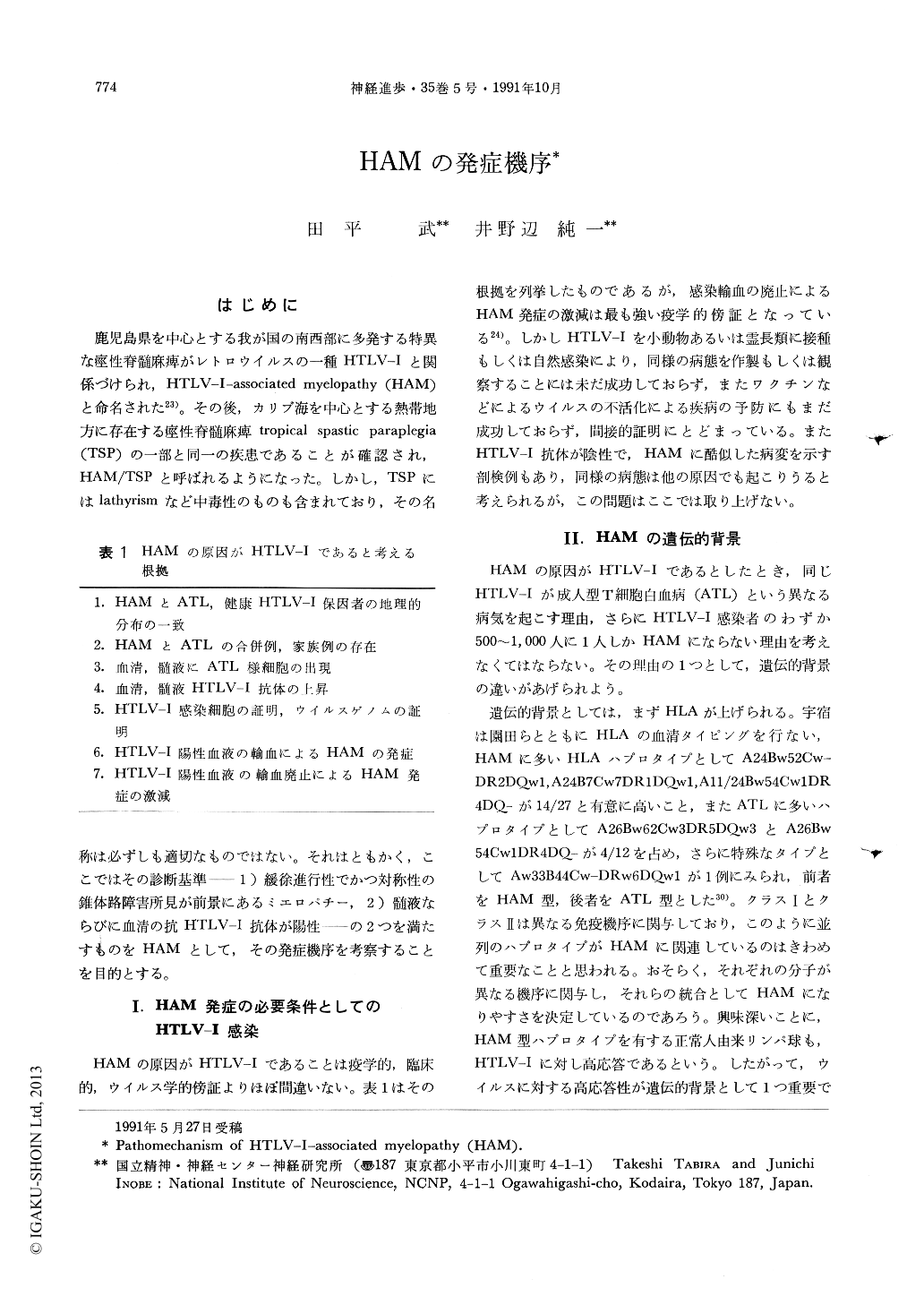
鹿児島県を中心とする我が国の南西部に多発する特異な痙性脊髄麻痺がレトロウイルスの一種HTLV-Iと関係づけられ,HTLV-I-associated myelopathy(HAM)と命名された23)。その後,カリブ海を中心とする熱帯地方に存在する痙性脊髄麻痺tropical spastic paraplegia(TSP)の一部と同一の疾患であることが確認され,HAM/TSPと呼ばれるようになった。しかし,TSPにはlathyrismなど中毒性のものも含まれており,その名称は必ずしも適切なものではない。それはともかく,ここではその診断基準―1)緩徐進行性でかつ対称性の錐体路障害所見が前景にあるミエロパチー,2)髄液ならびに血清の抗HTLV-I抗体が陽性―の2つを満たすものをHAMとして,その発症機序を考察することを目的とする。
Genetic, viral, immunological and pathologic studies of HTLV-I-associated myelopathy (HAM) were reviewed and a hypothetical pathomechanism was postulated. 1) HTLV-I infection is a prerequisit in HAM. 2) Those who have susceptibility gene develop HAM. 3) Chronic continuous inflammatory process by lymphocytes, macrophages and microglias takes place in the thoracic cord, which mimics parainfections myelitis. 4) Viral antigens and genomes are absent or hardly detectable in the lesion. 5) T-cells and B-cells are markedly activated polyclonally by transactivation of IL-2 and IL-2R, viral antigens, alloantigens, cytokines and other mechanism. 6) HAM patients and HTLV-I carriers are frequently associated with autoimmune-like diseases such as SLE, polymyositis, Sjogren syndrome, uveitis, arthritis, bronchopneumonitis and others, and transgenic mice of the HTLV-I PX gene developed Sjogren-like syndrome. From these findings, the authors speculate that generation of autoagressive T-cells towards the spinal cord is the key mechanism in HAM. However, the antigen, effector mechanism and homing mechanism are remained to be studied.
Copyright © 1991, Igaku-Shoin Ltd. All rights reserved.