Japanese
English
- 有料閲覧
PPV購入案内
1,320円 (1,200円+税10%) こちらは、633ページから639ページの文献です。購入には医書.jp本会員登録が必要です。
会員登録完了後に改めて上記「購入サイトへ」を選択してください。
または「購入サイトへ」選択後に「購入ログイン」、「新規会員登録」の順に進んでください。
会員登録について詳しくはをご確認ください。
- Abstract 文献概要
- 1ページ目 Look Inside
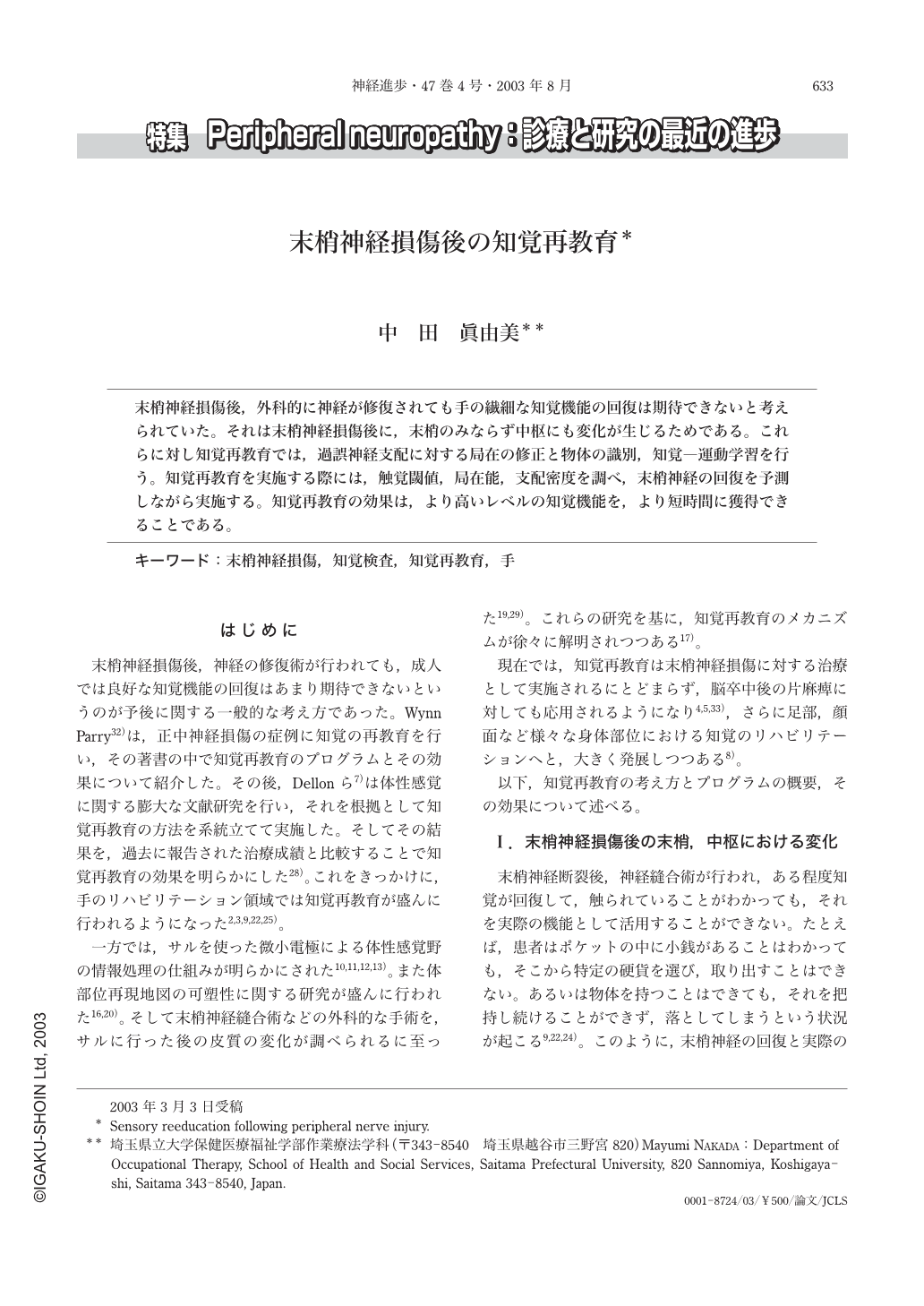
末梢神経損傷後,外科的に神経が修復されても手の繊細な知覚機能の回復は期待できないと考えられていた。それは末梢神経損傷後に,末梢のみならず中枢にも変化が生じるためである。これらに対し知覚再教育では,過誤神経支配に対する局在の修正と物体の識別,知覚―運動学習を行う。知覚再教育を実施する際には,触覚閾値,局在能,支配密度を調べ,末梢神経の回復を予測しながら実施する。知覚再教育の効果は,より高いレベルの知覚機能を,より短時間に獲得できることである。
はじめに
末梢神経損傷後,神経の修復術が行われても,成人では良好な知覚機能の回復はあまり期待できないというのが予後に関する一般的な考え方であった。Wynn Parry23)は,正中神経損傷の症例に知覚の再教育を行い,その著書の中で知覚再教育のプログラムとその効果について紹介した。その後,Dellonら7)は体性感覚に関する膨大な文献研究を行い,それを根拠として知覚再教育の方法を系統立てて実施した。そしてその結果を,過去に報告された治療成績と比較することで知覚再教育の効果を明らかにした28)。これをきっかけに,手のリハビリテーション領域では知覚再教育が盛んに行われるようになった2, 3, 9, 22, 25)。
一方では,サルを使った微小電極による体性感覚野の情報処理の仕組みが明らかにされた10, 11, 12, 13)。また体部位再現地図の可塑性に関する研究が盛んに行われた16, 20)。そして末梢神経縫合術などの外科的な手術を,サルに行った後の皮質の変化が調べられるに至った19, 29)。これらの研究を基に,知覚再教育のメカニズムが徐々に解明されつつある17)。
現在では,知覚再教育は末梢神経損傷に対する治療として実施されるにとどまらず,脳卒中後の片麻痺に対しても応用されるようになり4, 5, 33),さらに足部,顔面など様々な身体部位における知覚のリハビリテーションへと,大きく発展しつつある8)。
以下,知覚再教育の考え方とプログラムの概要,その効果について述べる。
The first published program of sensory reeducation following peripheral nerve repair was that of Wynn Parry in 1966. In 1974, Dellon presented a structured retraining program that defines sensory reeducation in terms of specific techniques to assist the sensory cortex in interpreting the altered profile in sensory impulses it receives after an intervention in the peripheral system.
Sensory reeducation programs are based on the assumption that patient with a regenerating peripheral nerve begins to demonstrate less recovery than patient's potential. The reason for this underachievement is the patient's inability to interpret the altered impulses. This alteration in perception of precise touch occurs along the entire sensory pathway. At the periphery there are ①degeneration of receptors, ②reduction in nerve fibers, ③erroneous reinnervation, ④establishment of erroneous receptive fields, ⑤cross innervation, ⑥reduced conduction velocity, ⑦changes in sizes of receptive fields. Centrally, investigation has shown, there are ①abnormal receptive fields, ②abnormal topographical organization. Clinically, the patient demonstrates partial tactile sensitivity, poor ability to localize, and impaired ability to identify textures, forms and objects.
The purpose of sensory reeducation is to correctly interpret pattern of abnormal sensory input. The goal is to increase cortical map representation for involved skin surfaces to improve spatial discrimination. The timing for the programs is determined by the pattern of sensory recovery.
The most common sensory reeducation programs utilized in hand rehabilitation following a nerve injury are ①correction of faulty localization:the goals are to reeducate specific perception and relearn how to identify the difference between moving touch and constant touch, and pressure, and correction of false localization, ②recognition of materials and objects:the goal is the recovery of functional tactile gnosis.
Exercises should be graded beginning with the discrimination of larger objects, with greater differences among them in size, shape, texture and weight, progressing to more subtle differences. As the patient improves, more difficult program, such as correction of the pattern of prehension in the hand, control of precise force for grasping objects and maintenance of grasping force during movement of more proximal joints are introduced.
In reporting results of sensory reeducation, they have demonstrated that patients undergoing a formal program achieved a higher level of functional sensation in less time than those not engaged in retraining.
Copyright © 2003, Igaku-Shoin Ltd. All rights reserved.