Japanese
English
- 有料閲覧
PPV購入案内
1,320円 (1,200円+税10%) こちらは、1237ページから1241ページの文献です。購入には医書.jp本会員登録が必要です。
会員登録完了後に改めて上記「購入サイトへ」を選択してください。
または「購入サイトへ」選択後に「購入ログイン」、「新規会員登録」の順に進んでください。
会員登録について詳しくはをご確認ください。
- Abstract 文献概要
- 1ページ目 Look Inside
- 参考文献 Reference
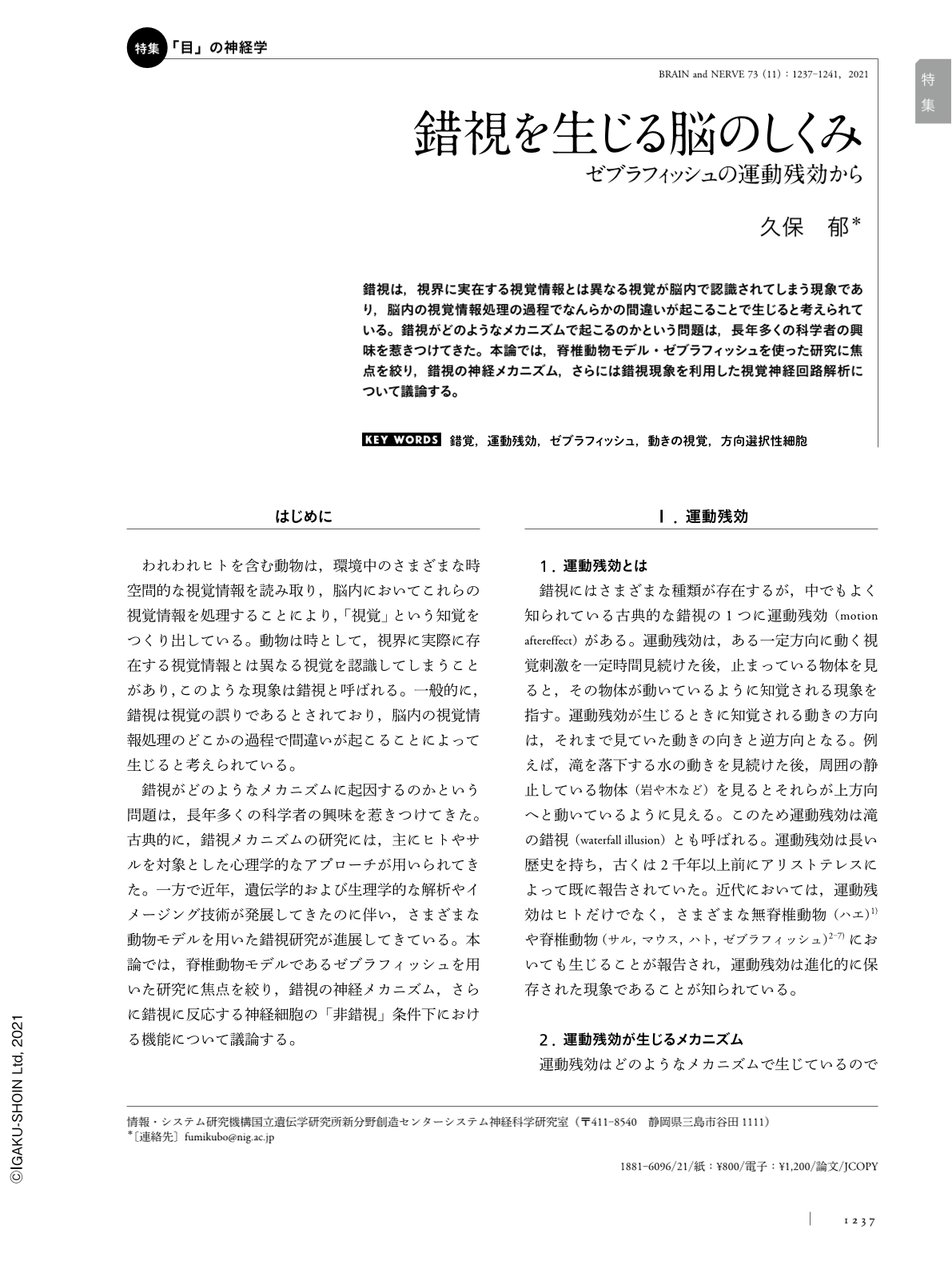
錯視は,視界に実在する視覚情報とは異なる視覚が脳内で認識されてしまう現象であり,脳内の視覚情報処理の過程でなんらかの間違いが起こることで生じると考えられている。錯視がどのようなメカニズムで起こるのかという問題は,長年多くの科学者の興味を惹きつけてきた。本論では,脊椎動物モデル・ゼブラフィッシュを使った研究に焦点を絞り,錯視の神経メカニズム,さらには錯視現象を利用した視覚神経回路解析について議論する。
Abstract
An optical illusion represents a perception that deviates from the actual visual information of the visualized scene and is considered to be generated by an error in visual processing in the brain. The mechanisms by which optical illusions are generated have attracted the interest of scientists for many years. In this review, I focus on a vertebrate model, the zebrafish, and discuss how research using zebrafish has uncovered the mechanisms underlying optical illusions, and how optical illusions serve as a tool to help us understand how normal visual processing works in the brain.
Copyright © 2021, Igaku-Shoin Ltd. All rights reserved.