Japanese
English
- 有料閲覧
PPV購入案内
1,320円 (1,200円+税10%) こちらは、971ページから979ページの文献です。購入には医書.jp本会員登録が必要です。
会員登録完了後に改めて上記「購入サイトへ」を選択してください。
または「購入サイトへ」選択後に「購入ログイン」、「新規会員登録」の順に進んでください。
会員登録について詳しくはをご確認ください。
- Abstract 文献概要
- 1ページ目 Look Inside
- 参考文献 Reference
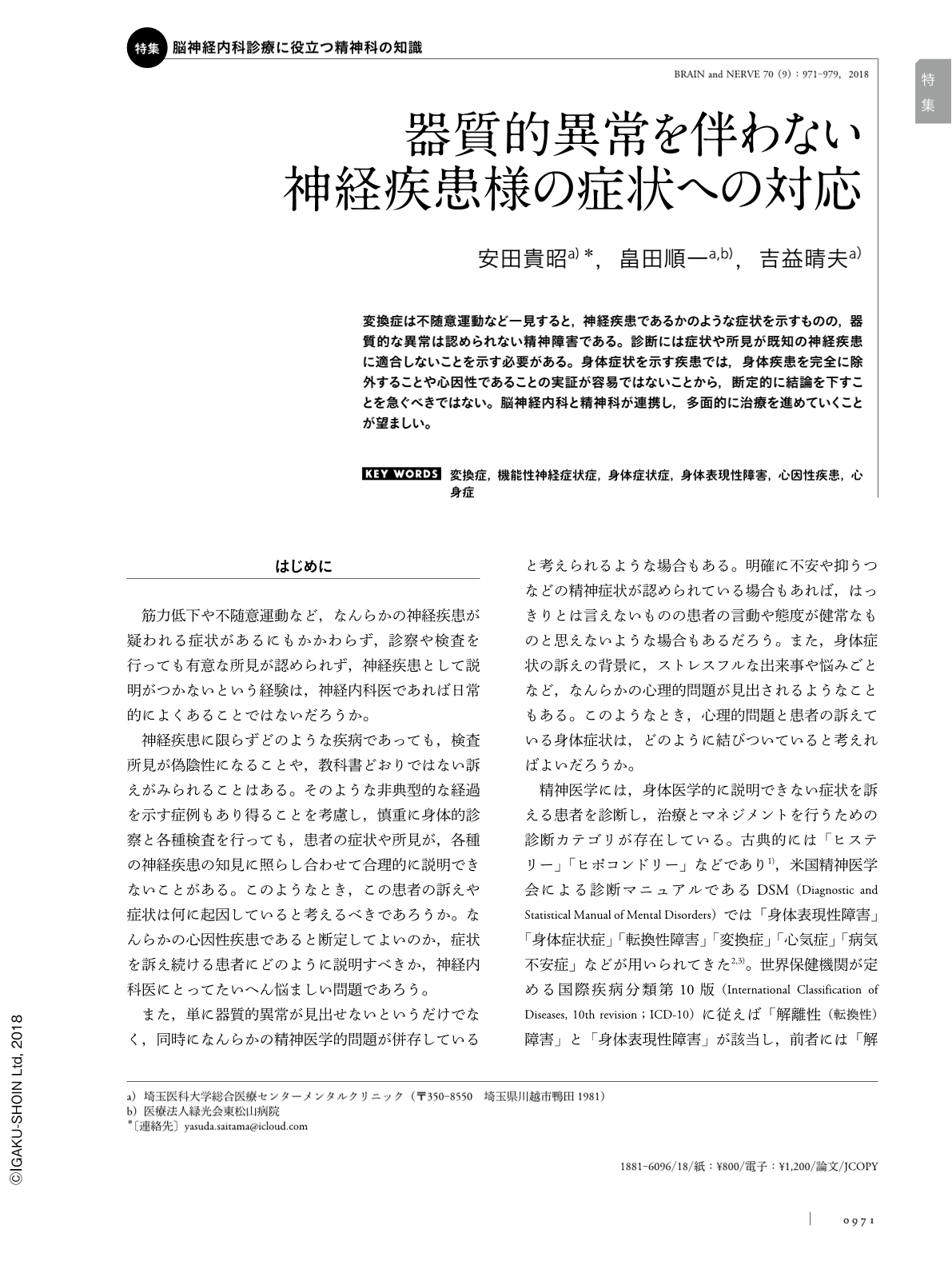
変換症は不随意運動など一見すると,神経疾患であるかのような症状を示すものの,器質的な異常は認められない精神障害である。診断には症状や所見が既知の神経疾患に適合しないことを示す必要がある。身体症状を示す疾患では,身体疾患を完全に除外することや心因性であることの実証が容易ではないことから,断定的に結論を下すことを急ぐべきではない。脳神経内科と精神科が連携し,多面的に治療を進めていくことが望ましい。
Abstract
Many clinicians treat patients with neurological symptoms such as muscle weakness and involuntary movements, that do not correspond to organic findings. The differential diagnosis of patients with medically unexplainable symptoms includes conversion disorder, somatic symptom disorder, and illness anxiety disorder among others. Conversion disorder is a mental disorder with pseudo-neurological symptoms that are not due to an organic abnormality. For its diagnosis it is necessary to show that the symptoms and findings are not compatible with neurological diseases. Conversion disorder and any neurological diseases can coexist, in which cases neurologists and psychiatrists should cooperate when treating the patient. However, it is difficult to clearly distinguish individual symptoms by their mechanism.
Patients complaining of physical symptoms, including those with conversion disorder, require careful explanation that takes into account the patient's explanatory model. Clinicians must switch from an acute disease model to a chronic disease model. These patients are more likely to concentrate consciously on their physical condition and clinicians should help patients avoid ruminating on their physical symptoms. Because it is not simple to completely exclude physical disorders and prove that the symptoms are psychogenic, confirming a diagnosis should be performed carefully.
Copyright © 2018, Igaku-Shoin Ltd. All rights reserved.