Japanese
English
- 有料閲覧
PPV購入案内
1,320円 (1,200円+税10%) こちらは、539ページから545ページの文献です。購入には医書.jp本会員登録が必要です。
会員登録完了後に改めて上記「購入サイトへ」を選択してください。
または「購入サイトへ」選択後に「購入ログイン」、「新規会員登録」の順に進んでください。
会員登録について詳しくはをご確認ください。
- Abstract 文献概要
- 1ページ目 Look Inside
- 参考文献 Reference
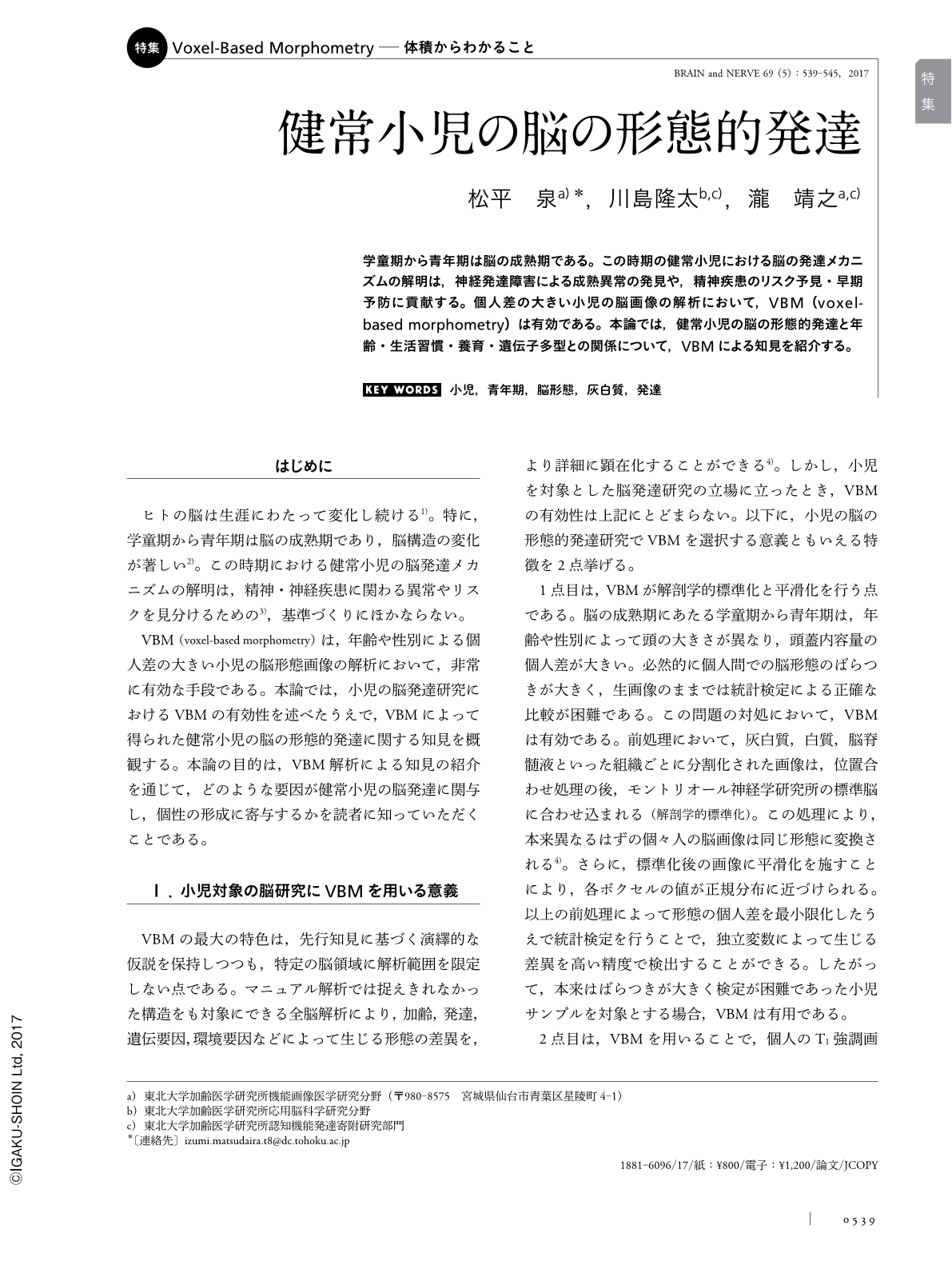
学童期から青年期は脳の成熟期である。この時期の健常小児における脳の発達メカニズムの解明は,神経発達障害による成熟異常の発見や,精神疾患のリスク予見・早期予防に貢献する。個人差の大きい小児の脳画像の解析において,VBM(voxel-based morphometry)は有効である。本論では,健常小児の脳の形態的発達と年齢・生活習慣・養育・遺伝子多型との関係について,VBMによる知見を紹介する。
Abstract
Brain maturation progresses throughout childhood into adolescence. Investigating the mechanism of brain development during these periods in healthy people is necessary for some clinical purposes. For example, these mechanisms are needed to investigate the mechanism of impaired brain maturation in neurodevelopmental disorders—such as autism spectrum disorders or attention-deficit hyper disorder—and improve early prevention of psychiatric or neurodegenerative diseases like depression or Alzheimer's disease. Voxel-based morphometry (VBM) is an effective way to analyze brain magnetic resonance images (MRI) of children and adolescents, as the brain structures of children and adolescents vary widely depending on their age, sex, and several other factors. In this article, information from studies using VBM about the relationship between structural brain development in healthy children and adolescents and age, life style, parenting, and genetic variations is discussed.
Copyright © 2017, Igaku-Shoin Ltd. All rights reserved.