Japanese
English
- 有料閲覧
PPV購入案内
1,320円 (1,200円+税10%) こちらは、1025ページから1033ページの文献です。購入には医書.jp本会員登録が必要です。
会員登録完了後に改めて上記「購入サイトへ」を選択してください。
または「購入サイトへ」選択後に「購入ログイン」、「新規会員登録」の順に進んでください。
会員登録について詳しくはをご確認ください。
- Abstract 文献概要
- 1ページ目 Look Inside
- 参考文献 Reference
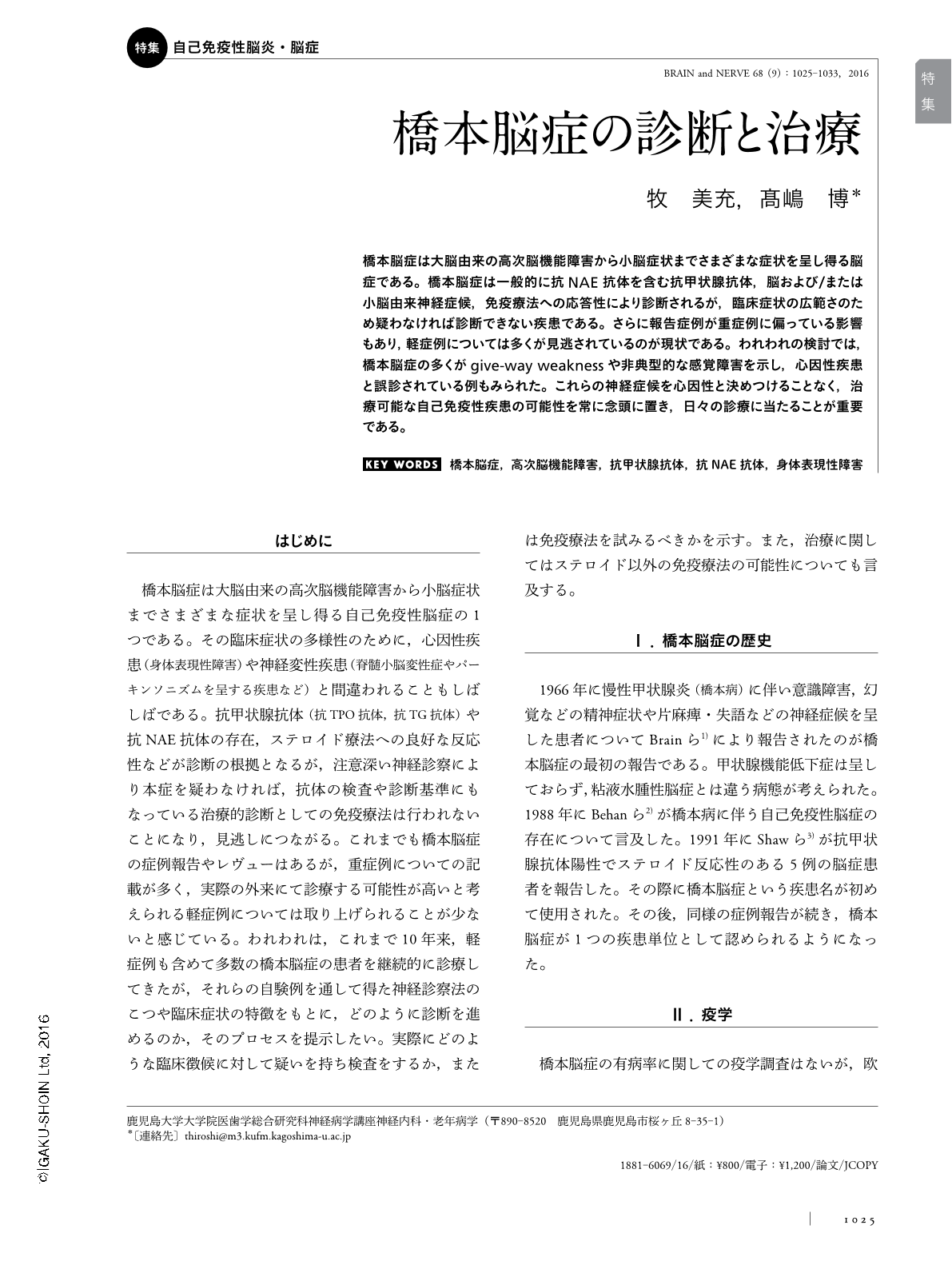
橋本脳症は大脳由来の高次脳機能障害から小脳症状までさまざまな症状を呈し得る脳症である。橋本脳症は一般的に抗NAE抗体を含む抗甲状腺抗体,脳および/または小脳由来神経症候,免疫療法への応答性により診断されるが,臨床症状の広範さのため疑わなければ診断できない疾患である。さらに報告症例が重症例に偏っている影響もあり,軽症例については多くが見逃されているのが現状である。われわれの検討では,橋本脳症の多くがgive-way weaknessや非典型的な感覚障害を示し,心因性疾患と誤診されている例もみられた。これらの神経症候を心因性と決めつけることなく,治療可能な自己免疫性疾患の可能性を常に念頭に置き,日々の診療に当たることが重要である。
Abstract
Hashimoto encephalopathy (HE) is characterized by heterogeneous neurological symptoms. HE is diagnosed based on three criteria-the presence of antithyroid antibodies, neurological symptoms from the cerebrum and/or cerebellum, and a positive response to immunotherapy. We clinically analyzed 18 patients (3 men, 15 women; age range, 38-81years) diagnosed with HE in our hospital from May 2013 to January 2016. Eleven patients showed sensory abnormalities such as strong pain, deep muscle pain, dysesthesia, paresthesia, or neuralgia. Surprisingly, the majority of the pain was distributed in a manner that was not explainable anatomically. Seventeen patients showed motor disturbances, such as weakness, paresis of extremities, or dexterity movement disorder, and eight patients showed give-way weakness, which is disruption of continuous muscle contraction. Other symptoms indicative of brain-related anomalies such as tremor, dystonia, involuntary movements, cerebellar ataxia, parkinsonism, memory loss, and chronic fatigue were also seen. In most patients, such motor, sensory, or higher brain functions were markedly improved with immunosuppressive therapies such as prednisolone, azathioprine, or immunoadsorption therapy. Although give-way weakness and anatomically unexplainable pain are typically considered as being psychogenic in origin, the presence of these symptoms is indicative of HE. HE exhibits diffuse involvement of the entire brain and thus, these symptoms are explainable. We propose that physicians should not diagnose somatoform disorders without first excluding autoimmune encephalopathy.
Copyright © 2016, Igaku-Shoin Ltd. All rights reserved.