Japanese
English
- 有料閲覧
PPV購入案内
1,320円 (1,200円+税10%) こちらは、1388ページから1396ページの文献です。購入には医書.jp本会員登録が必要です。
会員登録完了後に改めて上記「購入サイトへ」を選択してください。
または「購入サイトへ」選択後に「購入ログイン」、「新規会員登録」の順に進んでください。
会員登録について詳しくはをご確認ください。
- Abstract 文献概要
- 1ページ目 Look Inside
- 参考文献 Reference
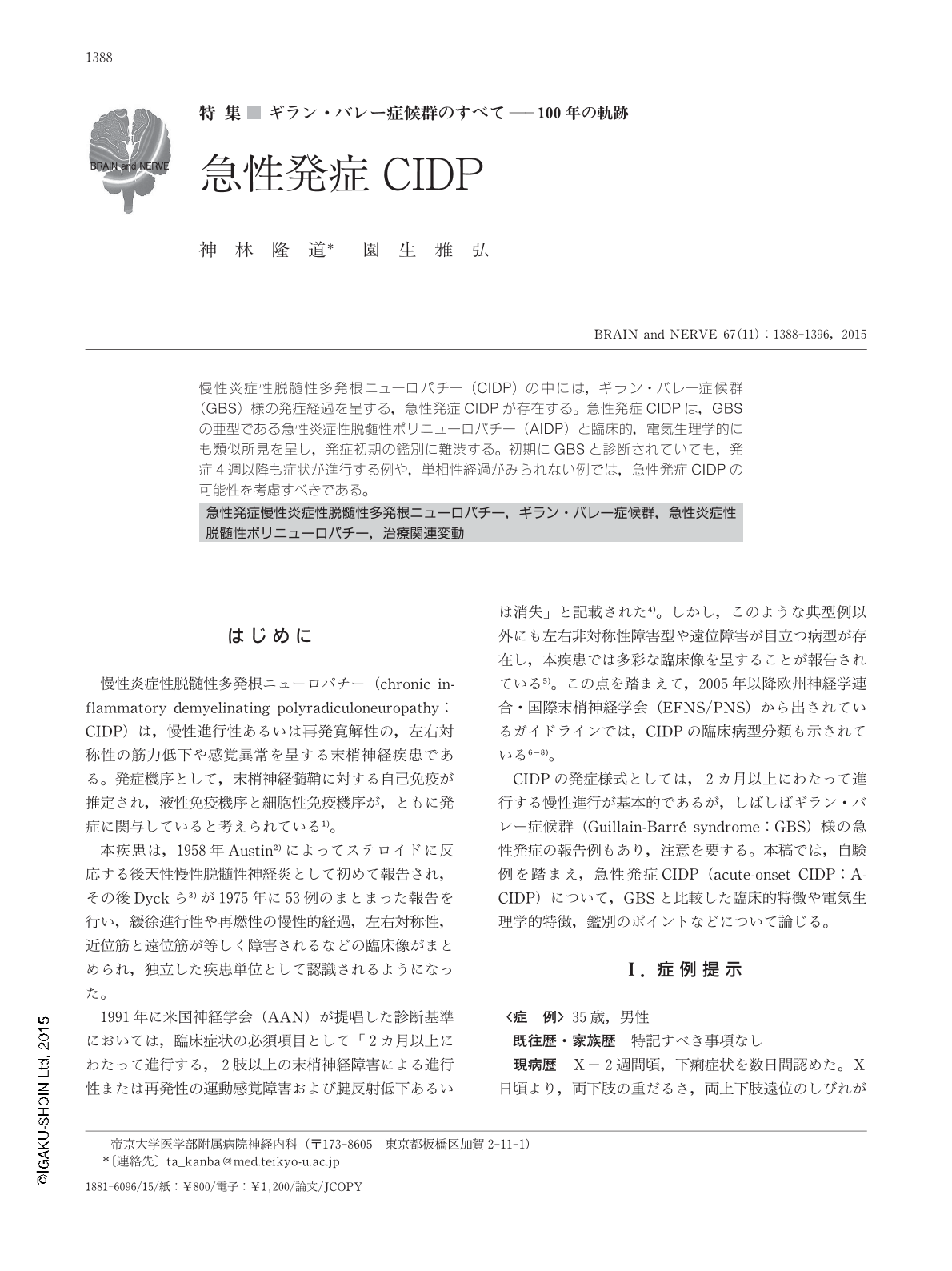
慢性炎症性脱髄性多発根ニューロパチー(CIDP)の中には,ギラン・バレー症候群(GBS)様の発症経過を呈する,急性発症CIDPが存在する。急性発症CIDPは,GBSの亜型である急性炎症性脱髄性ポリニューロパチー(AIDP)と臨床的,電気生理学的にも類似所見を呈し,発症初期の鑑別に難渋する。初期にGBSと診断されていても,発症4週以降も症状が進行する例や,単相性経過がみられない例では,急性発症CIDPの可能性を考慮すべきである。
Abstract
Chronic inflammatory demyelinating polyneuropathy (CIDP) is characterized by an insidious onset showing progression over two months. However, up to 16% of CIDP patients may show acute presentation similar to Guillain-Barré syndrome (GBS). Such cases are termed acute-onset CIDP (A-CIDP). Distinguishing A-CIDP from GBS, especially the acute inflammatory demyelinating polyneuropathy (AIDP) subtype, is critical because therapeutic strategies and outcomes may differ between the two syndromes. Regarding clinical features, A-CIDP is less likely to haveautonomic nervous system involvement, facial weakness, a preceding infectious illness, or the need for mechanical ventilation, in comparison with AIDP. Electrophysiological features are usually quite similar between the two, although follow-up studies may elucidate key differences. Around 8%-16% of GBS patients may show clinical deterioration shortly after improvement or stabilization following initial immunological therapy. Such a situation is termed treatment-related fluctuation (TRF; GBS-TRF). The distinction between GBS-TRF and A-CIDP is an important clinical issue because maintenance treatment is often required in CIDP. The diagnosis of A-CIDP should be considered when the condition of a patient with GBS deteriorates after nine weeks from onset, or when deterioration occurs three times or more.
Copyright © 2015, Igaku-Shoin Ltd. All rights reserved.