Japanese
English
- 有料閲覧
PPV購入案内
1,320円 (1,200円+税10%) こちらは、863ページから871ページの文献です。購入には医書.jp本会員登録が必要です。
会員登録完了後に改めて上記「購入サイトへ」を選択してください。
または「購入サイトへ」選択後に「購入ログイン」、「新規会員登録」の順に進んでください。
会員登録について詳しくはをご確認ください。
- Abstract 文献概要
- 1ページ目 Look Inside
- 参考文献 Reference
- サイト内被引用 Cited by
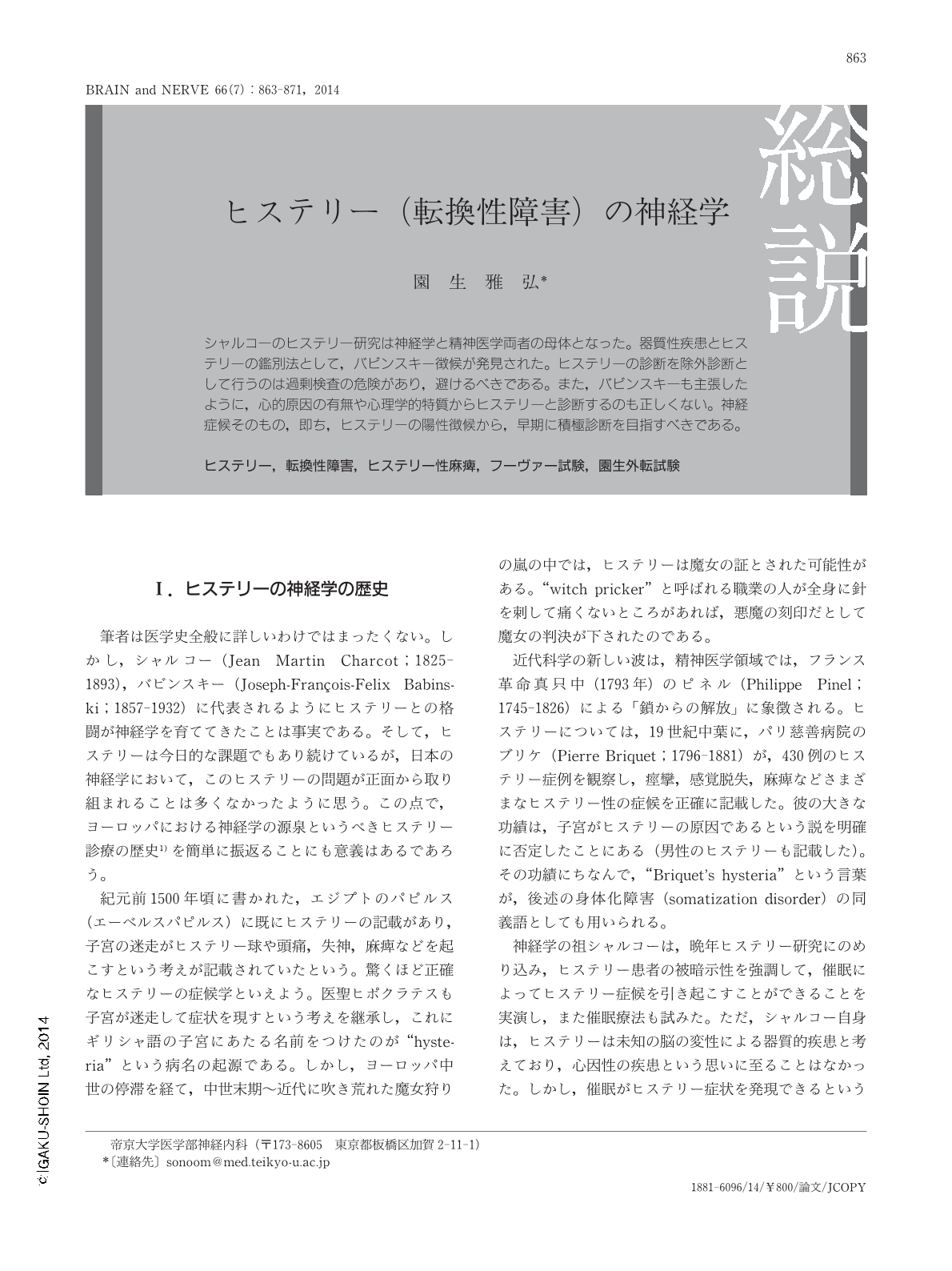
シャルコーのヒステリー研究は神経学と精神医学両者の母体となった。器質性疾患とヒステリーの鑑別法として,バビンスキー徴候が発見された。ヒステリーの診断を除外診断として行うのは過剰検査の危険があり,避けるべきである。また,バビンスキーも主張したように,心的原因の有無や心理学的特質からヒステリーと診断するのも正しくない。神経症候そのもの,即ち,ヒステリーの陽性徴候から,早期に積極診断を目指すべきである。
Abstract
Hysteria has served as an important driving force in the development of both neurology and psychiatry. Jean Martin Charcot's devotion to mesmerism for treating hysterical patients evoked the invention of psychoanalysis by Sigmund Freud. Meanwhile, Joseph Babinski took over the challenge to discriminate between organic and hysterical patients from Charcot and found Babinski's sign, the greatest milestone in modern neurological symptomatology. Nowadays, the usage of the term hysteria is avoided. However, new terms and new classifications are complicated and inconsistent between the two representative taxonomies, the DSM-IV and ICD-10. In the ICD-10, even the alternative term conversion disorder, which was becoming familiar to neurologists, has also disappeared as a group name. The diagnosis of hysteria remains important in clinical neurology. Extensive exclusive diagnoses and overinvestigation, including various imaging studies, should be avoided because they may prolong the disease course and fix their symptoms. Psychological reasons that seem to explain the conversion are not considered reliable. Positive neurological signs suggesting nonorganic etiologies are the most reliable measures for diagnosing hysteria, as Babinski first argued. Hysterical paresis has several characteristics, such as giving-way weakness or peculiar distributions of weakness. Signs to uncover nonorganic paresis utilizing synergy include Hoover's test and the Sonoo abductor test.
Copyright © 2014, Igaku-Shoin Ltd. All rights reserved.