Japanese
English
- 有料閲覧
PPV購入案内
1,320円 (1,200円+税10%) こちらは、817ページから826ページの文献です。購入には医書.jp本会員登録が必要です。
会員登録完了後に改めて上記「購入サイトへ」を選択してください。
または「購入サイトへ」選択後に「購入ログイン」、「新規会員登録」の順に進んでください。
会員登録について詳しくはをご確認ください。
- Abstract 文献概要
- 1ページ目 Look Inside
- 参考文献 Reference
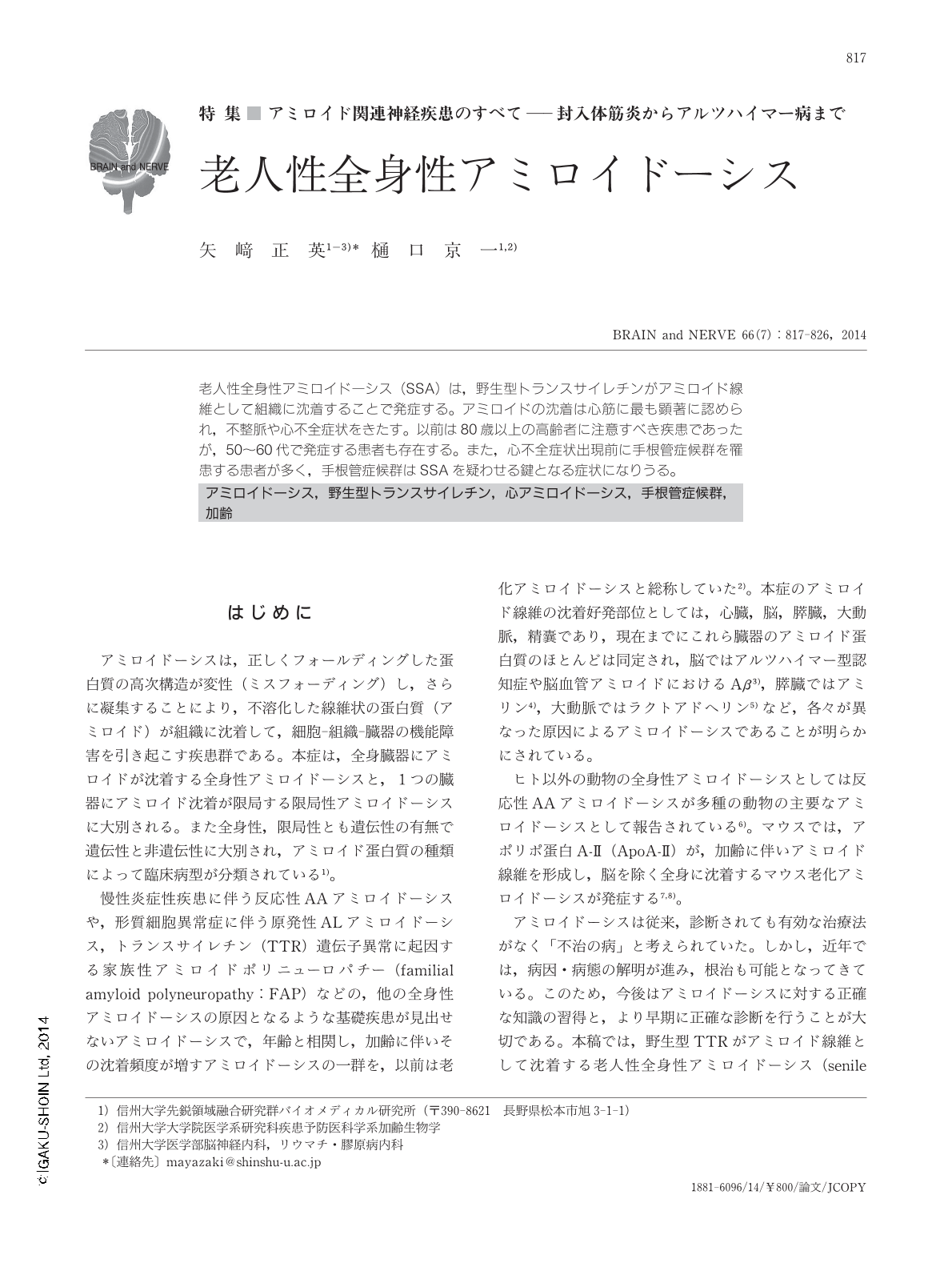
老人性全身性アミロイドーシス(SSA)は,野生型トランスサイレチンがアミロイド線維として組織に沈着することで発症する。アミロイドの沈着は心筋に最も顕著に認められ,不整脈や心不全症状をきたす。以前は80歳以上の高齢者に注意すべき疾患であったが,50~60代で発症する患者も存在する。また,心不全症状出現前に手根管症候群を罹患する患者が多く,手根管症候群はSSAを疑わせる鍵となる症状になりうる。
Abstract
Senile systemic amyloidosis (SSA) is a form of amyloidosis associated with aging, and is characterized by deposition of amyloid fibrils derived from wild-type transthyretin. Amyloid deposition is mainly seen in the myocardium, resulting in arrhythmia (atrial fibrillation) and/or heart failure. Previously, SSA was thought to represent a disease of aged patients over 80 years only; however, recent studies have indicated that SSA also affects much younger patients, with an onset around 50 years. In addition, a number of patients with SSA present with carpal tunnel syndrome (CTS), often several years prior to the onset of heart failure. Hence, CTS may be a key symptom suggestive of SSA, and amyloid deposits should always be confirmed in the operation specimens obtained during carpal tunnel release surgery in CTS patients aged over 50 years. Recently, effective drugs such as tafamidis and diflunisal, which stabilize the structure of the transthyretin tetramer, have been established in FAP patients, and therapeutic effectiveness of these drugs is also anticipated for SSA patients.
Copyright © 2014, Igaku-Shoin Ltd. All rights reserved.