Japanese
English
- 有料閲覧
PPV購入案内
1,320円 (1,200円+税10%) こちらは、1273ページから1277ページの文献です。購入には医書.jp本会員登録が必要です。
会員登録完了後に改めて上記「購入サイトへ」を選択してください。
または「購入サイトへ」選択後に「購入ログイン」、「新規会員登録」の順に進んでください。
会員登録について詳しくはをご確認ください。
- Abstract 文献概要
- 1ページ目 Look Inside
- 参考文献 Reference
- サイト内被引用 Cited by
Ⅰ.痛みの種類
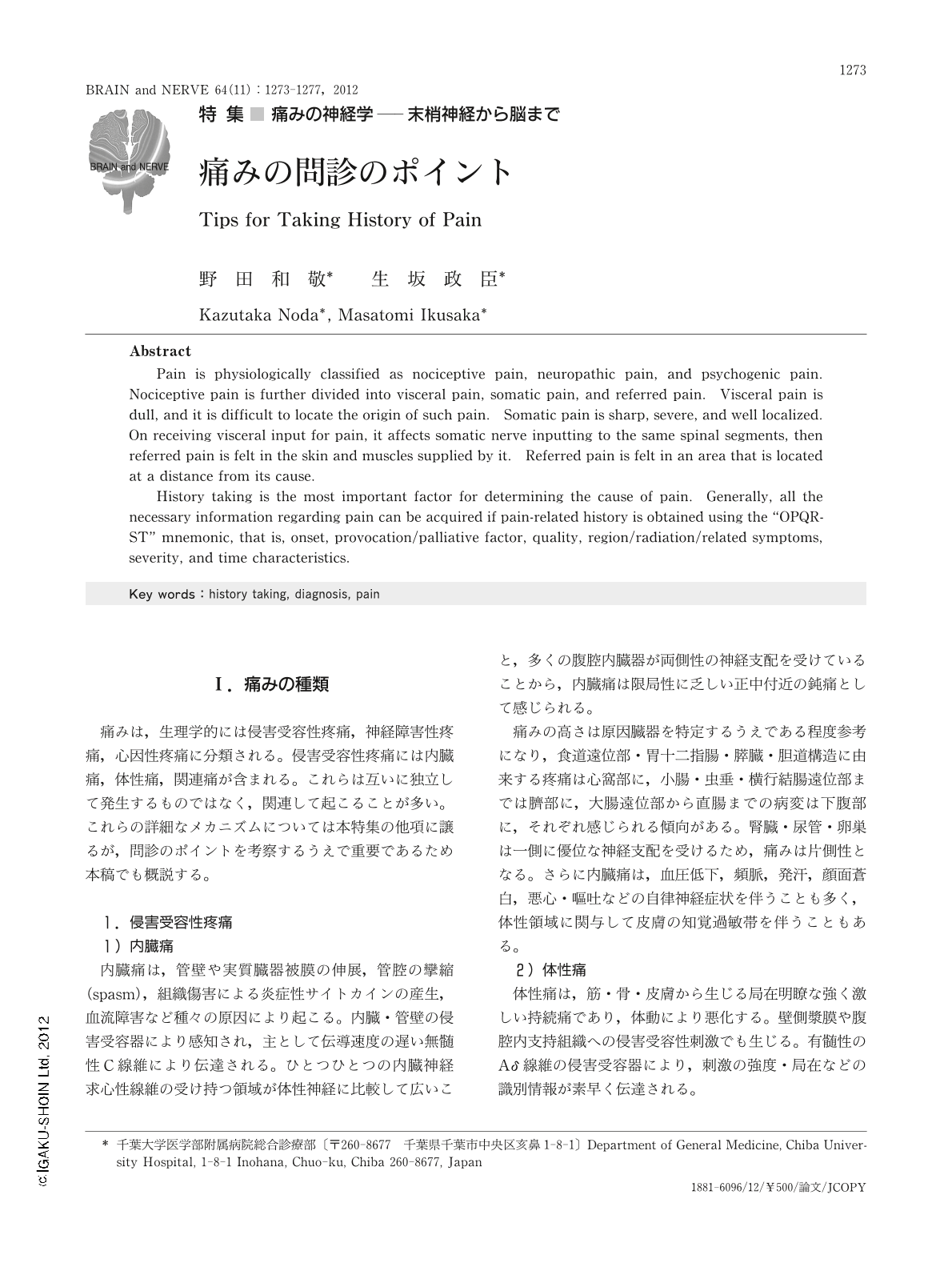
痛みは,生理学的には侵害受容性疼痛,神経障害性疼痛,心因性疼痛に分類される。侵害受容性疼痛には内臓痛,体性痛,関連痛が含まれる。これらは互いに独立して発生するものではなく,関連して起こることが多い。これらの詳細なメカニズムについては本特集の他項に譲るが,問診のポイントを考察するうえで重要であるため本稿でも概説する。
Abstract
Pain is physiologically classified as nociceptive pain, neuropathic pain, and psychogenic pain. Nociceptive pain is further divided into visceral pain, somatic pain, and referred pain. Visceral pain is dull, and it is difficult to locate the origin of such pain. Somatic pain is sharp, severe, and well localized. On receiving visceral input for pain, it affects somatic nerve inputting to the same spinal segments, then referred pain is felt in the skin and muscles supplied by it. Referred pain is felt in an area that is located at a distance from its cause.
History taking is the most important factor for determining the cause of pain. Generally, all the necessary information regarding pain can be acquired if pain-related history is obtained using the "OPQRST" mnemonic, that is, onset, provocation/palliative factor, quality, region/radiation/related symptoms, severity, and time characteristics.
Copyright © 2012, Igaku-Shoin Ltd. All rights reserved.