Japanese
English
- 有料閲覧
PPV購入案内
1,320円 (1,200円+税10%) こちらは、919ページから926ページの文献です。購入には医書.jp本会員登録が必要です。
会員登録完了後に改めて上記「購入サイトへ」を選択してください。
または「購入サイトへ」選択後に「購入ログイン」、「新規会員登録」の順に進んでください。
会員登録について詳しくはをご確認ください。
- Abstract 文献概要
- 1ページ目 Look Inside
- 参考文献 Reference
はじめに
うつ病は抑うつ気分や興味または喜びの喪失を主体とする精神疾患である。その生涯有病率は高く,自殺の主要な原因である。うつ病の治療には抗うつ薬による薬物治療や認知行動療法,電気痙攣療法が行われる。これらの治療の有用性は大きいが,再発予防には治療の継続が必要であり,寛解に至らない患者も多い。既存の治療に抵抗性の難治性うつ病も10~20%程度存在するとされる。このため,うつ病の病態に基づく新たな治療法の確立が待望されている。
脳イメージング,剖検脳研究,神経科学研究の知見から,うつ病の多様な症状は,前頭前皮質,海馬,扁桃体,線条体など,広範な脳領域の異常の総和と捉えられている。線条体の異常は,その強化学習や情動発現にお
ける重要性から,抑うつや快感覚の低下といったうつ病の主症状と関連づけられている。ストレスによる抑うつを対象とした小動物研究では,抑うつの発現に側坐核とそこに投射するドパミン系の遺伝子発現制御が重要であることが示された。抑うつにおける側坐核の役割の理解を通じて,ストレス抵抗性や抑うつ発現機構の多様性に関する新たな概念も提唱されている。
そこで本稿では,うつ病における線条体の機能変容を明らかにした脳イメージング研究と,抑うつにおける側坐核の役割とその制御機序を調べた小動物研究を紹介する。最後に,うつ病に関する線条体研究の今後の展望を述べたい。
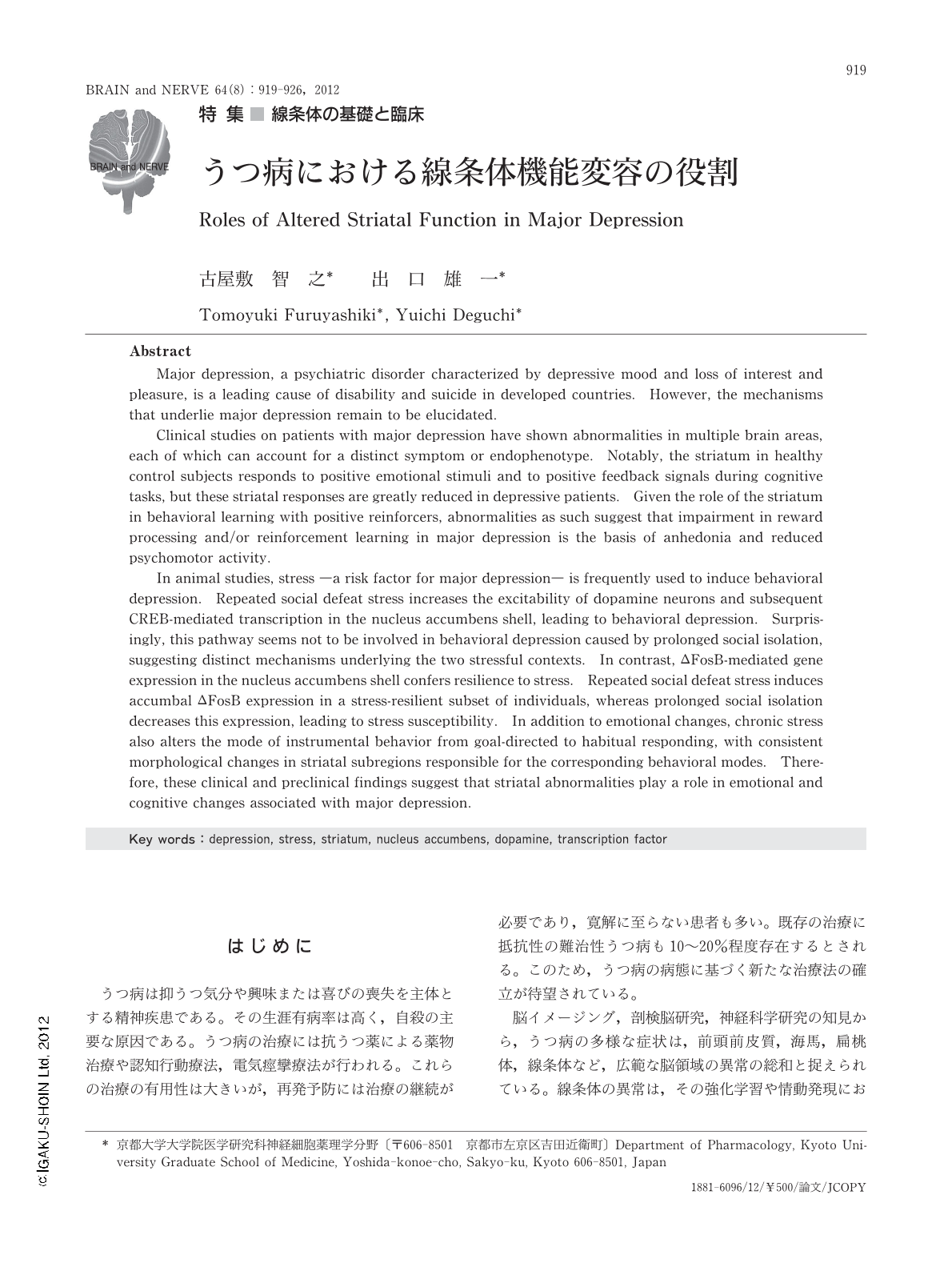
Abstract
Major depression, a psychiatric disorder characterized by depressive mood and loss of interest and pleasure, is a leading cause of disability and suicide in developed countries. However, the mechanisms that underlie major depression remain to be elucidated.
Clinical studies on patients with major depression have shown abnormalities in multiple brain areas, each of which can account for a distinct symptom or endophenotype. Notably, the striatum in healthy control subjects responds to positive emotional stimuli and to positive feedback signals during cognitive tasks, but these striatal responses are greatly reduced in depressive patients. Given the role of the striatum in behavioral learning with positive reinforcers, abnormalities as such suggest that impairment in reward processing and/or reinforcement learning in major depression is the basis of anhedonia and reduced psychomotor activity.
In animal studies, stress ―a risk factor for major depression― is frequently used to induce behavioral depression. Repeated social defeat stress increases the excitability of dopamine neurons and subsequent CREB-mediated transcription in the nucleus accumbens shell, leading to behavioral depression. Surprisingly, this pathway seems not to be involved in behavioral depression caused by prolonged social isolation, suggesting distinct mechanisms underlying the two stressful contexts. In contrast, ΔFosB-mediated gene expression in the nucleus accumbens shell confers resilience to stress. Repeated social defeat stress induces accumbal ΔFosB expression in a stress-resilient subset of individuals, whereas prolonged social isolation decreases this expression, leading to stress susceptibility. In addition to emotional changes, chronic stress also alters the mode of instrumental behavior from goal-directed to habitual responding, with consistent morphological changes in striatal subregions responsible for the corresponding behavioral modes. Therefore, these clinical and preclinical findings suggest that striatal abnormalities play a role in emotional and cognitive changes associated with major depression.
Copyright © 2012, Igaku-Shoin Ltd. All rights reserved.