Japanese
English
- 有料閲覧
PPV購入案内
1,320円 (1,200円+税10%) こちらは、911ページから917ページの文献です。購入には医書.jp本会員登録が必要です。
会員登録完了後に改めて上記「購入サイトへ」を選択してください。
または「購入サイトへ」選択後に「購入ログイン」、「新規会員登録」の順に進んでください。
会員登録について詳しくはをご確認ください。
- Abstract 文献概要
- 1ページ目 Look Inside
- 参考文献 Reference
はじめに
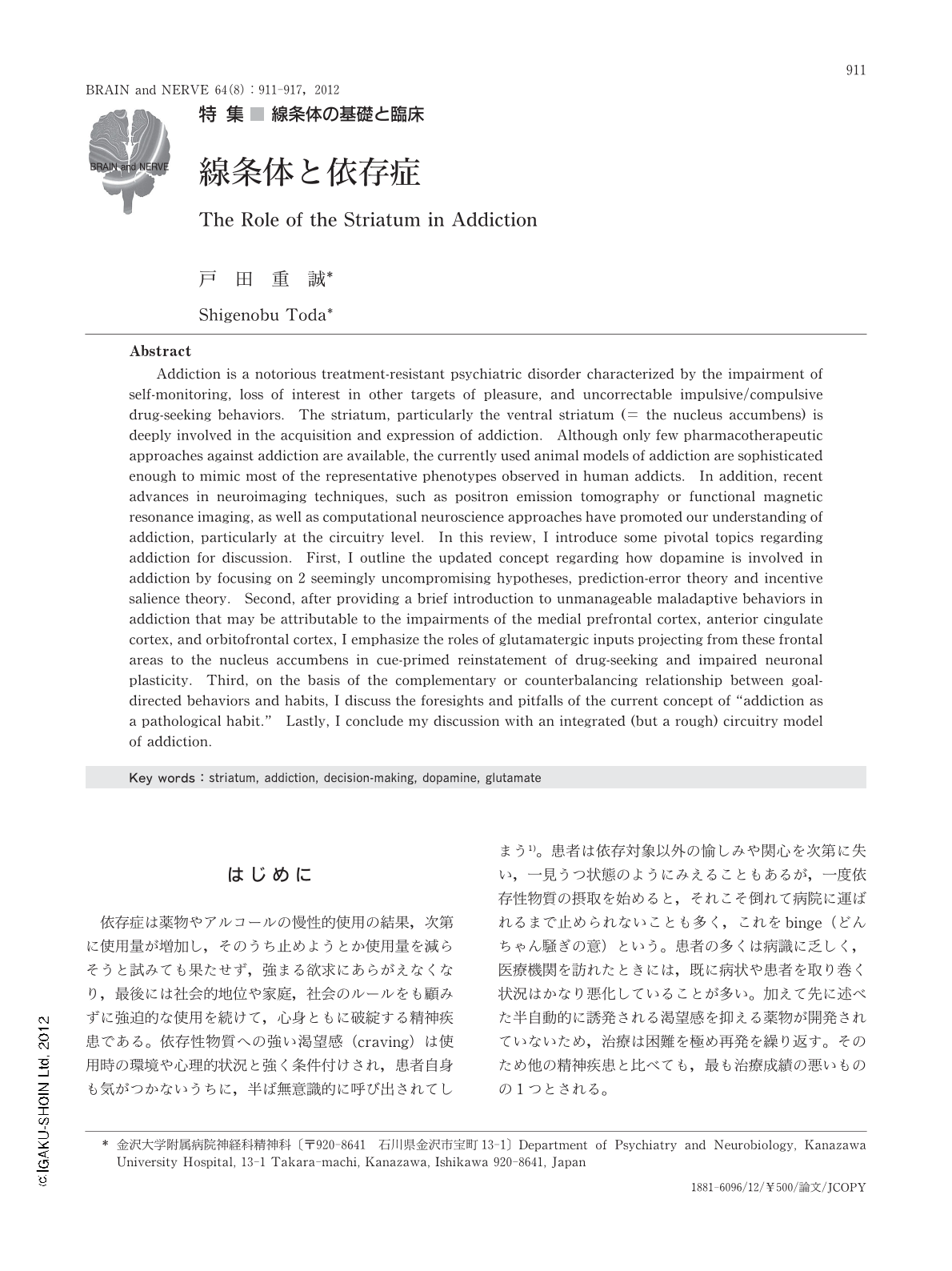
依存症は薬物やアルコールの慢性的使用の結果,次第に使用量が増加し,そのうち止めようとか使用量を減らそうと試みても果たせず,強まる欲求にあらがえなくなり,最後には社会的地位や家庭,社会のルールをも顧みずに強迫的な使用を続けて,心身ともに破綻する精神疾患である。依存性物質への強い渇望感(craving)は使用時の環境や心理的状況と強く条件付けされ,患者自身も気がつかないうちに,半ば無意識的に呼び出されてしまう1)。患者は依存対象以外の愉しみや関心を次第に失い,一見うつ状態のようにみえることもあるが,一度依存性物質の摂取を始めると,それこそ倒れて病院に運ばれるまで止められないことも多く,これをbinge(どんちゃん騒ぎの意)という。患者の多くは病識に乏しく,医療機関を訪れたときには,既に病状や患者を取り巻く状況はかなり悪化していることが多い。加えて先に述べた半自動的に誘発される渇望感を抑える薬物が開発されていないため,治療は困難を極め再発を繰り返す。そのため他の精神疾患と比べても,最も治療成績の悪いものの1つとされる。
依存症の研究は,精神刺激薬であるコカイン・覚せい剤や,麻薬であるヘロイン・モルヒネ,あるいはアルコールを用いた動物研究が欧米を中心に盛んに行われており,特に薬物依存の動物モデルは,数ある精神疾患動物モデルの中でも,完成度が高いものと見なされている2)。近年はPETやfMRIを用いたヒト患者での画像研究の進展も目覚ましく,加えて意思決定のメカニズムと絡めて回路理論的に病態を理解しようとする試みが盛んになった。
本稿では依存症と線条体の関わりについて,特にコカイン依存の動物研究の成果からいくつかのトピックを簡単に総説したい。
Abstract
Addiction is a notorious treatment-resistant psychiatric disorder characterized by the impairment of self-monitoring, loss of interest in other targets of pleasure, and uncorrectable impulsive/compulsive drug-seeking behaviors. The striatum, particularly the ventral striatum (= the nucleus accumbens) is deeply involved in the acquisition and expression of addiction. Although only few pharmacotherapeutic approaches against addiction are available, the currently used animal models of addiction are sophisticated enough to mimic most of the representative phenotypes observed in human addicts. In addition, recent advances in neuroimaging techniques, such as positron emission tomography or functional magnetic resonance imaging, as well as computational neuroscience approaches have promoted our understanding of addiction, particularly at the circuitry level. In this review, I introduce some pivotal topics regarding addiction for discussion. First, I outline the updated concept regarding how dopamine is involved in addiction by focusing on 2 seemingly uncompromising hypotheses, prediction-error theory and incentive salience theory. Second, after providing a brief introduction to unmanageable maladaptive behaviors in addiction that may be attributable to the impairments of the medial prefrontal cortex, anterior cingulate cortex, and orbitofrontal cortex, I emphasize the roles of glutamatergic inputs projecting from these frontal areas to the nucleus accumbens in cue-primed reinstatement of drug-seeking and impaired neuronal plasticity. Third, on the basis of the complementary or counterbalancing relationship between goal-directed behaviors and habits, I discuss the foresights and pitfalls of the current concept of "addiction as a pathological habit." Lastly, I conclude my discussion with an integrated (but a rough) circuitry model of addiction.
Copyright © 2012, Igaku-Shoin Ltd. All rights reserved.