Japanese
English
- 有料閲覧
PPV購入案内
1,320円 (1,200円+税10%) こちらは、1370ページから1377ページの文献です。購入には医書.jp本会員登録が必要です。
会員登録完了後に改めて上記「購入サイトへ」を選択してください。
または「購入サイトへ」選択後に「購入ログイン」、「新規会員登録」の順に進んでください。
会員登録について詳しくはをご確認ください。
- Abstract 文献概要
- 1ページ目 Look Inside
- 参考文献 Reference
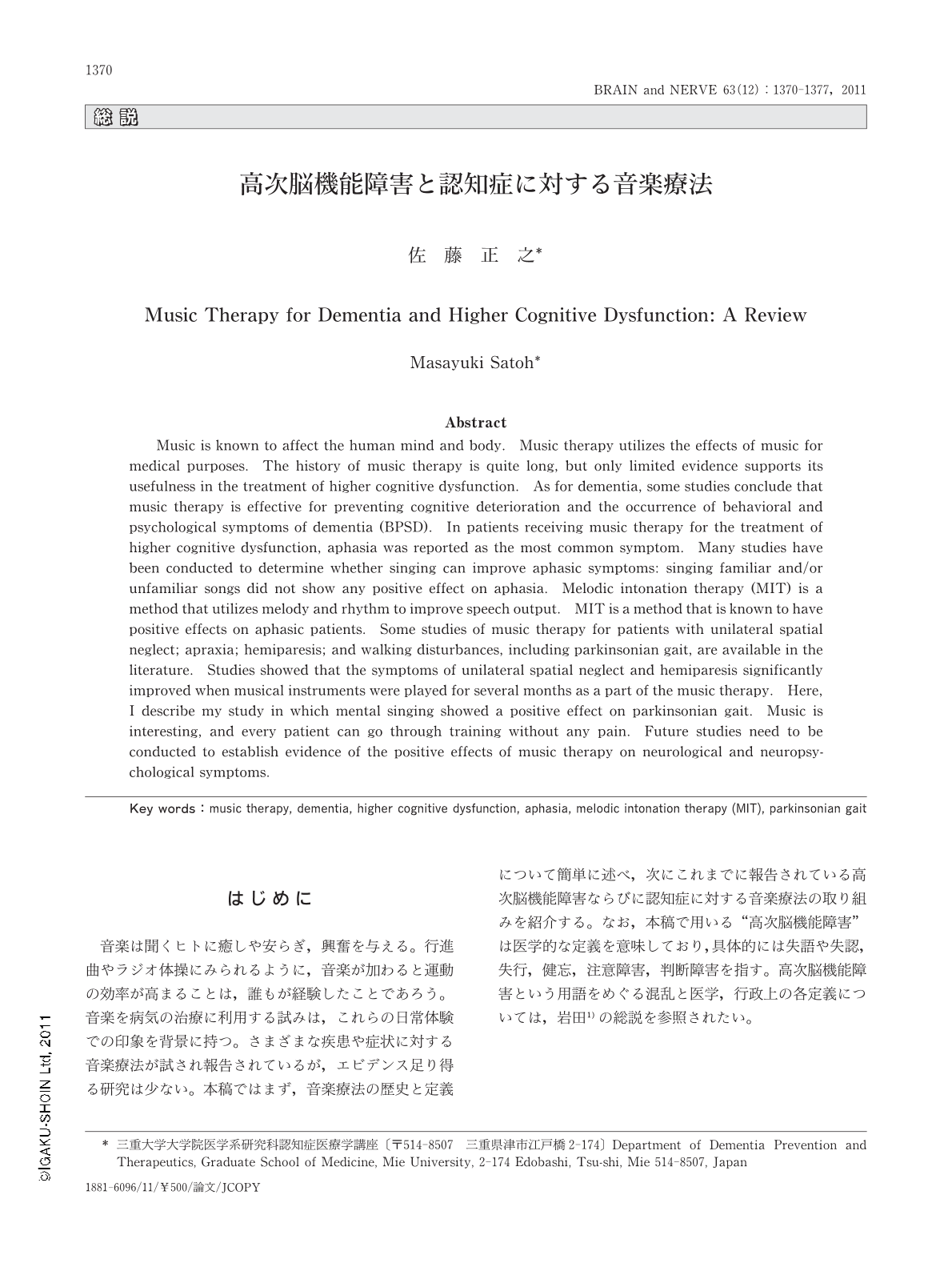
はじめに
音楽は聞くヒトに癒しや安らぎ,興奮を与える。行進曲やラジオ体操にみられるように,音楽が加わると運動の効率が高まることは,誰もが経験したことであろう。音楽を病気の治療に利用する試みは,これらの日常体験での印象を背景に持つ。さまざまな疾患や症状に対する音楽療法が試され報告されているが,エビデンス足り得る研究は少ない。本稿ではまず,音楽療法の歴史と定義について簡単に述べ,次にこれまでに報告されている高次脳機能障害ならびに認知症に対する音楽療法の取り組みを紹介する。なお,本稿で用いる“高次脳機能障害”は医学的な定義を意味しており,具体的には失語や失認,失行,健忘,注意障害,判断障害を指す。高次脳機能障害という用語をめぐる混乱と医学,行政上の各定義については,岩田1)の総説を参照されたい。
Abstract
Music is known to affect the human mind and body. Music therapy utilizes the effects of music for medical purposes. The history of music therapy is quite long,but only limited evidence supports its usefulness in the treatment of higher cognitive dysfunction. As for dementia,some studies conclude that music therapy is effective for preventing cognitive deterioration and the occurrence of behavioral and psychological symptoms of dementia (BPSD). In patients receiving music therapy for the treatment of higher cognitive dysfunction,aphasia was reported as the most common symptom. Many studies have been conducted to determine whether singing can improve aphasic symptoms: singing familiar and/or unfamiliar songs did not show any positive effect on aphasia. Melodic intonation therapy (MIT) is a method that utilizes melody and rhythm to improve speech output. MIT is a method that is known to have positive effects on aphasic patients. Some studies of music therapy for patients with unilateral spatial neglect; apraxia; hemiparesis; and walking disturbances,including parkinsonian gait,are available in the literature. Studies showed that the symptoms of unilateral spatial neglect and hemiparesis significantly improved when musical instruments were played for several months as a part of the music therapy. Here,I describe my study in which mental singing showed a positive effect on parkinsonian gait. Music is interesting,and every patient can go through training without any pain. Future studies need to be conducted to establish evidence of the positive effects of music therapy on neurological and neuropsychological symptoms.
Copyright © 2011, Igaku-Shoin Ltd. All rights reserved.