Japanese
English
- 有料閲覧
PPV購入案内
1,320円 (1,200円+税10%) こちらは、830ページから838ページの文献です。購入には医書.jp本会員登録が必要です。
会員登録完了後に改めて上記「購入サイトへ」を選択してください。
または「購入サイトへ」選択後に「購入ログイン」、「新規会員登録」の順に進んでください。
会員登録について詳しくはをご確認ください。
- Abstract 文献概要
- 1ページ目 Look Inside
- 参考文献 Reference
はじめに
「熟知している場所で道に迷う症状」を地理的障害と呼ぶ。ただし,意識障害,認知症,健忘症候群,半側空間無視など,他の神経症状や神経心理症状によって説明可能な場合は除外する。地誌的障害,地誌的失見当,地誌的見当識障害,広義の地誌的失認なども地理的障害とほぼ同義である。従来の文献にしばしば登場する「地誌的記憶障害」は,自宅付近の地図や自宅の間取りを想起して口述・描写することの障害[地理的知識の視覚表象能力の障害1)]であり,本稿でいう地理的障害とは異なる。
「熟知している場所」は,自宅付近,職場付近など発症前からよく知っていた場所(旧知の場所)だけではない。入院した病院内など発症後頻繁に行き来することによって,新たによく知るようになった場所(新規の場所)も含まれる。地理的障害では通常,旧知の場所でも新規の場所でも道に迷う。しかし,稀には新規の場所のみで症状を呈する例がある。これは健忘症候群における逆向性健忘と前向性健忘との関係に似ている。健忘症候群では通常この両者が併存するが,稀にはどちらかが孤立性に発現することがある2)。旧知の場所の中でも発症に近い時期に住んでいた場所では症状がみられ,発症から遠い時期の場所では異常がない症例3,4)の存在などは,逆向性健忘の「時間勾配」を思わせる。地理的障害では,現在まで旧知の場所のみの症例は報告されていない。しかし,理論的にはその存在が推定される。
筆者らは地理的障害を症候と病巣の違いから街並失認(agnosia for streetsまたはlandmark agnosia)と道順障害(defective root findingまたはheading disorientation)の2つに分類した5)。一言でいえば,前者は街並(建物・風景)の同定障害に基づくものであり,視覚性失認の一型と考えられる。後者は広い地域内における自己や,離れた他の地点の空間的定位障害であり,視空間失認に含まれる。
街並失認は相貌失認と合併して生ずることが多く,その存在自体は古くから知られていた6,7)。環境失認(environmental agnosia)8),場所失認(agnosia for place)などと呼ばれたこともある。筆者は多数例の検討から,その症候や病巣を整理し,地理的障害全体の中での位置づけを示したにすぎない。この症候を街並失認と呼ぶことにしたのは,物体失認,画像失認,相貌失認などと同様,「街並(建物・風景)」という視覚対象に対する失認であることを明確にするためである。最近まで,神経心理学の中で地理的障害に関する研究が後れをとっていたとすれば,孤立性の症状を呈する症例が少ない,検査方法が確立されていない,などの点とともに用語の混乱にその一因があったのではないかと思われる。
一方,道順障害は従来ほとんど注目されていなかった症候である。筆者らは街並失認の症候,病巣の分析を進める過程で,これとは異なる地理的障害の1例に出会った。街並失認での患者の訴えが「(よく知っているはずの)回りの景色が初めてみるように感じる」であるのに対し,その症例の訴えは「(よく知っている)目の前の交叉点をどの方角へ曲がればよいかわからない」というものであった。これは,私たちが道をたどる際に,現在いる地点の周囲にある建物・風景を確認するだけではなく,目的地の方角を意識していることとよく対応する。この方角定位能力が選択的に障害されている症例と考えられた。その後,さらに同様の症例を経験し,1990年9)と1993年5)に日本神経心理学会総会で発表するとともに,3例をまとめて原著論文10)とした。
本稿は街並失認と道順障害について,原著10,11)およびその後の総説12-15)や著書16)に記載した内容を総括し,さらに最近の知見を加えたものである。
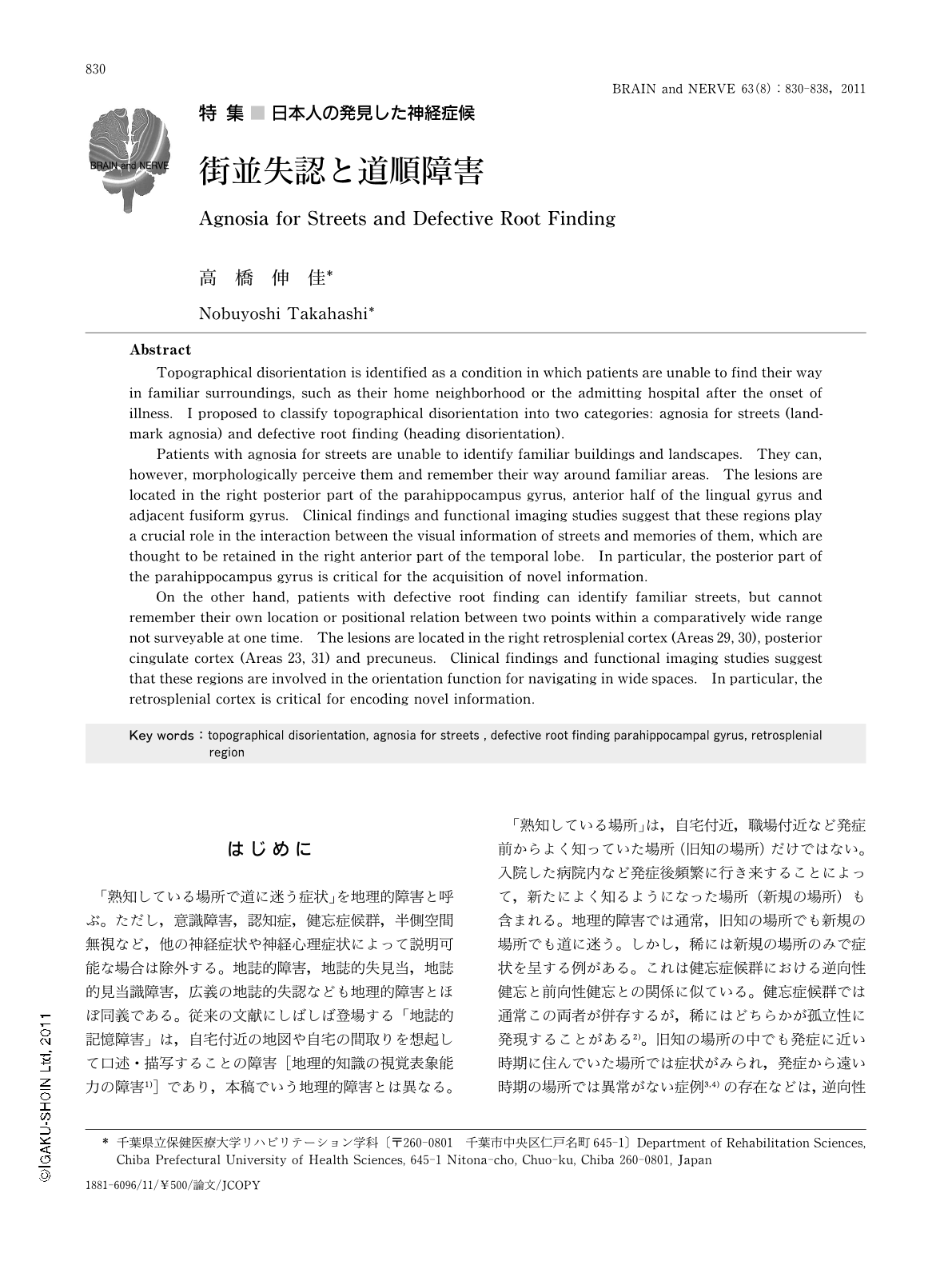
Abstract
Topographical disorientation is identified as a condition in which patients are unable to find their way in familiar surroundings, such as their home neighborhood or the admitting hospital after the onset of illness. I proposed to classify topographical disorientation into two categories: agnosia for streets (landmark agnosia) and defective root finding (heading disorientation).
Patients with agnosia for streets are unable to identify familiar buildings and landscapes. They can, however, morphologically perceive them and remember their way around familiar areas. The lesions are located in the right posterior part of the parahippocampus gyrus, anterior half of the lingual gyrus and adjacent fusiform gyrus. Clinical findings and functional imaging studies suggest that these regions play a crucial role in the interaction between the visual information of streets and memories of them, which are thought to be retained in the right anterior part of the temporal lobe. In particular, the posterior part of the parahippocampus gyrus is critical for the acquisition of novel information.
On the other hand,patients with defective root finding can identify familiar streets,but cannot remember their own location or positional relation between two points within a comparatively wide range not surveyable at one time. The lesions are located in the right retrosplenial cortex (Areas 29,30),posterior cingulate cortex (Areas 23,31) and precuneus. Clinical findings and functional imaging studies suggest that these regions are involved in the orientation function for navigating in wide spaces. In particular,the retrosplenial cortex is critical for encoding novel information.
Copyright © 2011, Igaku-Shoin Ltd. All rights reserved.