Japanese
English
- 有料閲覧
PPV購入案内
1,320円 (1,200円+税10%) こちらは、389ページから396ページの文献です。購入には医書.jp本会員登録が必要です。
会員登録完了後に改めて上記「購入サイトへ」を選択してください。
または「購入サイトへ」選択後に「購入ログイン」、「新規会員登録」の順に進んでください。
会員登録について詳しくはをご確認ください。
- Abstract 文献概要
- 1ページ目 Look Inside
- 参考文献 Reference
Ⅰ.報酬による行動の調節
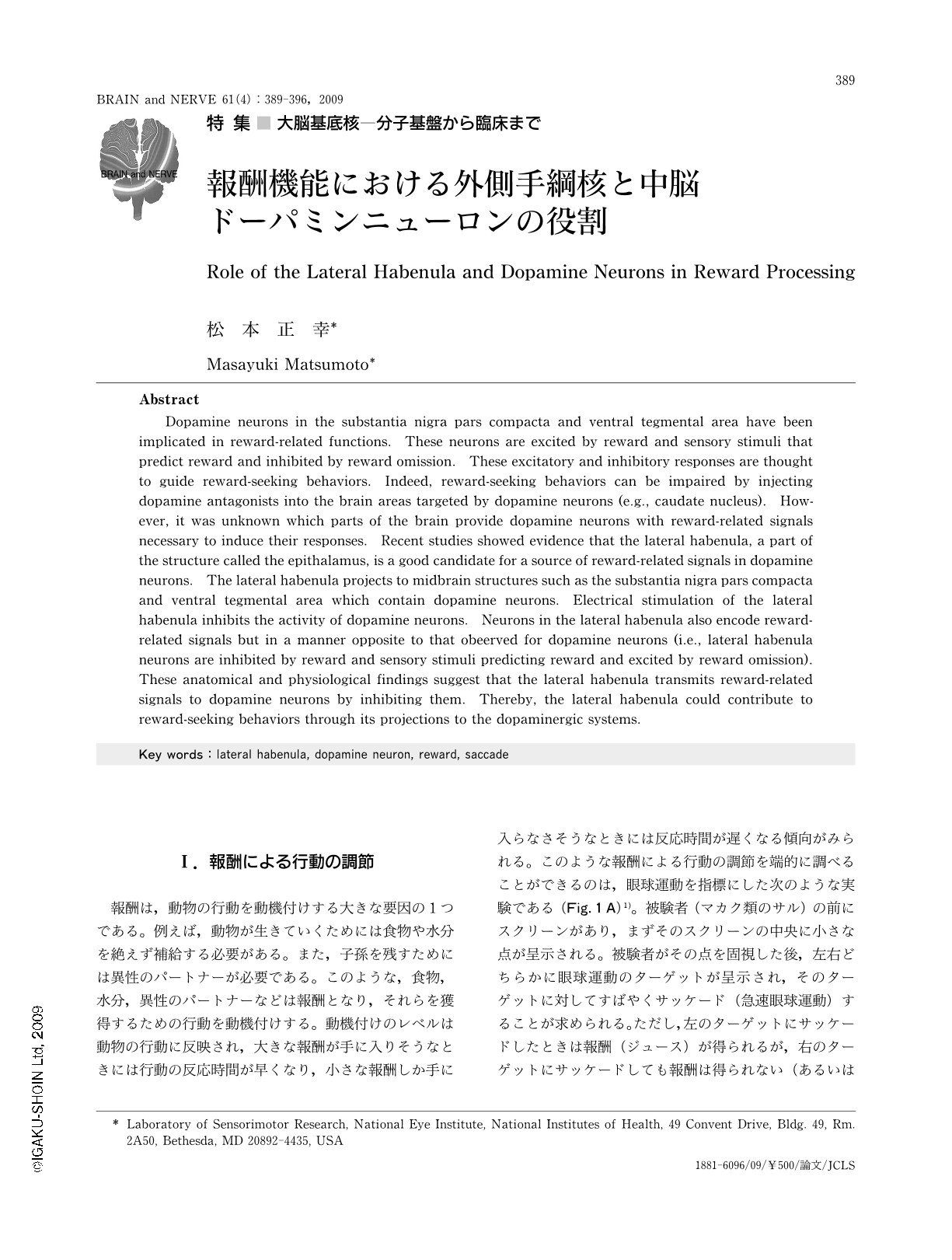
報酬は,動物の行動を動機付けする大きな要因の1つである。例えば,動物が生きていくためには食物や水分を絶えず補給する必要がある。また,子孫を残すためには異性のパートナーが必要である。このような,食物,水分,異性のパートナーなどは報酬となり,それらを獲得するための行動を動機付けする。動機付けのレベルは動物の行動に反映され,大きな報酬が手に入りそうなときには行動の反応時間が早くなり,小さな報酬しか手に入らなさそうなときには反応時間が遅くなる傾向がみられる。このような報酬による行動の調節を端的に調べることができるのは,眼球運動を指標にした次のような実験である(Fig.1A)1)。被験者(マカク類のサル)の前にスクリーンがあり,まずそのスクリーンの中央に小さな点が呈示される。被験者がその点を固視した後,左右どちらかに眼球運動のターゲットが呈示され,そのターゲットに対してすばやくサッケード(急速眼球運動)することが求められる。ただし,左のターゲットにサッケードしたときは報酬(ジュース)が得られるが,右のターゲットにサッケードしても報酬は得られない(あるいは左右逆)。このとき,報酬が得られるサッケードのほうが,報酬が得られないサッケードよりも短い反応潜時がみられる(Fig.1B)。
ここで重要な問題は,報酬によって動物の行動が調節されるのは,どのようなメカニズムによってなのかということである。最近の研究により,中脳にあるドーパミンニューロンと外側手綱核がこのメカニズムに深く関わっていることがわかってきた。本稿では,筆者らが最近得た知見に基づき,これらの神経メカニズムについて概説したい。
Abstract
Dopamine neurons in the substantia nigra pars compacta and ventral tegmental area have been implicated in reward-related functions. These neurons are excited by reward and sensory stimuli that predict reward and inhibited by reward omission. These excitatory and inhibitory responses are thought to guide reward-seeking behaviors. Indeed,reward-seeking behaviors can be impaired by injecting dopamine antagonists into the brain areas targeted by dopamine neurons (e.g.,caudate nucleus). However,it was unknown which parts of the brain provide dopamine neurons with reward-related signals necessary to induce their responses. Recent studies showed evidence that the lateral habenula,a part of the structure called the epithalamus,is a good candidate for a source of reward-related signals in dopamine neurons. The lateral habenula projects to midbrain structures such as the substantia nigra pars compacta and ventral tegmental area which contain dopamine neurons. Electrical stimulation of the lateral habenula inhibits the activity of dopamine neurons. Neurons in the lateral habenula also encode reward-related signals but in a manner opposite to that obeerved for dopamine neurons (i.e.,lateral habenula neurons are inhibited by reward and sensory stimuli predicting reward and excited by reward omission). These anatomical and physiological findings suggest that the lateral habenula transmits reward-related signals to dopamine neurons by inhibiting them. Thereby,the lateral habenula could contribute to reward-seeking behaviors through its projections to the dopaminergic systems.
Copyright © 2009, Igaku-Shoin Ltd. All rights reserved.