Japanese
English
- 有料閲覧
PPV購入案内
1,320円 (1,200円+税10%) こちらは、149ページから155ページの文献です。購入には医書.jp本会員登録が必要です。
会員登録完了後に改めて上記「購入サイトへ」を選択してください。
または「購入サイトへ」選択後に「購入ログイン」、「新規会員登録」の順に進んでください。
会員登録について詳しくはをご確認ください。
- Abstract 文献概要
- 1ページ目 Look Inside
- 参考文献 Reference
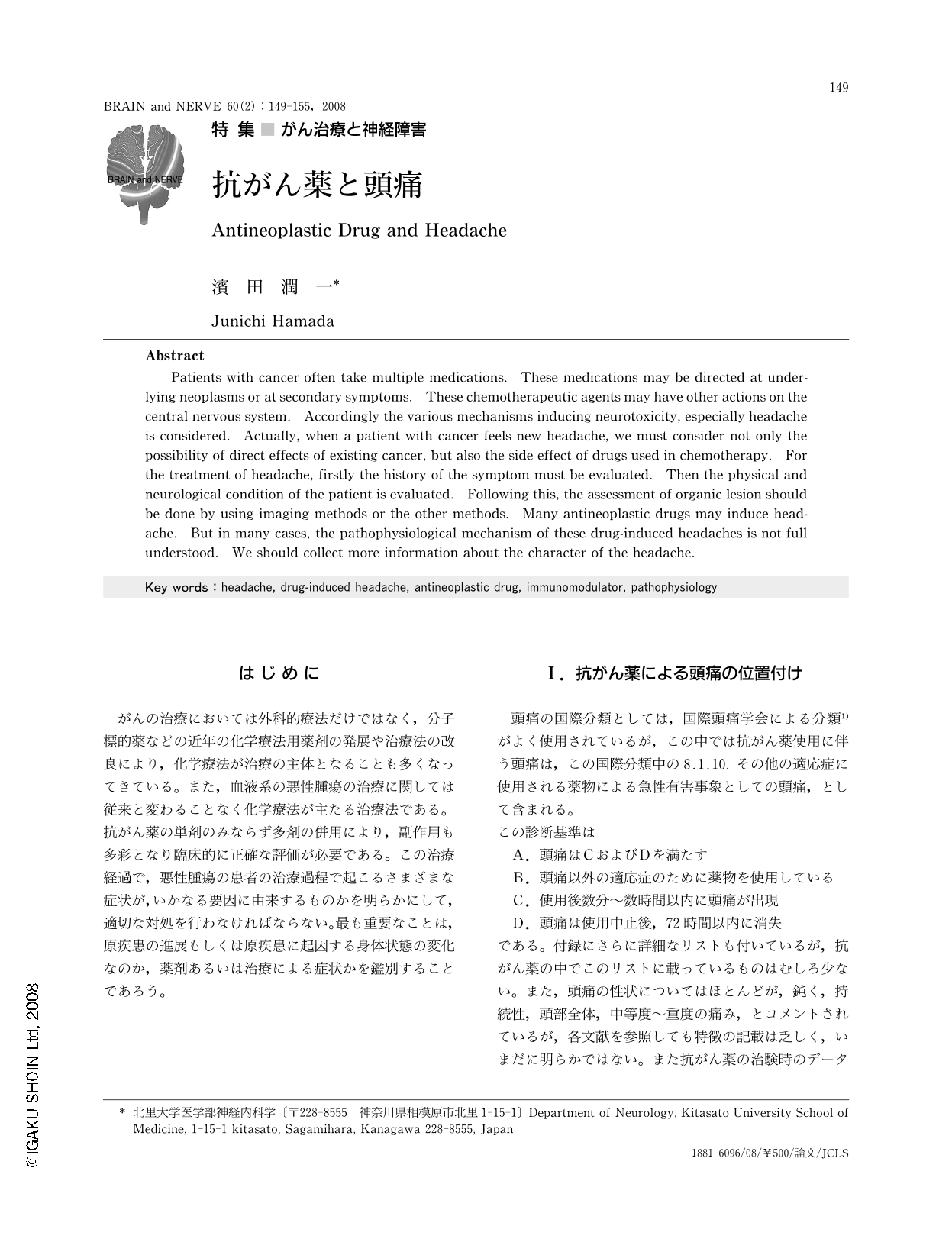
はじめに
がんの治療においては外科的療法だけではなく,分子標的薬などの近年の化学療法用薬剤の発展や治療法の改良により,化学療法が治療の主体となることも多くなってきている。また,血液系の悪性腫瘍の治療に関しては従来と変わることなく化学療法が主たる治療法である。抗がん薬の単剤のみならず多剤の併用により,副作用も多彩となり臨床的に正確な評価が必要である。この治療経過で,悪性腫瘍の患者の治療過程で起こるさまざまな症状が,いかなる要因に由来するものかを明らかにして,適切な対処を行わなければならない。最も重要なことは,原疾患の進展もしくは原疾患に起因する身体状態の変化なのか,薬剤あるいは治療による症状かを鑑別することであろう。
Abstract
Patients with cancer often take multiple medications. These medications may be directed at underlying neoplasms or at secondary symptoms. These chemotherapeutic agents may have other actions on the central nervous system. Accordingly the various mechanisms inducing neurotoxicity, especially headache is considered. Actually, when a patient with cancer feels new headache, we must consider not only the possibility of direct effects of existing cancer, but also the side effect of drugs used in chemotherapy. For the treatment of headache, firstly the history of the symptom must be evaluated. Then the physical and neurological condition of the patient is evaluated. Following this, the assessment of organic lesion should be done by using imaging methods or the other methods. Many antineoplastic drugs may induce headache. But in many cases, the pathophysiological mechanism of these drug-induced headaches is not full understood. We should collect more information about the character of the headache.
Copyright © 2008, Igaku-Shoin Ltd. All rights reserved.