Japanese
English
- 有料閲覧
PPV購入案内
1,320円 (1,200円+税10%) こちらは、157ページから161ページの文献です。購入には医書.jp本会員登録が必要です。
会員登録完了後に改めて上記「購入サイトへ」を選択してください。
または「購入サイトへ」選択後に「購入ログイン」、「新規会員登録」の順に進んでください。
会員登録について詳しくはをご確認ください。
- Abstract 文献概要
- 1ページ目 Look Inside
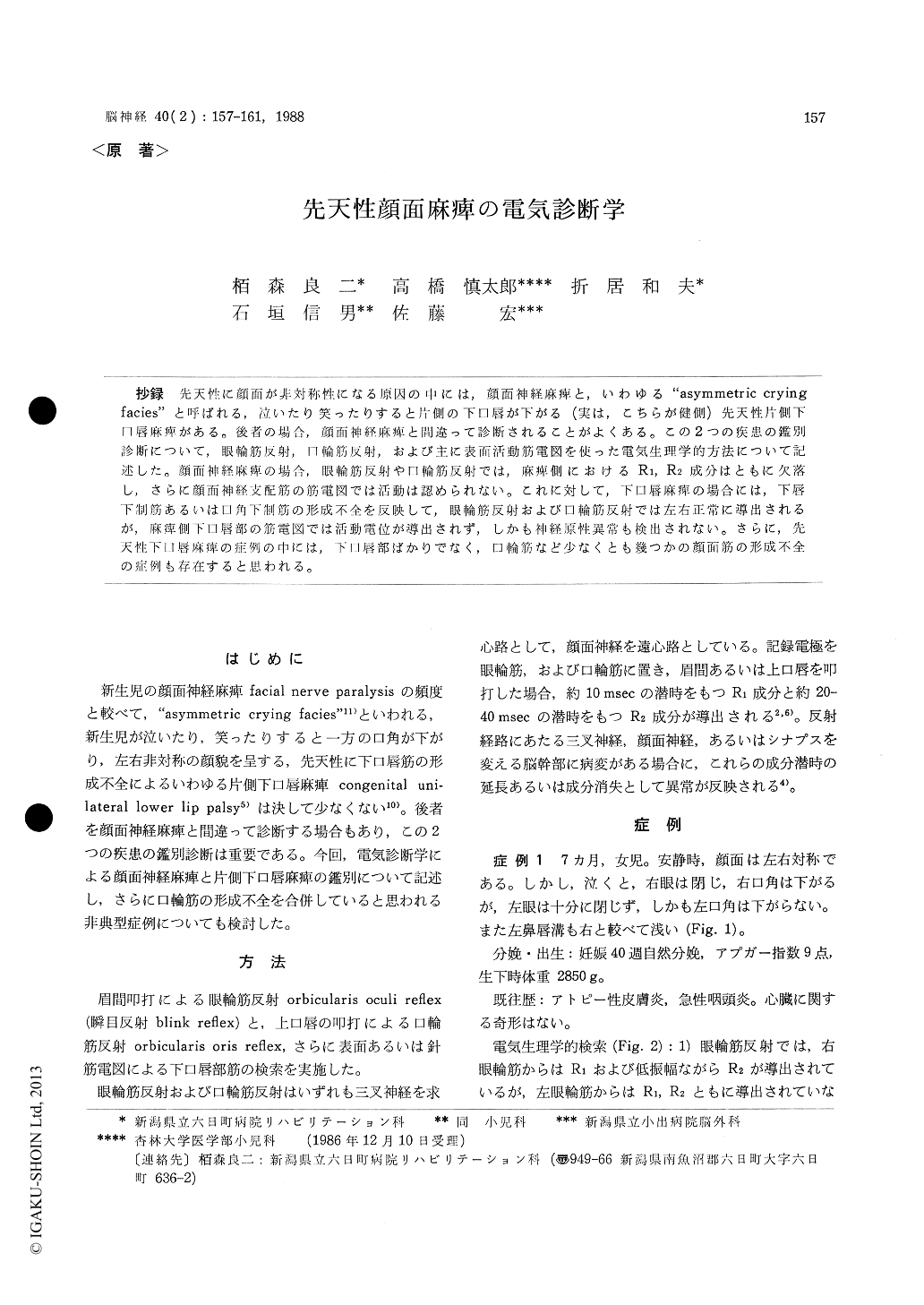
抄録 先天性に顔面が非対称性になる原因の中には,顔面神経麻痺と,いわゆる"asymmetric cryingfacies"と呼ばれる,泣いたり笑ったりすると片側の下[唇が下がる(実は,こちらが健側)先天性片側下口唇麻痺がある。後者の場合,顔面神経麻痺と間違って診断されることがよくある。この2つの疾患の鑑別診断について,眼輪筋反射,口輪筋反射,および主に表面活動筋電図を使った電気生理学的方法について記述した。顔面神経麻痺の場合,眼輪筋反射や口輪筋反射では,麻痺側におけるR1,R2成分はともに欠落し,さらに顔面神経支配筋の筋電図では活動は認められない。これに対して,下口唇麻痺の場合には,下唇下制筋あるいは口角下制筋の形成不全を反映して,眼輪筋反射および口輪筋反射では左右正常に導出されるが,麻痺側下口唇部の筋電図では活動電位が導出されず,しかも神経原性異常も検出されない。さらに,先天性下口唇麻痺の症例の中には,下口唇部ばかりでなく,口輪筋など少なくとも幾つかの顔面筋の形成不全の症例も存在すると思われる。
The common cause of neonatal facial asym-metry is facial nerve paralysis or "asymmetric crying facies syndrome". In the not uncommon later the lower lip, symmetrical at rest, becomes tilted to the so-called normal side when the pa-tient is smiling or crying, as the congenital hypo-genesis of sublabial muscles fail to pull down the lower lip in the opposite side. The electrophysio-logical differentiation between the two diseases has been performed by orbicularis oculi and oris reflexes with mechanically glabellar and supra-labial tapping stimulation, respectively, in addi-tion to needle and/or surface EMG recording. In the facial nerve paralysis of the case 1, R1 and R2 were absent in the orbicularis oculi and oris reflexes. EMG activity was completely lacking over the M. orbicularis oculi and oris innervated by facial nerve. On the contrary, the orbicularis oculi and oris reflexes were normal in the asym-metric crying facial of the case 2. EMG activity was absent only in the sublabial muscles inclu-ding M. depressor anguli oris and/or M. depressor labii inferioris. Furthermore, needle EMG dis-closed no spontaneous activity at rest, which was suggestive of no denervation in the sublabial mus-cles. It was, however, not possible to determine exactly which muscle the needle was inserted, the M. deprossor anguli oris or the M. depressor labii inferioris. The case 3 might be a variant of asymmetric crying facies with hypogenesis of M. orbicularis oris and/or oculi as well as the sub-labial muscle, since the latency was normal but the amplitude was significantly attenuated in the components of orbicularis oculi and oris reflexes. These findings are of considerable importance in the early diagnosis of "facial palsy in newborn".
Copyright © 1988, Igaku-Shoin Ltd. All rights reserved.