Japanese
English
- 有料閲覧
PPV購入案内
1,320円 (1,200円+税10%) こちらは、455ページから462ページの文献です。購入には医書.jp本会員登録が必要です。
会員登録完了後に改めて上記「購入サイトへ」を選択してください。
または「購入サイトへ」選択後に「購入ログイン」、「新規会員登録」の順に進んでください。
会員登録について詳しくはをご確認ください。
- Abstract 文献概要
- 1ページ目 Look Inside
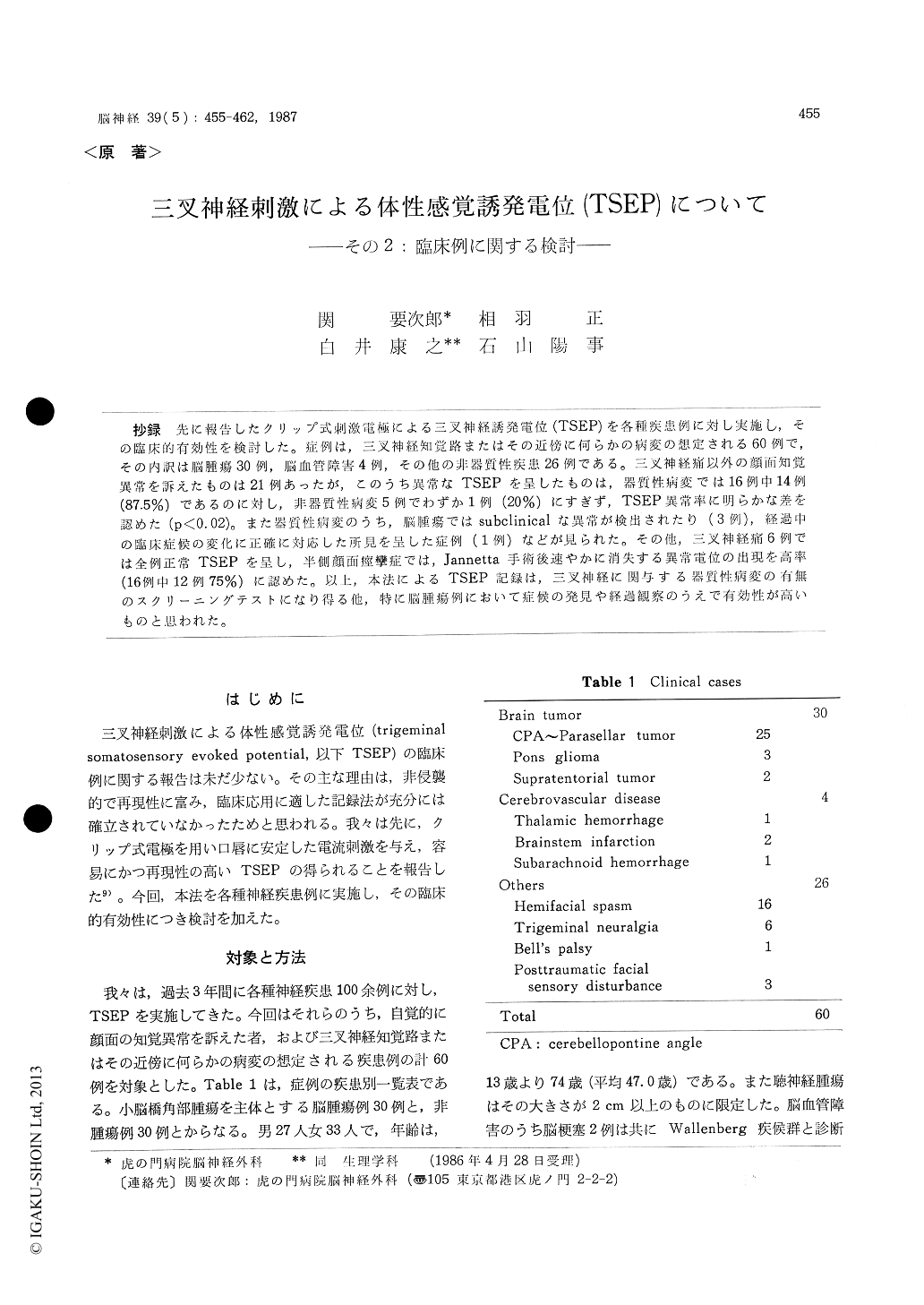
抄録 先に報告したクリップ式刺激電極による三叉神経誘発電位(TSEP)を各種疾患例に対し実施し,その臨床的有効性を検討した。症例は,三叉神経知覚路またはその近傍に何らかの病変の想定される60例で,その内訳は脳腫瘍30例,脳血管障害4例,その他の非器質性疾患26例である。三叉神経痛以外の顔面知覚異常を訴えたものは21例あったが,このうち異常なTSEPを呈したものは,器質性病変では16例中14例(87.5%)であるのに対し,非器質性病変5例でわずか1例(20%)にすぎず,TSEP異常率に明らかな差を認めた(p<0.02)。また器質性病変のうち,脳腫瘍ではsubclinicalな異常が検出されたり(3例),経過中の臨床症候の変化に正確に対応した所見を呈した症例(1例)などが見られた。その他,三叉神経痛6例では全例正常TSEPを呈し,半側顔面痙攣症では,Jannetta手術後速やかに消失する異常電位の出現を高率(16例中12例75%)に認めた。以上,本法によるTSEP記録は,三叉神経に関与する器質性病変の有無のスクリーニングテストになり得る他,特に脳腫瘍例において症候の発見や経過観察のうえで有効性が高いものと思われた。
Compared to other somatosensory evoked poten-tials (SEP), little information has been published so far on trigeminal somatosensory evoked poten-tials (TSEP) in the various kind of disorders. This may be due to few recording technique suitable for clinical practice. We previously re-ported a new recording method and showed the normal pattern of TSEP. The purpose of this report is to examine its reliability for clinical use.
Sixty patients, with either a complaint of facial numbness or an organic lesion supposed to involve facial sensory pathway, were investigated. Their age ranged from 13 to 74 years old (mean 47.0). They consisted of 34 organic lesions (30 brain tumors and 4 cerebrovascular diseases) and 26 non-organic lesions (16 hemifacial spasms, 6 trige-minal neuralgias and other miscellaneous disorders). TSEP was recorded by the stimulation of the half of the contralateral upper or lower lip with the clip-shaped electrode. C'5 or C'6 (midpoint between Cz and the external auditory porus) was used as an active electrode and Fz as a reference. Two hundred or four hundred responses were averaged by a Nicolet Pathfinder II. All record-ings were repeated at least twice to confirm the reproducibility.
(1) Among 21 patients with a complaint of facial numbness except for neuralgia, the abnorma-lity rate of TSEP was significantly different (p< 0.02) between organic and non-organic lesions. The former was 87.5% (14 out of 16 cases) and the latter was 20% (1 out of 5 cases). In one case with pons glioma, the amelioration and deteriora-tion of symptoms caused by the treatment and recurrence correlated well with the results of the serial studies of TSEP. (2) All of 6 trigeminal neuralgias showed normal TSEP. (3) Of the remain-ing 23 cases without any subjective and objective abnormality of facial sensation, abnormal TSEP was detected in 3 cases. All of them were tumor cases, composed of 2 huge acoustic neurinomas and 1 pons glioma. Severe compression of the trigeminal nerve by the tumor was observed dur-ing surgery in these 2 neurinomas.
Through these experiences, our recording techni-que was proved to be a useful clinical examination of the trigeminal nerve function. Firstly, it is a good screening test for the differentiation between organic and non-organic lesion with trigeminal nerve dysfunction. Secondly, among organic le-sions, it may be a valuable examination in tumor cases, particularly for the detection of subclinical abnormality and for the follow-up study.
Copyright © 1987, Igaku-Shoin Ltd. All rights reserved.