Japanese
English
- 有料閲覧
PPV購入案内
1,320円 (1,200円+税10%) こちらは、121ページから126ページの文献です。購入には医書.jp本会員登録が必要です。
会員登録完了後に改めて上記「購入サイトへ」を選択してください。
または「購入サイトへ」選択後に「購入ログイン」、「新規会員登録」の順に進んでください。
会員登録について詳しくはをご確認ください。
- Abstract 文献概要
- 1ページ目 Look Inside
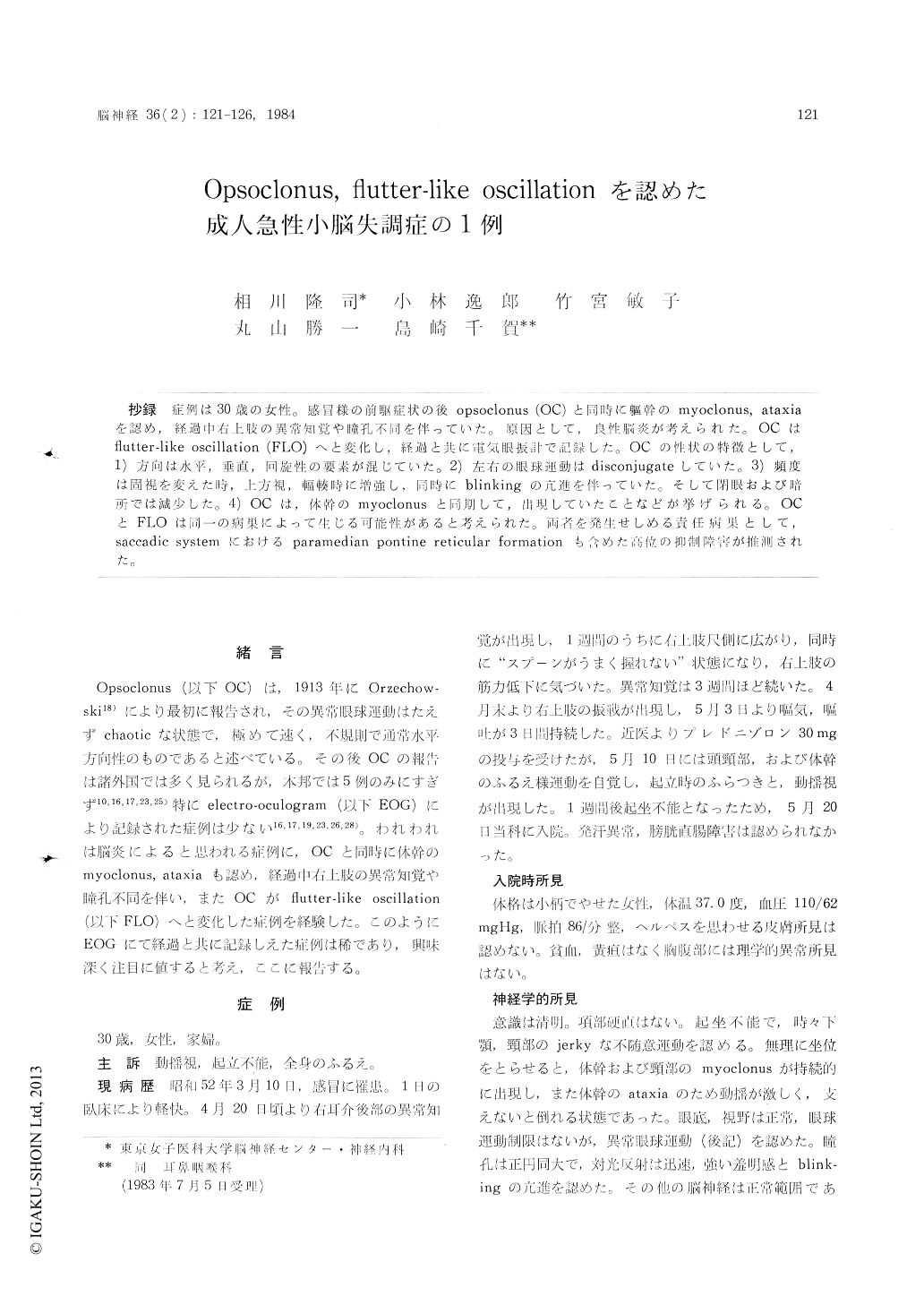
抄録 症例は30歳の女性。感冒様の前駆症状の後opsoclonus (OC)と同時に躯幹のmyoclonus, ataxiaを認め,経過中右上肢の異常知覚や瞳孔不同を伴っていた。原因として,良性脳炎が考えられた。OCはflutter-like oscillation (FLO)へと変化し,経過と共に電気眼振計で記録した。OCの性状の特徴として,1)方向は水平,垂直,回旋性の要素が混じていた。2)左右の眼球運動はdisconjugateしていた。3)頻度は固視を変えた時,上方視,幅輳時に増強し,同時にblinkingの亢進を伴っていた。そして閉眼および暗所では誠少した。4) OCは,体幹のmyoclonusと同期して,出現していたことなどが挙げられる。OCとFLOは同一の病巣によって生じる可能性があると考えられた。両者を発生せしめる責任病巣として,saccadic systemにおける paramedian pontine reticular formation も含めた高位の抑制障害が推測された。
A 30-year-old woman was admitted to our hos-pital in May 1977, suffering from oscillation, body tremulousness and astasia-abasia. Two months prior to admission she had caught a common cold and felt paresthesia on the right arm. Three days before admission, she had photophobia, tremulousness of the trunk and head, and astasia-abasia.
A neurological examination revealed difficulty in standing, and jerky movement of the body and neck. Although mild tremor was appeared on the right arm, her limbs were well coordinated. Anocular examination resulted in normal findings except for intermittent oscillation of the eyeballs. As the pupils and fundi were normal, so were the routine laboratory tests. The cerebrospinal fluid was clear and colorless under normal pressure, and showed no more than 6 mononuclear cells in any of the three examinations. CSF protein was registered 20 mg/dl, glucose 75 mg/dl, and no virus titers were elevated. Electroencephalogram was slightly abnormal due to a slowing of the Alpha wave in the background activity. Both computer-lized tomography and vertebral-angiography were normal. A slow and steady abatement of all symptoms started while she was taking steroid treatment in hospital. Electrooculogram showed irregular disconjugation GI the eyes rotating or moving in horizontal and vertical direction. There movements conjugated or disconjugated in both eyes with 5-7 Hz of frequency and 10-20ー of amp-litude. They decreased when the eye-lids were closed or staying in a dark room.
These ocular movements were regarded as opsoclonus. Then opsoclonus changed to flutter-like oscillation. This case suggested benign post-infectious encephalitis which has been described in other adult cases by many authors. The patho-genesis of opsoclonus and flutter-like oscillation were discussed on the basis of clinical finding and electrooculogram in this case.
Copyright © 1984, Igaku-Shoin Ltd. All rights reserved.