Japanese
English
- 有料閲覧
PPV購入案内
1,320円 (1,200円+税10%) こちらは、229ページから235ページの文献です。購入には医書.jp本会員登録が必要です。
会員登録完了後に改めて上記「購入サイトへ」を選択してください。
または「購入サイトへ」選択後に「購入ログイン」、「新規会員登録」の順に進んでください。
会員登録について詳しくはをご確認ください。
- Abstract 文献概要
- 1ページ目 Look Inside
緒言
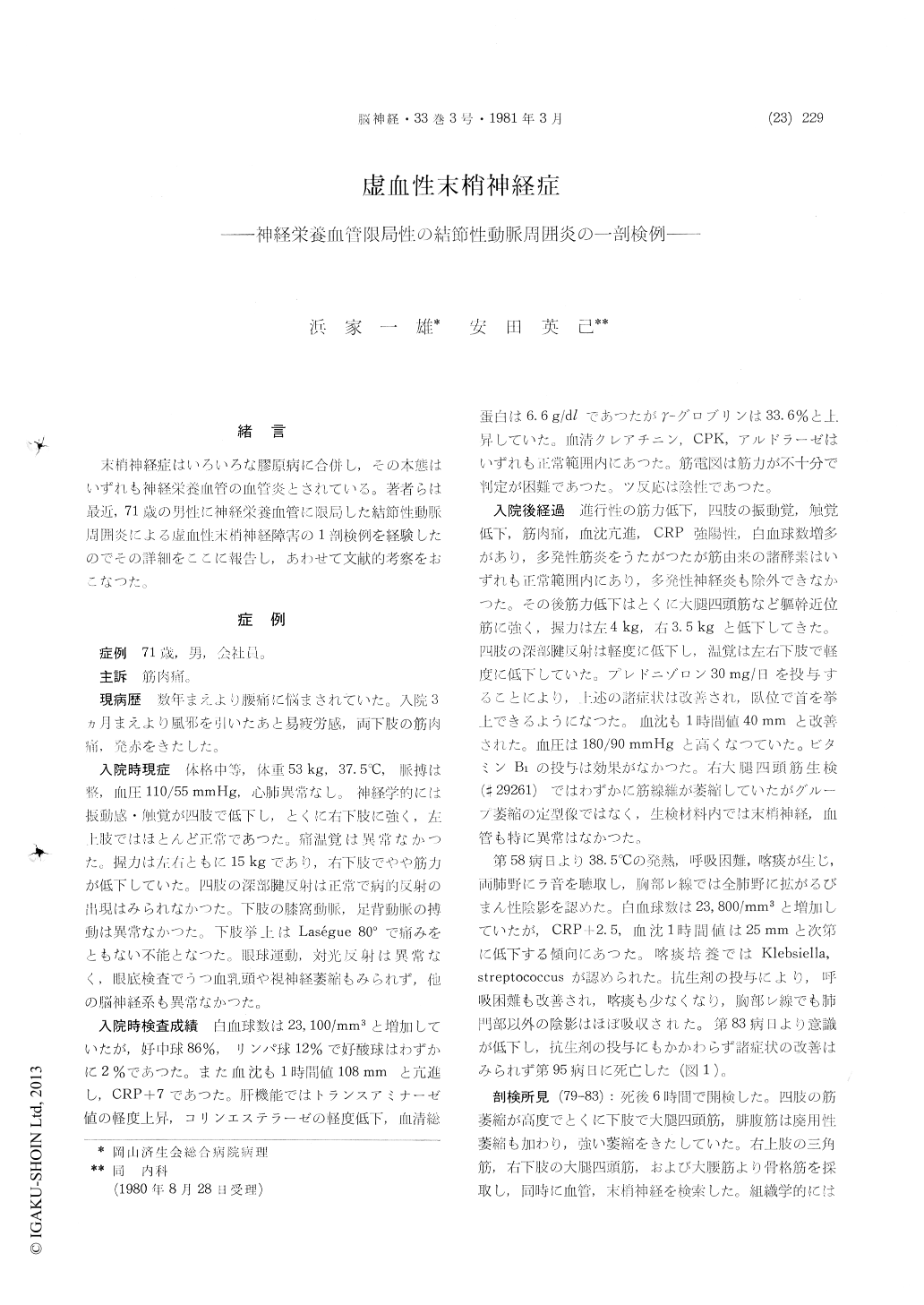
末梢神経症はいろいろな膠原病に合併し,その本態はいずれも神経栄養血管の血管炎とされている。著者らは最近,71歳の男性に神経栄養血管に限局した結節性動脈周囲炎による虚血性末梢神経障害の1剖検例を経験したのでその詳細をここに報告し,あわせて文献的考察をおこなつた。
Anoxic peripheral neuropathy is a common clini-cal manifestation of polyarteritis nodosa. In rare instances, the vascular lesions are limited to the vasa nervosum.
This 71 year-old male complained of progressive myalgia, muscle weakness and paresthesias of all four extremities, more severe in the lower extremi-ties. Laboratory examination revealed marked leukocytosis with neutrophilia, elevated erythrocyte sedimentation rate, positive C-reactive protein, and hypergammaglobulinemia. Serum creatinine phos-phokinase and aldolase were within normal limits. Prednisolone was effective in the temporary im-provement of symptoms. Improvement was also reflected in the laboratory tests. However, the patient's condition soon deteriorated with the development of pulmonary infiltrates, and he ex-pired 6 months after the onset of illness.
Gross autopsy revealed marked atrophy of volun-tary muscles more in the lower extremities. Microscopically, no typical neurogenic group changes were seen ; scattered voluntary muscle fibers exhibited atrophy. Some of the small arteries (150μ to 350μ) running within the voluntary muscles showed marked narrowing or occlusion of the lumens by intimal thickening. There was destruction of the internal elastic lamina, peri-adventitial lymphocy tic and monocytic infiltrations and hemosiderin deposits. Eosinophiles and neu-trophiles were not conspicuous. Fibrinoid necrosis of the vessel wall was not present. The peripheral nerves showed moderate edema within the mye-linated fibres, vacuolar degeneration of myelin,focal axonal swelling and fragmentation, and Schwann cell proliferations. These pathological findings were more prominent in the distal lower extremities. The proximal ischiac nerves were relatively spared. The described vascular changes were not found in the spinal cord, brain, nor in any visceral organs. The terminal cause of death was candida pneumonia.
The vascular changes found in this case were consistent with the healed, end-stage of polyarteritis nodosa. Ischemic neuropathy in polyarteritis nodosa was first described by Wohlwill in 1923. Kernohan reported 5 similar cases in 1938 and, in one of them, the arteritis did not involve the visceral organs. Torvik reported 3 similar cases of poly-arteritis and neuropathy, without visceral involve-ment. In 1948, Lovshin reviewed 29 cases of ischemic neuropathy due to polyarteritis nodosa. Characteristic clinical features included, 1) myalgia, weakness and paresthesias in the extremities, 2) neurologic manifestations included mononeuritis mutiplex and multiple peripheral neuropathies, 3) leukocytosis, elevated erythrocyte sedimentation rate, and strongly positive C-reactive protein.
Approximately 50 per cent of patients with poly-arteritis nodosa show neurological abnormalities. Pathologically, 1) vascular changes are seen in arterioles of 100μ to 300μ in diameter. 2) these changes occur segmentally and are found proximal to the peripheral nerve lesions, 3) peripheral nerves reveal intrafascicular edema, swelling, vacuolation, disintegration or beading of the myelin sheath, proliferations of Schwann cells, and axonal swelling, all of which are found more peripherally. 4) Striated muscles reveal secondary degeneration.
In Japan, 18 cases of ischemic neuropathy second-ary to vasculitis have been reported prior to 1978. However, none of these roports from Japan describe vascular lesions restricted to the vasa nervosum as we have demonstrated in this case.
Copyright © 1981, Igaku-Shoin Ltd. All rights reserved.