Japanese
English
- 有料閲覧
PPV購入案内
1,320円 (1,200円+税10%) こちらは、637ページから647ページの文献です。購入には医書.jp本会員登録が必要です。
会員登録完了後に改めて上記「購入サイトへ」を選択してください。
または「購入サイトへ」選択後に「購入ログイン」、「新規会員登録」の順に進んでください。
会員登録について詳しくはをご確認ください。
- Abstract 文献概要
- 1ページ目 Look Inside
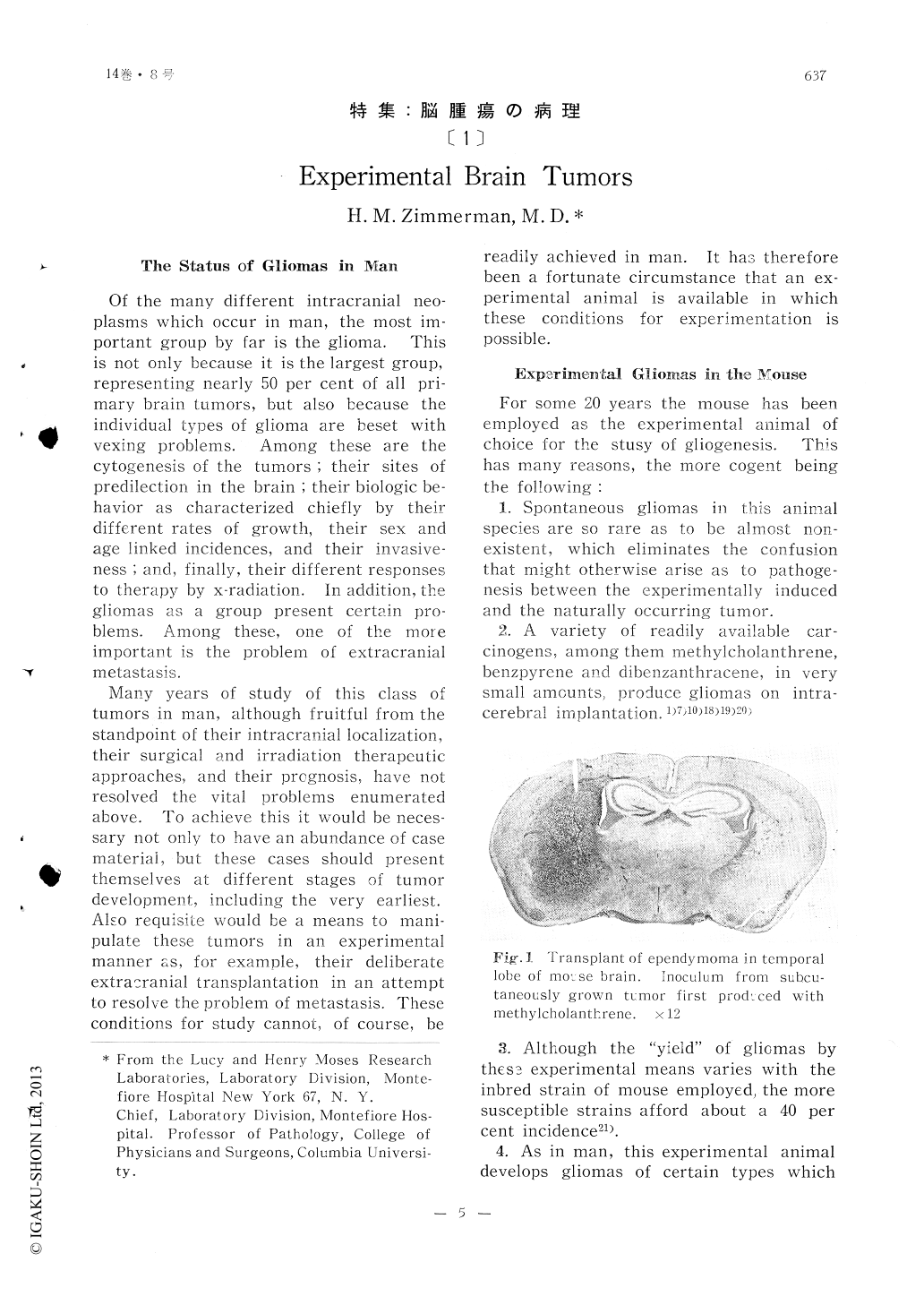
Experiments in gliogenesis with adult inbred strains of mice have eliminated the necessity to explain certain types of ana—plasia on the basis of dedifferentiation of tumor cells. The single cell theory of origin of gliomas is false; "mixed" gliomas develop from the simultaneous multiplica—tion of cells of different type. The "pure" or single cell type of glioma is that which arises from the proliferation of but one single variety of cell, or it occurs when a malignant cell type overgrows and replaces a benign type.
so-called microgliomas have not been produced experimentally.
Cells which reach a certain stage of mor—phologic and functional differentiation no longer can be stimulated to proliferative activity. This is probably the reason why most neurones are incapable of neoplastic transformation. The experimental tumors which resemble the "gangliogliomas" are, in reality, gliomas which have entrapped normal neurones in their midst.
Tumors in the cerebellum which are indistinguishable from human medullobla—stomas have been readily produced in adult mice. It is reasonably certain that these tumors do not arise from embryonic cell rests or bipotential "medulloblasts". They are rather neuroblastomas, derived from the neurones in the granular cell layer of the cerebellar cortex. Occasionally, tumors of this variety also contain proliferating astrocytes and are therefore "mixed" tu—mors.
Abundant experimental evidence is avail—able which indicates that gliogenous tumor cells are incapable of invading blood ves—sels. This seems to be the reason why this class of neoplasm dose not metastasize spontaneously extracranially. Transplants of gliomas, however, grow readily in all viscera and subcutaneously in homologous animal species. Intravenous transplants are often destroyed by what appears to be a local immune tissue response on the part of the host, or even a humoral cytotoxic effect on the injected tumor cells.
Copyright © 1962, Igaku-Shoin Ltd. All rights reserved.