Japanese
English
- 有料閲覧
PPV購入案内
1,320円 (1,200円+税10%) こちらは、219ページから224ページの文献です。購入には医書.jp本会員登録が必要です。
会員登録完了後に改めて上記「購入サイトへ」を選択してください。
または「購入サイトへ」選択後に「購入ログイン」、「新規会員登録」の順に進んでください。
会員登録について詳しくはをご確認ください。
- Abstract 文献概要
- 1ページ目 Look Inside
- 参考文献 Reference
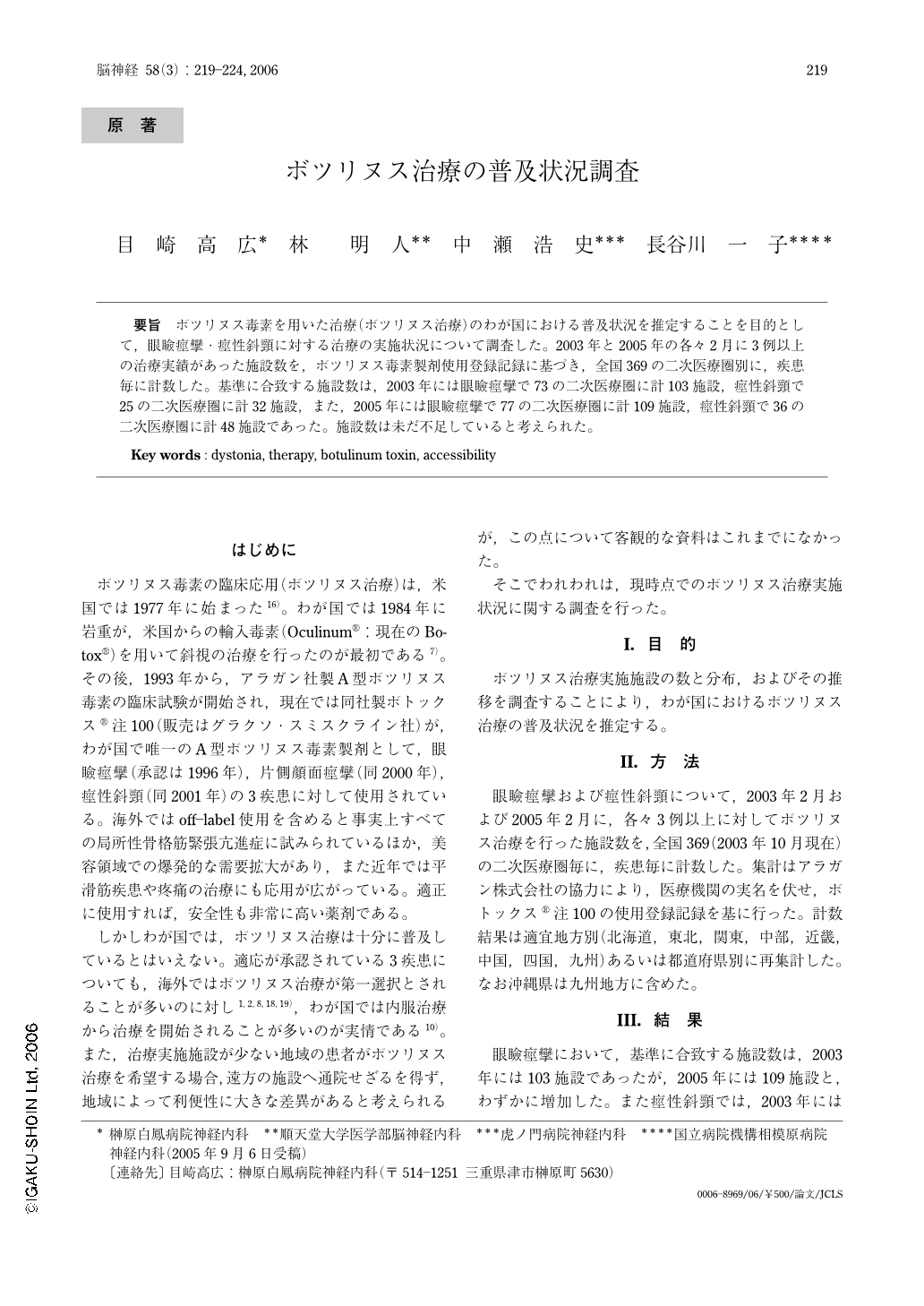
ボツリヌス毒素を用いた治療(ボツリヌス治療)のわが国における普及状況を推定することを目的として,眼瞼痙攣・痙性斜頸に対する治療の実施状況について調査した。2003年と2005年の各々2月に3例以上の治療実績があった施設数を,ボツリヌス毒素製剤使用登録記録に基づき,全国369の二次医療圏別に,疾患毎に計数した。基準に合致する施設数は,2003年には眼瞼痙攣で73の二次医療圏に計103施設,痙性斜頸で25の二次医療圏に計32施設,また,2005年には眼瞼痙攣で77の二次医療圏に計109施設,痙性斜頸で36の二次医療圏に計48施設であった。施設数は未だ不足していると考えられた。
We investigated the accessibility of the therapy with botulinum toxin for blepharospasm or cervical dystonia in Japan. Based on the administration sheet for Botox(R) sent to the Japan Branch of Allergan Co. Ltd. (Tokyo, Japan), the survey was performed about how many institutions treated 3 or more patients with botulinum toxin in each of February, 2003, and February, 2005, for each disease entity. Among 369 secondary medical zones covering all the areas of Japan, 73 zones had 103 institutions that met our criteria for blepharospasm in 2003, and the number slightly increased to 77 zones and 109 institutions in 2005. For cervical dystonia, 25 zones had 32 institutions in 2003, and the number increased to 36 zones and 48 institutions in 2005. Although medical zones with larger population tended to have more institutions, there was great inequality in the accessibility of patients among medical zones. Besides, the number of institutions was thought to be quite insufficient especially for cervical dystonia in most areas of Japan. Larger number of institutions in any region of Japan should be preferably able to treat focal dystonia with botulinum toxin in order to improve patients' accessibility, because this safe and effective therapy can be now regarded as the first line for both blepharospasm and cervical dystonia.
Copyright © 2006, Igaku-Shoin Ltd. All rights reserved.