Japanese
English
- 有料閲覧
PPV購入案内
1,320円 (1,200円+税10%) こちらは、1039ページから1047ページの文献です。購入には医書.jp本会員登録が必要です。
会員登録完了後に改めて上記「購入サイトへ」を選択してください。
または「購入サイトへ」選択後に「購入ログイン」、「新規会員登録」の順に進んでください。
会員登録について詳しくはをご確認ください。
- Abstract 文献概要
- 1ページ目 Look Inside
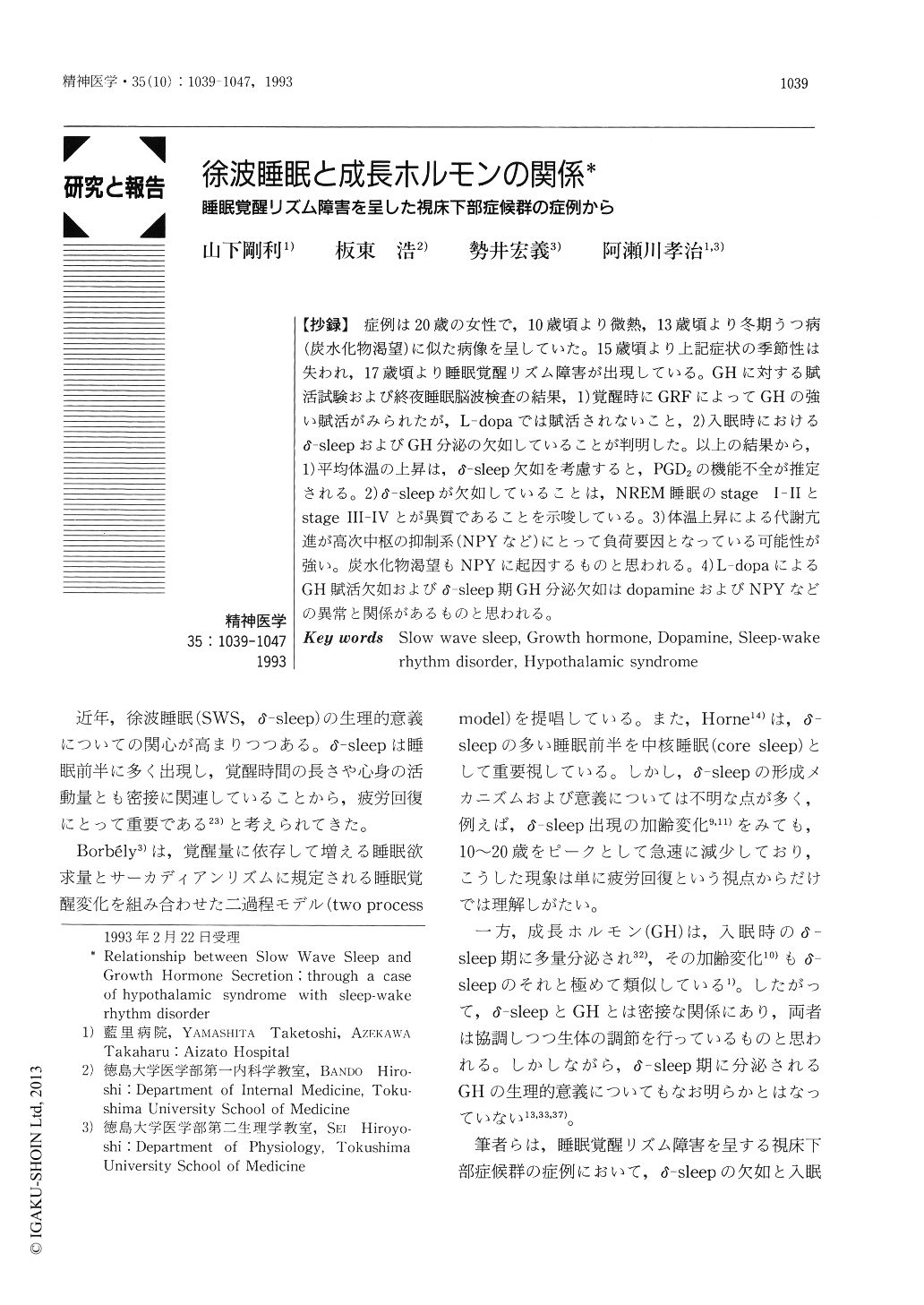
【抄録】 症例は20歳の女性で,10歳頃より微熱,13歳頃より冬期うつ病(炭水化物渇望)に似た病像を呈していた。15歳頃より上記症状の季節性は失われ,17歳頃より睡眠覚醒リズム障害が出現している。GHに対する賦活試験および終夜睡眠脳波検査の結果,1)覚醒時にGRFによってGHの強い賦活がみられたが,L-dopaでは賦活されないこと,2)入眠時におけるδ-sleepおよびGH分泌の欠如していることが判明した。以上の結果から,1)平均体温の上昇は,δ-sleep欠如を考慮すると,PGD2の機能不全が推定される。2)δ-sleepが欠如していることは,NREM睡眠のstage Ⅰ-Ⅱとstage Ⅲ-Ⅳとが異質であることを示唆している。3)体温上昇による代謝亢進が高次中枢の抑制系(NPYなど)にとって負荷要因となっている可能性が強い。炭水化物渇望もNPYに起因するものと思われる。4)L-dopaによるGH賦活欠如およびδ-sleep期GH分泌欠如はdopamineおよびNPYなどの異常と関係があるものと思われる。
A 20-year-old female has had slight (31.1~37.2℃) and sometimes high (39~42℃) fever of unknown origin since she was about 10 years old. She complained of autonomic symptoms, such as headache, nausea, malaise and fatigue in winter, and moreover shown carbohydrate craving (weight gain) suggestive of seasonal affective disorder since the age of 13 years. Such symptoms have continued throughout the year and sleep-wake rhythm disorder has been noticed at the age of 15 and 17 years old, respectively. As a result of growth hormone (GH) provocation tests and sleeping EEG, it has been found that 1) GH is strongly responsive (80 ng/ml or more) to GRF (growth hormone releasing factor) during waking hours, but is not provoked by L-dpoa (peak : 1,6 ng/ml) or insulin (peak: 6,6 ng/ml) and 2) δ-sleep and its related GH secretion are not noticed. These results indicate the following. 1) Taking the absence of δ-sleep into consideration, hyperthermia suggests prostaglandin D2 (PGD2) hypofunction. 2) Absence of δ-sleep suggests that stage Ⅰ-Ⅱ and stage Ⅲ-Ⅳ of NREM sleep are qualitatively different from each other. Further, absence of δ-sleep may be partly ascribable to PGD2 hypofunction. 3) It seems possible that excessive metabolism due to hyperthermia may be a loading factor for the regulatory systems in central nerves, especialy inhibitory systems including neuropeptide Y (NPY) and somatostatin (SRIF). As a result, carbohydrate craving due to increased NPY and absence of GH provocation by insulin which inhibits SRIF secretion, may occur. 4) NPY and SRIF in a loading state (hyperfunction) may inhibit the function of dopamine (DA) antagonizing them, resulting in the absence of GH provocation by L-dopa during waking hours and absence of GH secretion during δ-sleep. On the contrary, since the pulsatory secretion of GH during waking hours and sleep other than δ-sleep is normal, DA may be concerned with the regulation of GH primarily during δ-sleep. 5) Various autonomic symptoms may be ascribable to difficulty in reorganization (renewal) associated with functional and structural change of organism during waking hours because of absence of δ-sleep and its related GH secretion.
Copyright © 1993, Igaku-Shoin Ltd. All rights reserved.