Japanese
English
- 有料閲覧
PPV購入案内
1,320円 (1,200円+税10%) こちらは、1283ページから1292ページの文献です。購入には医書.jp本会員登録が必要です。
会員登録完了後に改めて上記「購入サイトへ」を選択してください。
または「購入サイトへ」選択後に「購入ログイン」、「新規会員登録」の順に進んでください。
会員登録について詳しくはをご確認ください。
- Abstract 文献概要
- 1ページ目 Look Inside
- 参考文献 Reference
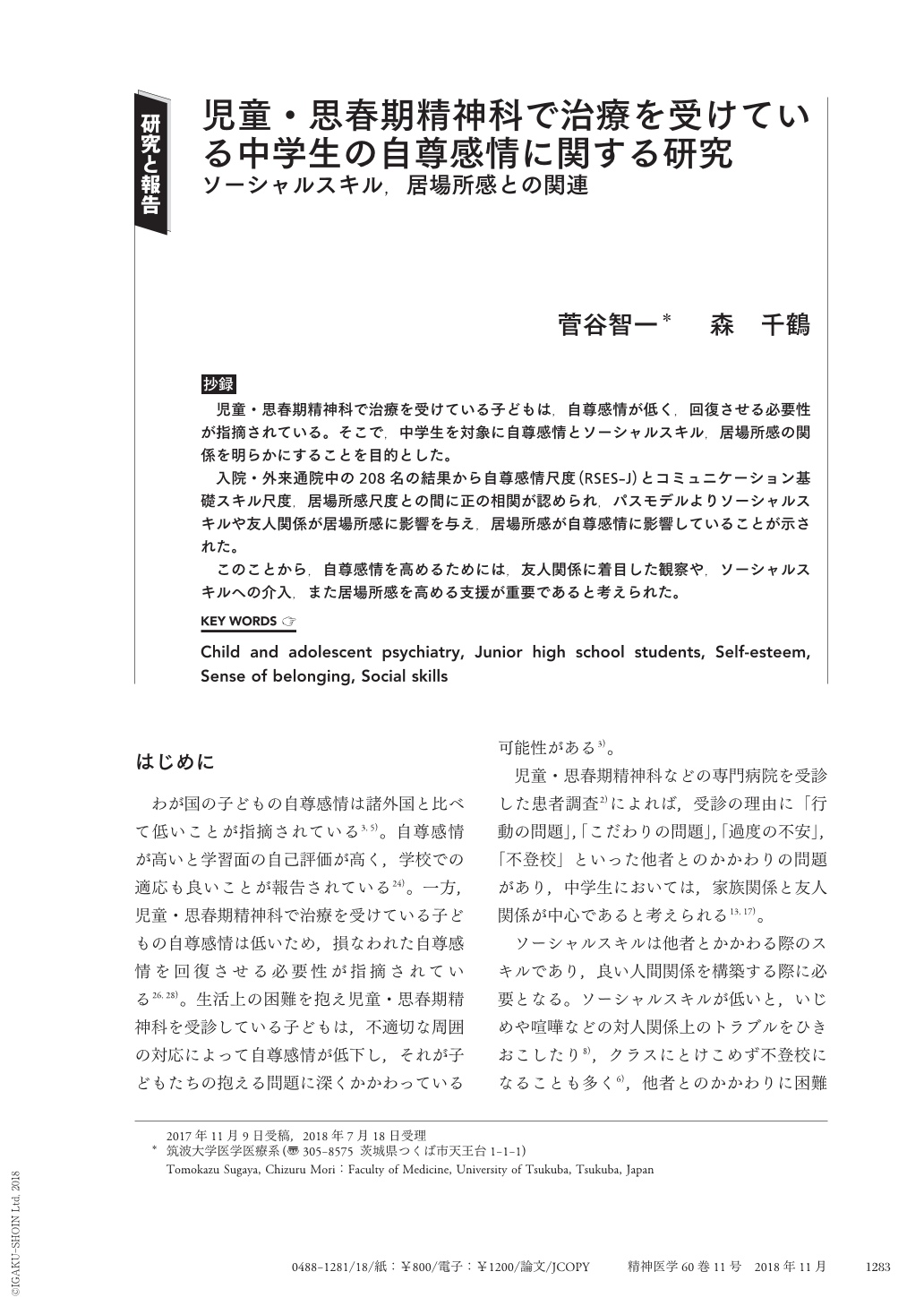
抄録 児童・思春期精神科で治療を受けている子どもは,自尊感情が低く,回復させる必要性が指摘されている。そこで,中学生を対象に自尊感情とソーシャルスキル,居場所感の関係を明らかにすることを目的とした。
入院・外来通院中の208名の結果から自尊感情尺度(RSES-J)とコミュニケーション基礎スキル尺度,居場所感尺度との間に正の相関が認められ,パスモデルよりソーシャルスキルや友人関係が居場所感に影響を与え,居場所感が自尊感情に影響していることが示された。
このことから,自尊感情を高めるためには,友人関係に着目した観察や,ソーシャルスキルへの介入,また居場所感を高める支援が重要であると考えられた。
It has been pointed out that children with mental disorders have low self-esteem and that medical staff should raise it. The purpose of this study was to clarify the relationships among self-esteem, social skills, and sense of belonging in junior high school students with mental disorders.
We investigated the following in 208 inpatient and outpatients:a Japanese version of the Rosenberg Self-Esteem Scale (RSES-J), a Basic Communication Skills Scale for Junior High School Students, a Sense of Belonging Scale, and interpersonal relations. We found a positive correlation between the RESE-J and the Basic Communication Skills Scale and between the RSES-J and the Sense of Belonging Scale. Path analysis showed that social skills and friendship affected sense of belonging and that sense of belonging and social skills affected self-esteem.
Our findings indicate that medical staff should focus on friendship, intervene in social skills, and increase the sense of belonging to build up children's self-esteem.
Copyright © 2018, Igaku-Shoin Ltd. All rights reserved.