Japanese
English
- 有料閲覧
PPV購入案内
1,320円 (1,200円+税10%) こちらは、213ページから219ページの文献です。購入には医書.jp本会員登録が必要です。
会員登録完了後に改めて上記「購入サイトへ」を選択してください。
または「購入サイトへ」選択後に「購入ログイン」、「新規会員登録」の順に進んでください。
会員登録について詳しくはをご確認ください。
- Abstract 文献概要
- 1ページ目 Look Inside
- 参考文献 Reference
- サイト内被引用 Cited by
抄録
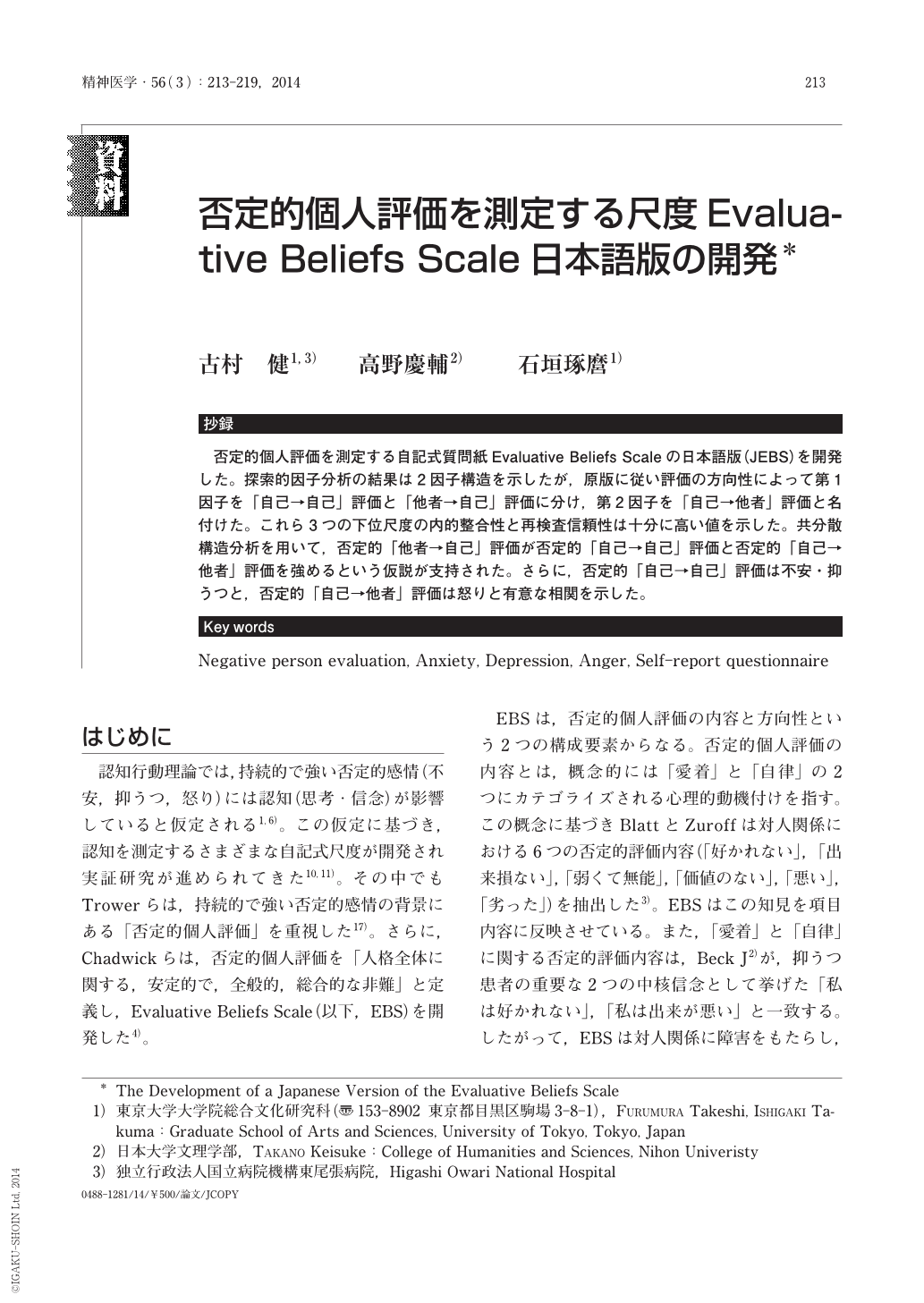
否定的個人評価を測定する自記式質問紙Evaluative Beliefs Scaleの日本語版(JEBS)を開発した。探索的因子分析の結果は2因子構造を示したが,原版に従い評価の方向性によって第1因子を「自己→自己」評価と「他者→自己」評価に分け,第2因子を「自己→他者」評価と名付けた。これら3つの下位尺度の内的整合性と再検査信頼性は十分に高い値を示した。共分散構造分析を用いて,否定的「他者→自己」評価が否定的「自己→自己」評価と否定的「自己→他者」評価を強めるという仮説が支持された。さらに,否定的「自己→自己」評価は不安・抑うつと,否定的「自己→他者」評価は怒りと有意な相関を示した。
The purpose of this study was to develop a Japanese version of the Evaluative Beliefs Scale (JEBS), which is a self-report questionnaire that assesses negative person evaluation. Exploratory factor analysis revealed that the JEBS had a two-factor structure. Following the recommendation of the original version of the Evaluative Beliefs Scale, we divided the first factor into two subscales with respect to the direction of evaluation (“Self→Self” and “Other→Self” evaluations) and named the second factor “Self→Other.” Each subscale of the JEBS showed sufficient internal consistency and test-retest reliability. Structural equation modeling indicated that the “Other→Self” evaluation was associated with increased “Self→Self” and “Self→Other” evaluations. Furthermore, the “Self→Self” evaluation showed significant associations with depression and anxiety, whereas the “Self→Other” evaluation had a specific association with trait anger. These results suggested that the JEBS had high reliability and validity as a measure of negative person evaluation.
Copyright © 2014, Igaku-Shoin Ltd. All rights reserved.