Japanese
English
- 有料閲覧
PPV購入案内
1,320円 (1,200円+税10%) こちらは、1165ページから1174ページの文献です。購入には医書.jp本会員登録が必要です。
会員登録完了後に改めて上記「購入サイトへ」を選択してください。
または「購入サイトへ」選択後に「購入ログイン」、「新規会員登録」の順に進んでください。
会員登録について詳しくはをご確認ください。
- Abstract 文献概要
- 1ページ目 Look Inside
- 参考文献 Reference
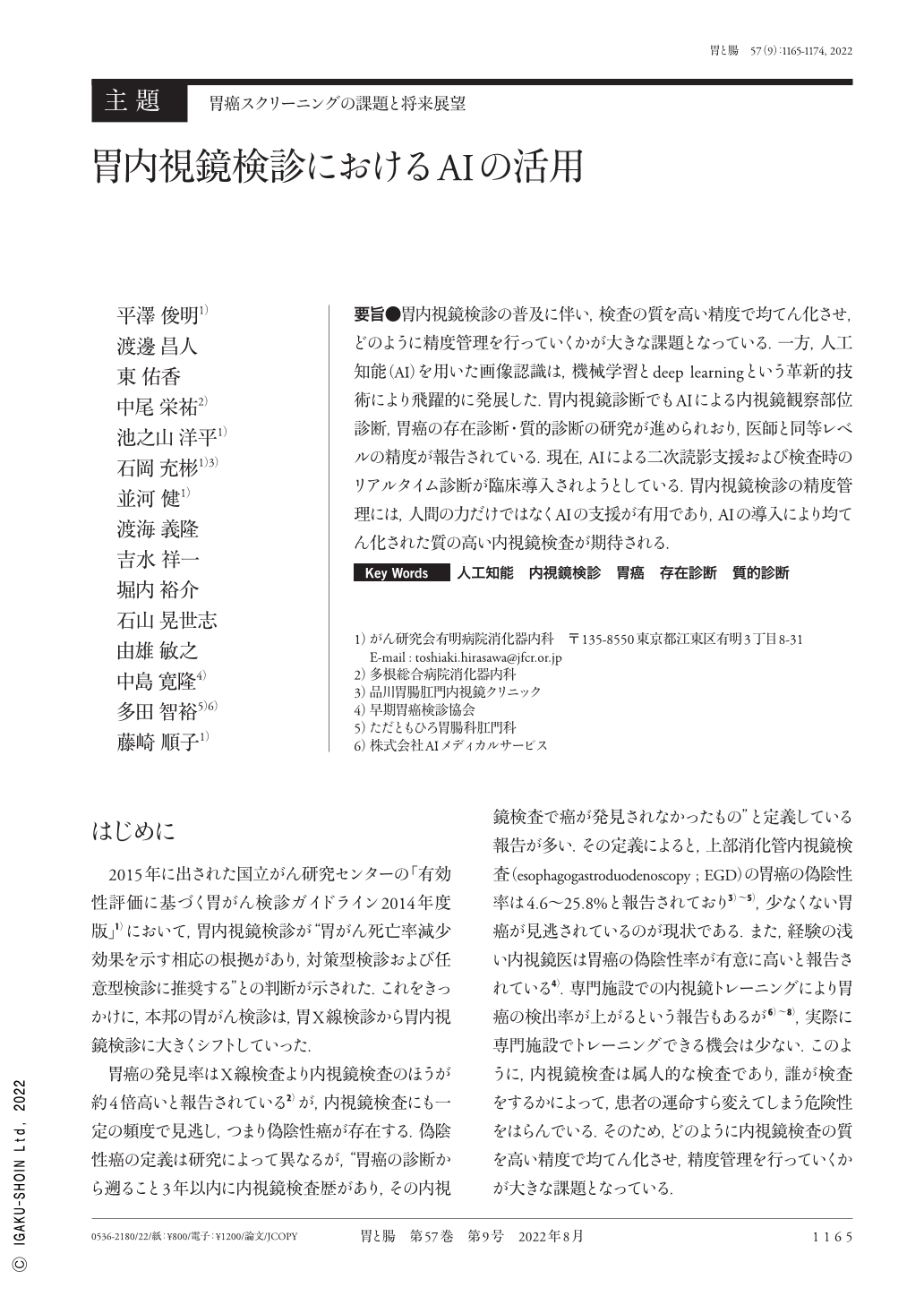
要旨●胃内視鏡検診の普及に伴い,検査の質を高い精度で均てん化させ,どのように精度管理を行っていくかが大きな課題となっている.一方,人工知能(AI)を用いた画像認識は,機械学習とdeep learningという革新的技術により飛躍的に発展した.胃内視鏡診断でもAIによる内視鏡観察部位診断,胃癌の存在診断・質的診断の研究が進められおり,医師と同等レベルの精度が報告されている.現在,AIによる二次読影支援および検査時のリアルタイム診断が臨床導入されようとしている.胃内視鏡検診の精度管理には,人間の力だけではなくAIの支援が有用であり,AIの導入により均てん化された質の高い内視鏡検査が期待される.
Ensuring an equalized examination quality with high accuracy and controlling the examination accuracy are major challenges with the spread of endoscopic screening for gastric cancer. Meanwhile, image recognition using AI(artificial intelligence)has made dramatic progress with innovative machine learning and deep learning technologies. AI has been studied to diagnose endoscopic observation sites and presence, as well as qualitative gastric cancer diagnosis in gastrointestinal endoscopic diagnosis, and its accuracy has been reported as equivalent to that of physicians. Currently, AI is about to be clinically introduced for double-checking after examination and real-time diagnosis during examination. Not only human power but also AI support is useful for quality control of endoscopic screening examinations. Additionally, the introduction of AI is expected to lead to more uniform and higher-quality endoscopic examinations.
Copyright © 2022, Igaku-Shoin Ltd. All rights reserved.