Japanese
English
- 有料閲覧
PPV購入案内
1,320円 (1,200円+税10%) こちらは、48ページから56ページの文献です。購入には医書.jp本会員登録が必要です。
会員登録完了後に改めて上記「購入サイトへ」を選択してください。
または「購入サイトへ」選択後に「購入ログイン」、「新規会員登録」の順に進んでください。
会員登録について詳しくはをご確認ください。
- Abstract 文献概要
- 1ページ目 Look Inside
- 参考文献 Reference
- サイト内被引用 Cited by
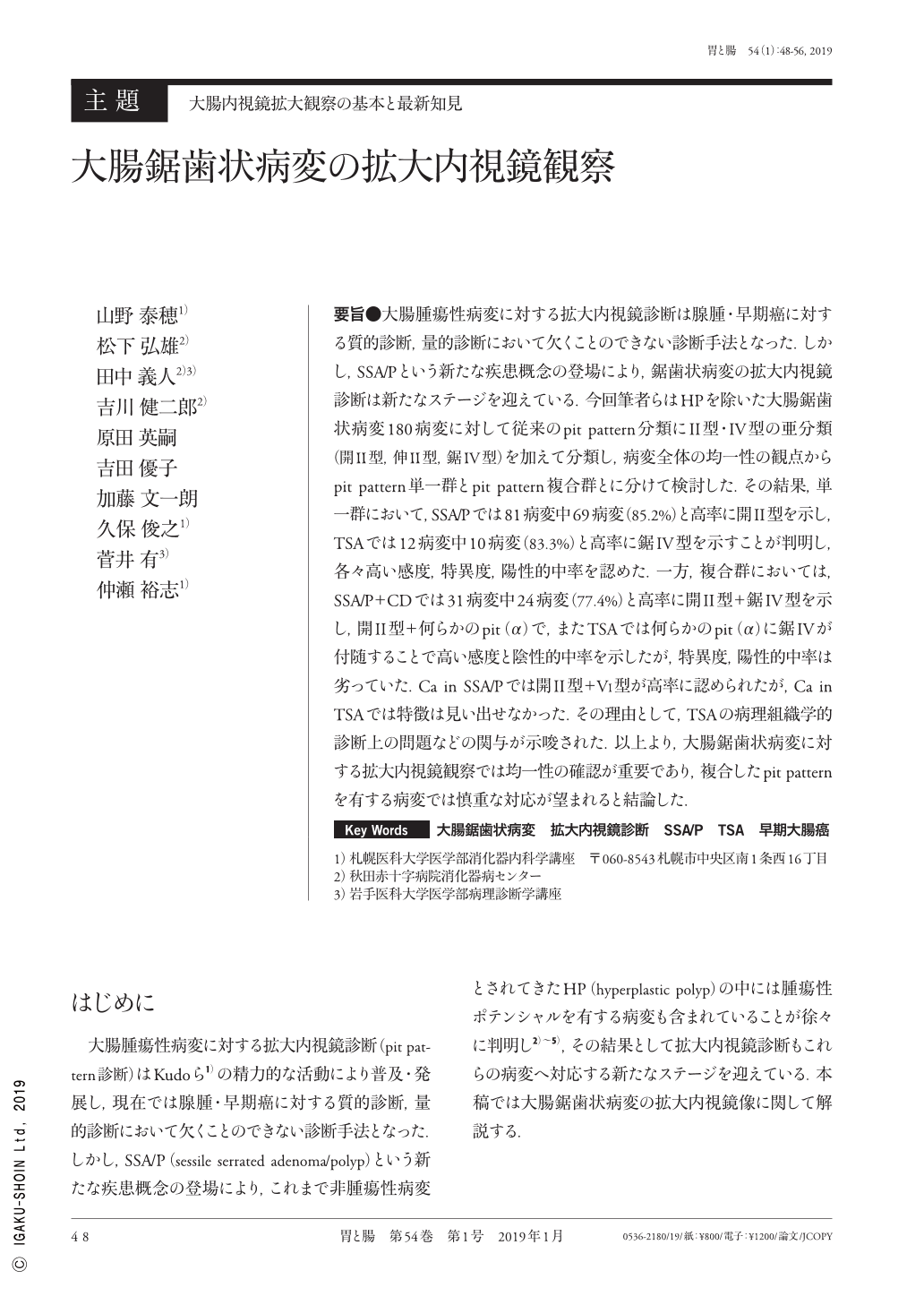
要旨●大腸腫瘍性病変に対する拡大内視鏡診断は腺腫・早期癌に対する質的診断,量的診断において欠くことのできない診断手法となった.しかし,SSA/Pという新たな疾患概念の登場により,鋸歯状病変の拡大内視鏡診断は新たなステージを迎えている.今回筆者らはHPを除いた大腸鋸歯状病変180病変に対して従来のpit pattern分類にII型・IV型の亜分類(開II型,伸II型,鋸IV型)を加えて分類し,病変全体の均一性の観点からpit pattern単一群とpit pattern複合群とに分けて検討した.その結果,単一群において,SSA/Pでは81病変中69病変(85.2%)と高率に開II型を示し,TSAでは12病変中10病変(83.3%)と高率に鋸IV型を示すことが判明し,各々高い感度,特異度,陽性的中率を認めた.一方,複合群においては,SSA/P+CDでは31病変中24病変(77.4%)と高率に開II型+鋸IV型を示し,開II型+何らかのpit(α)で,またTSAでは何らかのpit(α)に鋸IVが付随することで高い感度と陰性的中率を示したが,特異度,陽性的中率は劣っていた.Ca in SSA/Pでは開II型+VI型が高率に認められたが,Ca in TSAでは特徴は見い出せなかった.その理由として,TSAの病理組織学的診断上の問題などの関与が示唆された.以上より,大腸鋸歯状病変に対する拡大内視鏡観察では均一性の確認が重要であり,複合したpit patternを有する病変では慎重な対応が望まれると結論した.
Magnifying endoscopic diagnosis for colon neoplastic lesions has become an indispensable diagnostic method for qualitative and quantitative diagnoses. However, due to the emergence of a new disease concept called SSA/P(sessile serrated adenoma/polyp), endoscopic diagnosis for serrated lesion is entering a new stage. In this study, we classified the conventional pit pattern classification by adding II and IV subclasses(type II-O, type II-L, and type IV serration). For 180 lesions of colorectal serrated lesions excluding HP(hyperplastic polyp), we examined separately homogenous and heterogenous pit groups from the viewpoint of uniformity of the entire lesion. As a result, in the homogenous pit group, SSA/P showed type II-O at a high rate of 85.2% of the 69 lesions in 81 lesions, and TSA(traditional serrated adenoma)showed type IV serration as high as 83.3% of the 10 lesions in 12 lesions. High sensitivity, specificity and positive predictive value were reported. Conversely, in heterogenous pit group, SSA/P with cytological dysplasia showed type II-O+type IV serration at a high rate. In this category, type II-O+α showed high sensitivity and negative predictive value. TSA also had a similar tendency in α+type IV serration, but in both groups the specificity and positive predictive value were inferior. In cancer in SSA/P, type II-O+type VI was observed at a high rate, but no characteristic could be found with cancer in TSA. This might be explained by the involvement of TSA in pathological diagnostic problems. Therefore, we conclude that confirmation of homogeneity is important for magnifying endoscopic observation for colorectal serrated lesions, and careful correspondence is desirable for lesions with heterogenous pits.
Copyright © 2019, Igaku-Shoin Ltd. All rights reserved.