Japanese
English
- 有料閲覧
PPV購入案内
1,320円 (1,200円+税10%) こちらは、963ページから968ページの文献です。購入には医書.jp本会員登録が必要です。
会員登録完了後に改めて上記「購入サイトへ」を選択してください。
または「購入サイトへ」選択後に「購入ログイン」、「新規会員登録」の順に進んでください。
会員登録について詳しくはをご確認ください。
- Abstract 文献概要
- 1ページ目 Look Inside
近年,吐血症例に対する緊急内視鏡検査の進歩と普及に伴い,内視鏡的に発見・診断されるMallory-Weiss症候群の症例が増加してきている.
最近,われわれは暴食後に持続性の悪心・嘔吐と頻回の吐血をきたし,緊急内視鏡検査で食道下部から胃噴門部へ達する長い線状の粘膜裂創に,多発性出血性胃十二指腸ビランや食道胃噴門接合部潰瘍を伴ったMallory-Weiss症候群を経験したので,文献的考察を加えながら,本症候群の幾つかの問題点をとりあげてみた.
Since in 1929 Mallory & Weiss described 15 patients in whom massive upper gastrointestinal bleeding developed after an alcoholic debauch associated with nausea and vomiting, an increasing number of Mallory-Weiss syndrome has been reported with recent remarkable advances of endoscopic examination. Up to date 229 cases of this syndrome in English World, and 59 cases in Japan have been already reported.
In this paper is reported a follow-up case of Mallory-Weiss syndrome by endoscopy, and we have also collected the literature hitherto published in Japan and English World, with some comments on its etiology, incidence, site of organ, pertinent diagnosis and therapy.
Case: a 47-year-old man.
He was healthy by nature, but he was a heavy drinker. The midnight before the admission he drank two bottles of Japanese wine amounting to about 1,000 ml. At 2:00 a.m. he awoke with sudden nausea, retching and vomiting colorless liquid. He continuously retched until the next morning. At 8:00 a.m. he vomited four times dark and bright red blood.
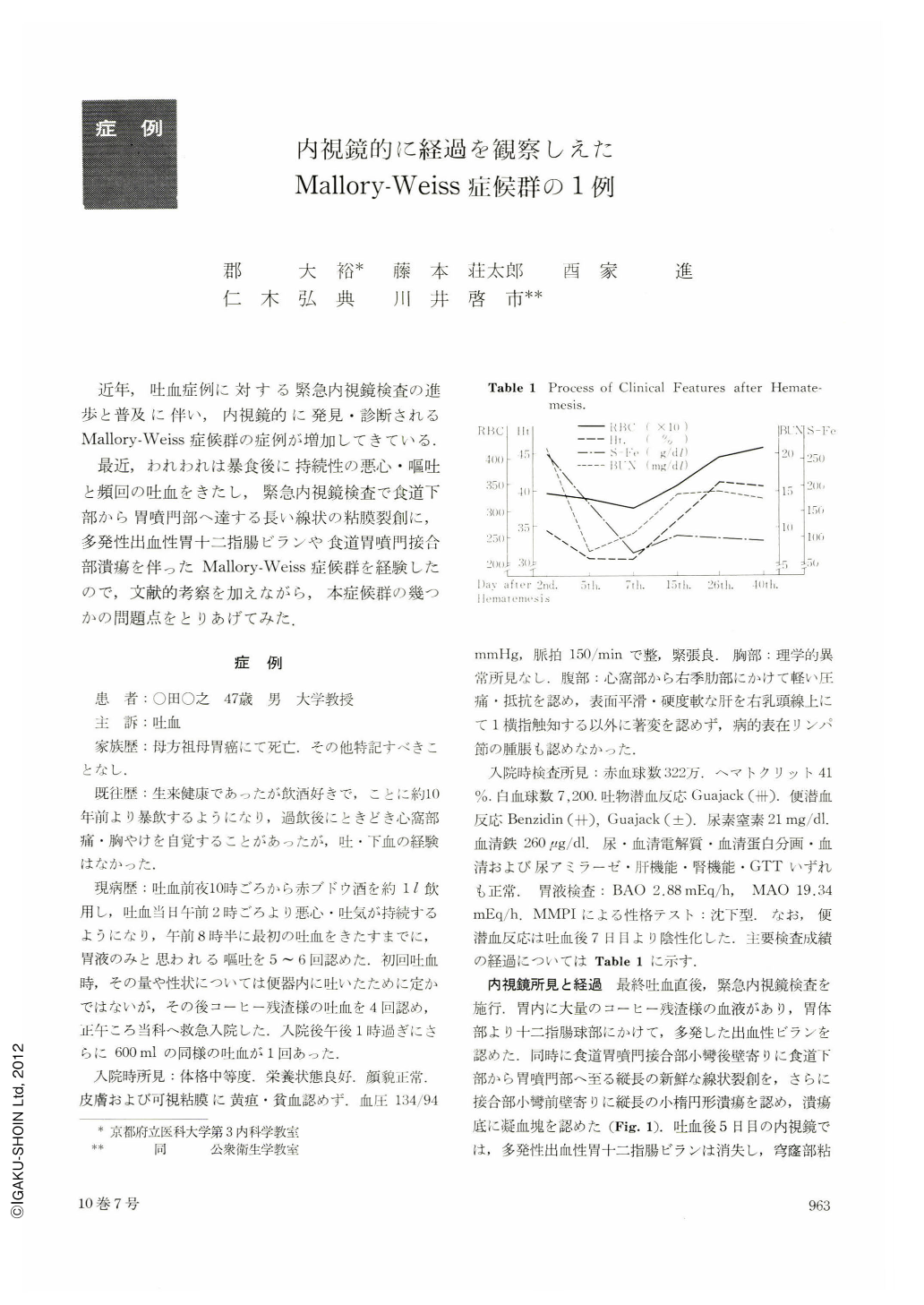
At 1:00 p.m. he was admitted to our University hospital where he vomited 600 ml of dark red blood after the admission. Immediately an endoscopic examination was performed, and a long linear laceration from the lower part of the esophagus to the cardia, a round ulceration at the esophagogastric junction and multiple hemorrhagic gastroduodenal erosions were found. But the patient remained in good condition, and no transfusion was given. By the internal treatment under the control of endoscopy, which was performed seven times during the healing process, the laceration and other ulcerative lesions were seen to heal rapidly. Fourty-four days after the gastrointestinal bleeding, the laceration healed up and only a reddish linear sulcus remained on its surface.
Copyright © 1975, Igaku-Shoin Ltd. All rights reserved.