Japanese
English
- 有料閲覧
PPV購入案内
1,320円 (1,200円+税10%) こちらは、817ページから823ページの文献です。購入には医書.jp本会員登録が必要です。
会員登録完了後に改めて上記「購入サイトへ」を選択してください。
または「購入サイトへ」選択後に「購入ログイン」、「新規会員登録」の順に進んでください。
会員登録について詳しくはをご確認ください。
- Abstract 文献概要
- 1ページ目 Look Inside
- サイト内被引用 Cited by
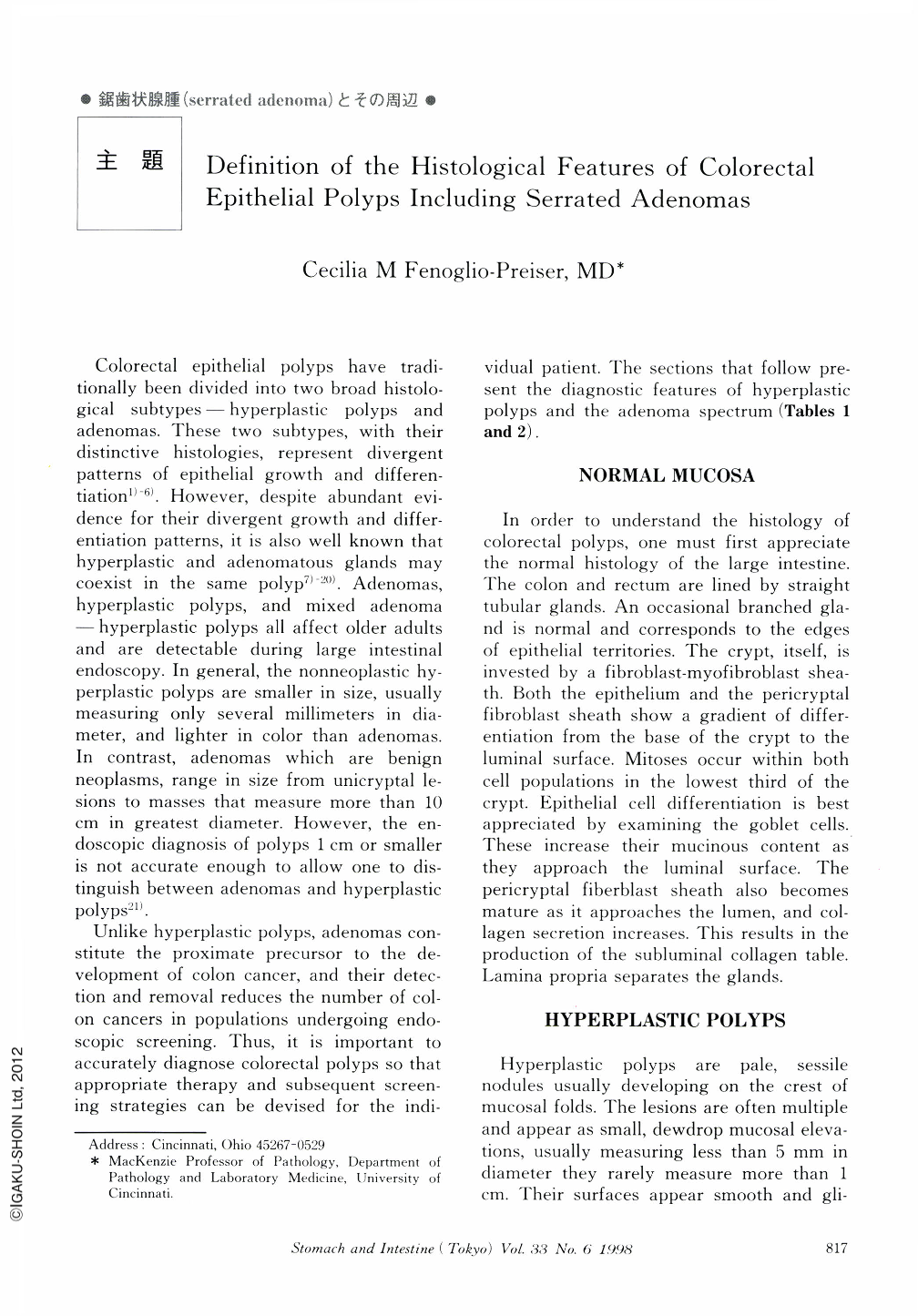
Colorectal epithelial polyps have traditionally been divided into two broad histological subtypes-hyperplastic polyps and adenomas. These two subtypes, with their distinctive histologies, represent divergent patterns of epithelial growth and differentiation1)-6). However, despite abundant evidence for their divergent growth and differentiation patterns, it is also well known that hyperplastic and adenomatous glands may coexist in the same polyp7)-20). Adenomas, hyperplastic polyps, and mixed adenoma -hyperplastic polyps all affect older adults and are detectable during large intestinal endoscopy. In general, the nonneoplastic hyperplastic polyps are smaller in size, usually measuring only several millimeters in diameter, and lighter in color than adenomas. In contrast, adenomas which are benign neoplasms, range in size from unicryptal lesions to masses that measure more than 10 cm in greatest diameter. However, the endoscopic diagnosis of polyps 1 cm or smaller is not accurate enough to allow one to distinguish between adenomas and hyperplastic polyps21).
Unlike hyperplastic polyps, adenomas constitute the proximate precursor to the development of colon cancer, and their detection and removal reduces the number of colon cancers in populations undergoing endoscopic screening. Thus, it is important to accurately diagnose colorectal polyps so that appropriate therapy and subsequent screening strategies can be devised for the individual patient. The sections that follow present the diagnostic features of hyperplastic polyps and the adenoma spectrum (Tables 1 and 2).
Colorectal epithelial polyps have traditionally been divided into two broad histological subtypes-hyperplastic polyps and adenomas. These two subtypes, with their distinctive histologies, represent divergent patterns of epithelial growth and differentiation1)-6). However, despite abundant evidence for their divergent growth and differentiation patterns, it is also well known that hyperplastic and adenomatous glands may coexist in the same polyp7)-20). Adenomas, hyperplastic polyps, and mixed adenoma -hyperplastic polyps all affect older adults and are detectable during large intestinal endoscopy. In general, the nonneoplastic hyperplastic polyps are smaller in size, usually measuring only several millimeters in diameter, and lighter in color than adenomas. In contrast, adenomas which are benign neoplasms, range in size from unicryptal lesions to masses that measure more than 10 cm in greatest diameter. However, the endoscopic diagnosis of polyps 1 cm or smaller is not accurate enough to allow one to distinguish between adenomas and hyperplastic polyps21).
Unlike hyperplastic polyps, adenomas constitute the proximate precursor to the development of colon cancer, and their detection and removal reduces the number of colon cancers in populations undergoing endoscopic screening. Thus, it is important to accurately diagnose colorectal polyps so that appropriate therapy and subsequent screening strategies can be devised for the individual patient. The sections that follow present the diagnostic features of hyperplastic polyps and the adenoma spectrum (Tables 1 and 2).
Copyright © 1998, Igaku-Shoin Ltd. All rights reserved.