Japanese
English
- 有料閲覧
PPV購入案内
1,320円 (1,200円+税10%) こちらは、671ページから679ページの文献です。購入には医書.jp本会員登録が必要です。
会員登録完了後に改めて上記「購入サイトへ」を選択してください。
または「購入サイトへ」選択後に「購入ログイン」、「新規会員登録」の順に進んでください。
会員登録について詳しくはをご確認ください。
- Abstract 文献概要
- 1ページ目 Look Inside
- 参考文献 Reference
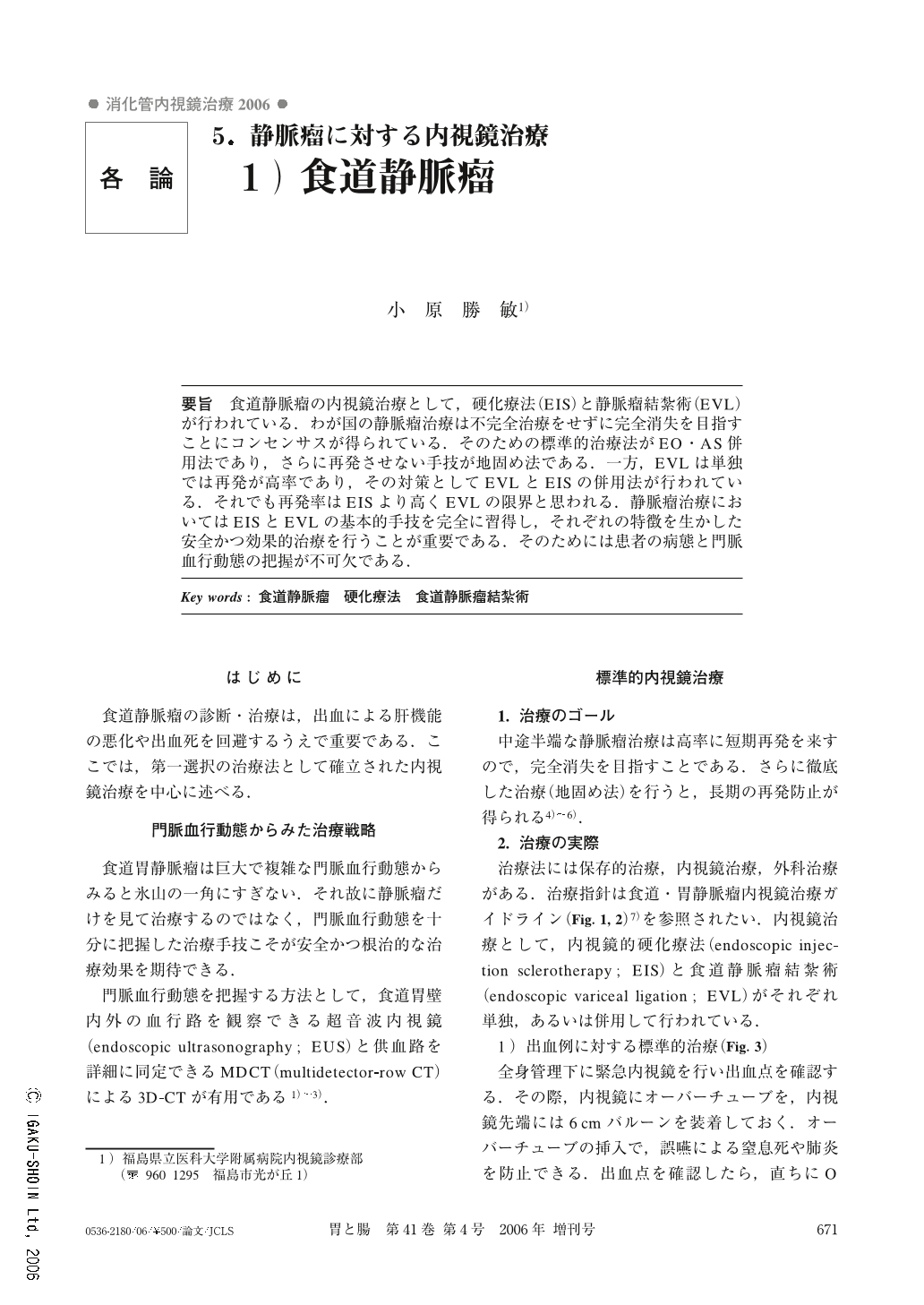
要旨 食道静脈瘤の内視鏡治療として,硬化療法(EIS)と静脈瘤結紮術(EVL)が行われている.わが国の静脈瘤治療は不完全治療をせずに完全消失を目指すことにコンセンサスが得られている.そのための標準的治療法がEO・AS併用法であり,さらに再発させない手技が地固め法である.一方,EVLは単独では再発が高率であり,その対策としてEVLとEISの併用法が行われている.それでも再発率はEISより高くEVLの限界と思われる.静脈瘤治療においてはEISとEVLの基本的手技を完全に習得し,それぞれの特徴を生かした安全かつ効果的治療を行うことが重要である.そのためには患者の病態と門脈血行動態の把握が不可欠である.
Endoscopic injection sclerotherapy (EIS) and endoscopic variceal ligation (EVL) are two major endoscopic treatments of esophageal varices. In Japan, there is a large consensus that the aim of variceal treatments is to achieve complete eradication. EO-AS combination therapy is considered a standard procedure, further followed by mucosal fibrosing procedures to prevent variceal recurrence. As the variceal recurrence rate is high when EVL is used as a single first-line therapy, combination therapy of EVL and EIS is performed to reduce variceal recurrence. Nevertheless, the recurrence rate associated with EVL still remains higher than the rate with EIS alone, and thus the efficacy of EVL appears to be limited. It is important that safe and effective variceal treatments be performed considering the merits and demerits of both EIS and EVL, and that the operator be fully qualified for their basic procedures. Furthermore, it is essential to correctly assess the patients' clinical status and portal hemodynamics.
Copyright © 2006, Igaku-Shoin Ltd. All rights reserved.