Japanese
English
- 有料閲覧
PPV購入案内
1,320円 (1,200円+税10%) こちらは、1726ページから1743ページの文献です。購入には医書.jp本会員登録が必要です。
会員登録完了後に改めて上記「購入サイトへ」を選択してください。
または「購入サイトへ」選択後に「購入ログイン」、「新規会員登録」の順に進んでください。
会員登録について詳しくはをご確認ください。
- Abstract 文献概要
- 1ページ目 Look Inside
- 参考文献 Reference
- サイト内被引用 Cited by
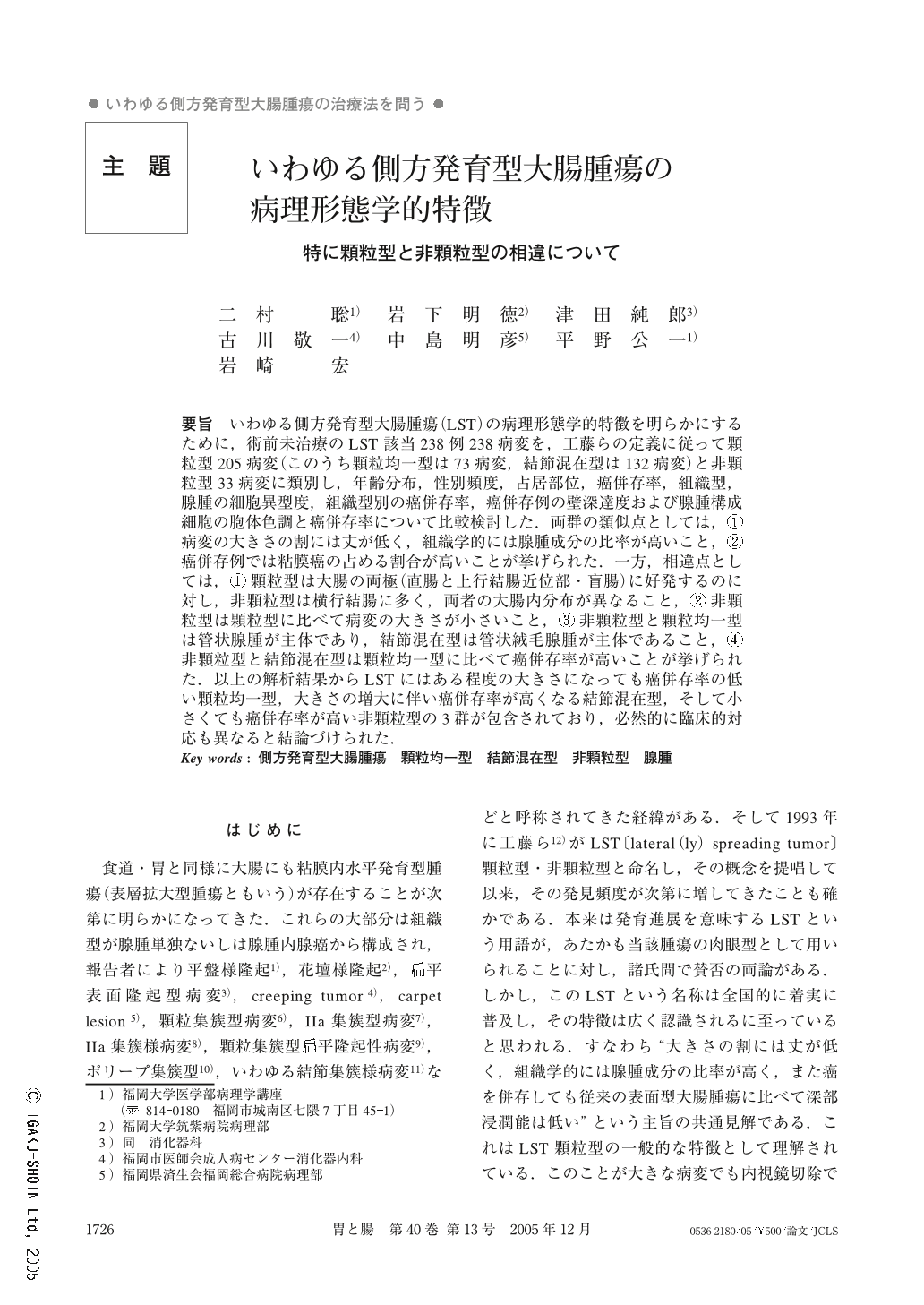
要旨
いわゆる側方発育型大腸腫瘍(LST)の病理形態学的特徴を明らかにするために,術前未治療のLST該当238例238病変を,工藤らの定義に従って顆粒型205病変(このうち顆粒均一型は73病変,結節混在型は132病変)と非顆粒型33病変に類別し,年齢分布,性別頻度,占居部位,癌併存率,組織型,腺腫の細胞異型度,組織型別の癌併存率,癌併存例の壁深達度および腺腫構成細胞の胞体色調と癌併存率について比較検討した.両群の類似点としては①病変の大きさの割には丈が低く,組織学的には腺腫成分の比率が高いこと②癌併存例では粘膜癌の占める割合が高いことが挙げられた.一方,相違点としては,①顆粒型は大腸の両極(直腸と上行結腸近位部・盲腸)に好発するのに対し,非顆粒型は横行結腸に多く,両者の大腸内分布が異なること②非顆粒型は顆粒型に比べて病変の大きさが小さいこと,③非顆粒型と顆粒均一型は管状腺腫が主体であり,結節混在型は管状絨毛腺腫が主体であること④非顆粒型と結節混在型は顆粒均一型に比べて癌併存率が高いことが挙げられた.以上の解析結果からLSTにはある程度の大きさになっても癌併存率の低い顆粒均一型,大きさの増大に伴い癌併存率が高くなる結節混在型,そして小さくても癌併存率が高い非顆粒型の3群が包含されており,必然的に臨床的対応も異なると結論づけられた.
Two-hundred and thirty-eight lesions of colorectal laterally spreading tumors (LSTs) from 238 patients without preoperative treatment were studied histopathologically to analyze differences and similarities between the three macroscopic types. The colorectal LSTs were collected from 1999 through 2005 and were classified as follows : 73 lesions of homogenous granular type, 132 lesions of nodular mixed type, and 33 lesions of non-granular type. The major anatomical sites of the granular type were the rectum, the proximal region of ascending colon and cecum, while the non-granular type was commonly located in the transverse colon. Regardless of their maximum diameter, LSTs were low in height, and small-sized lesions (e.g. non-granular type) were also included. In all LST cases, the intramucosal spreading area contained an adenomatous component. On histologic examination, non-granular types showed tubular adenoma with severe cytologic atypia despite their relatively small size. In contrast, granular types showed tubular and/or tubulovillous adenoma with moderate cytologic atypia despite their relatively large size. Among the LSTs cases, both nodular mixed type and non-granular type contained a carcinomatous component with high frequency as compared with the homogenous granular type. Target biopsy from erosive and ulcerative areas of the LST is an effective measure for detecting carcinomatous component. LSTs were classified into three groups according to incidence of associated carcinoma. A different clinical management is needed to cope with these types. The conclusion is that to classify LSTs into three groups is worthwhile from the standpoint of a pathologist.
Copyright © 2005, Igaku-Shoin Ltd. All rights reserved.