Japanese
English
- 有料閲覧
- Abstract 文献概要
- 1ページ目 Look Inside
- 参考文献 Reference
抄録
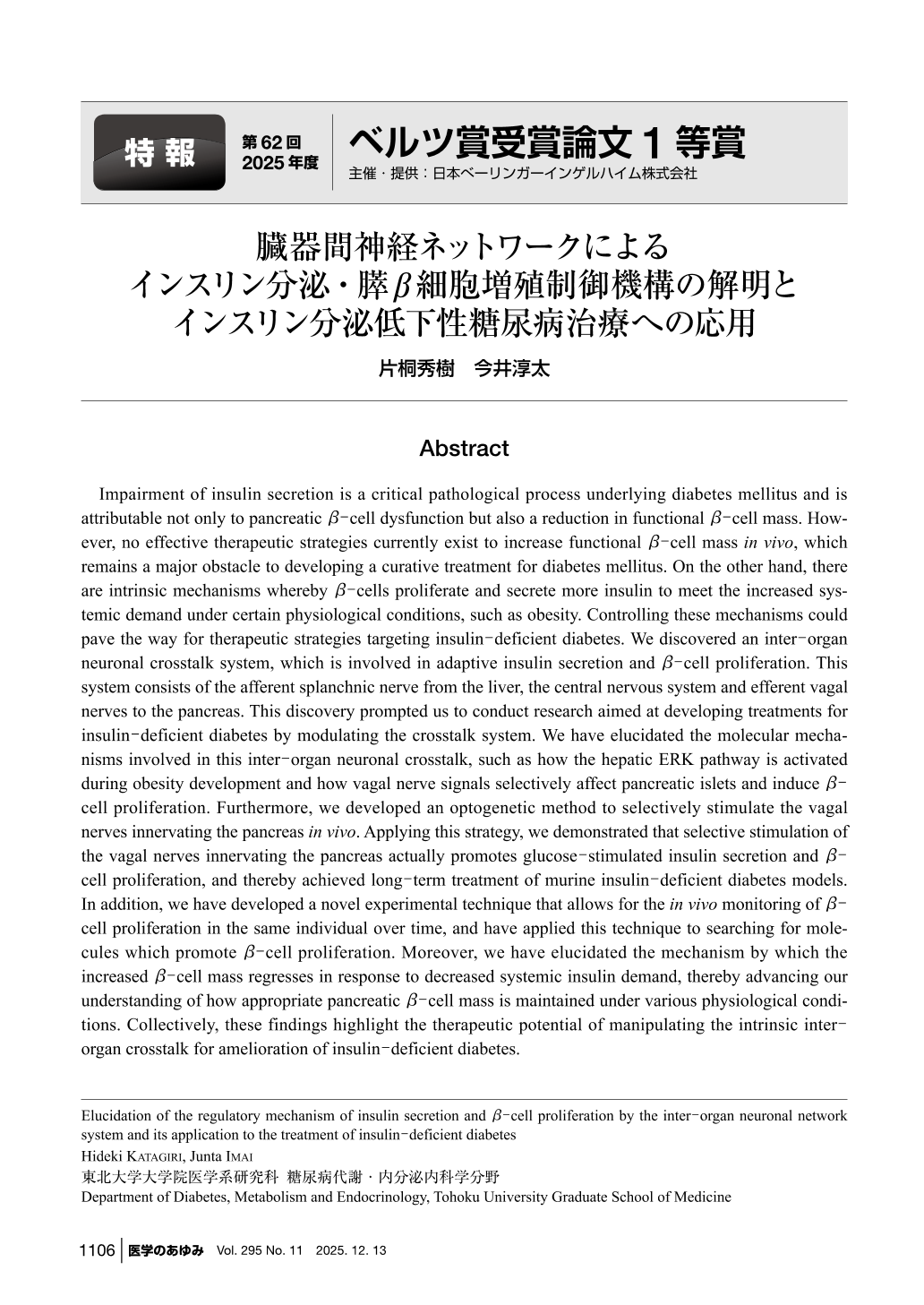
インスリン分泌低下は糖尿病の重要な病態基盤であり,膵β細胞機能の低下と膵β細胞量(数)の減少によって引き起こされる.このうち,膵β細胞量の減少によるインスリン分泌低下性糖尿病に対して膵β細胞を増量する薬物療法はなく,これは糖尿病根治療法開発が進まない大きな要因となっている.一方,生物の体には,肥満などの際に膵β細胞が代償性に増殖しインスリン分泌を増加させることによって血糖値の上昇を抑制する仕組みが存在する.この仕組みを人為的に制御することができれば,膵β細胞量減少を基盤としたインスリン分泌低下性糖尿病の治療開発につながると考えられる.筆者らは,臓器間ネットワークの研究から,肝臓のERK(extracellular-signal regulated kinase)経路が活性化することが起点となり,内臓神経求心性線維→中枢神経→迷走神経遠心性線維という神経経路を介して糖応答性インスリン分泌や膵β細胞増殖を促進するという,肝臓-膵β細胞間神経ネットワークを明らかにし,これが肥満時の代償性膵β細胞反応として機能していることを示した.また,この神経ネットワークにおいて,肥満の際に肝臓ERK経路が活性化する腸管を介したメカニズム,迷走神経の膵島選択性につながる解剖学的特徴,迷走神経シグナルが膵β細胞増殖を誘導する分子メカニズムなどを明らかにしてきた.さらに,オプトジェネティクスの手法を用いてマウス個体において膵臓に分布する迷走神経を選択的に刺激する手法を開発し,膵臓迷走神経を刺激することによりインスリン分泌や膵β細胞増殖が促進されることを示した.そして,インスリン分泌低下性糖尿病モデルマウスの長期にわたる治療に成功し,現在,迷走神経刺激によるヒトでの効果の検証が進んでいる.また,化合物での臓器間ネットワークの制御を目指して,in vivoにおける膵β細胞の増殖を同一個体で経時的に観察することができる新たな実験手法を開発し,求心性神経に働きかけ膵β細胞の増殖を促進する分子の探索につなげている.それに加え,増加した膵β細胞量を環境変化よるインスリンの需要低下に応じて減少させるメカニズムも明らかにし,適切な膵β細胞量が維持される仕組みの一端を解明した.以上の成果から,体に内在する臓器間ネットワークの仕組みを活用することにより,インスリン分泌低下性糖尿病の根治治療法へとつながることが期待される.
Abstract
Impairment of insulin secretion is a critical pathological process underlying diabetes mellitus and is attributable not only to pancreatic β-cell dysfunction but also a reduction in functional β-cell mass. However, no effective therapeutic strategies currently exist to increase functional β-cell mass in vivo, which remains a major obstacle to developing a curative treatment for diabetes mellitus. On the other hand, there are intrinsic mechanisms whereby β-cells proliferate and secrete more insulin to meet the increased systemic demand under certain physiological conditions, such as obesity. Controlling these mechanisms could pave the way for therapeutic strategies targeting insulin-deficient diabetes. We discovered an inter-organ neuronal crosstalk system, which is involved in adaptive insulin secretion and β-cell proliferation. This system consists of the afferent splanchnic nerve from the liver, the central nervous system and efferent vagal nerves to the pancreas. This discovery prompted us to conduct research aimed at developing treatments for insulin-deficient diabetes by modulating the crosstalk system. We have elucidated the molecular mechanisms involved in this inter-organ neuronal crosstalk, such as how the hepatic ERK pathway is activated during obesity development and how vagal nerve signals selectively affect pancreatic islets and induce β-cell proliferation. Furthermore, we developed an optogenetic method to selectively stimulate the vagal nerves innervating the pancreas in vivo. Applying this strategy, we demonstrated that selective stimulation of the vagal nerves innervating the pancreas actually promotes glucose-stimulated insulin secretion and β-cell proliferation, and thereby achieved long-term treatment of murine insulin-deficient diabetes models. In addition, we have developed a novel experimental technique that allows for the in vivo monitoring of β-cell proliferation in the same individual over time, and have applied this technique to searching for molecules which promote β-cell proliferation. Moreover, we have elucidated the mechanism by which the increased β-cell mass regresses in response to decreased systemic insulin demand, thereby advancing our understanding of how appropriate pancreatic β-cell mass is maintained under various physiological conditions. Collectively, these findings highlight the therapeutic potential of manipulating the intrinsic inter-organ crosstalk for amelioration of insulin-deficient diabetes.
Copyright © 2025 Ishiyaku Pub,Inc. All Rights Reserved.