Japanese
English
- 有料閲覧
- Abstract 文献概要
- 1ページ目 Look Inside
- 参考文献 Reference
抄録
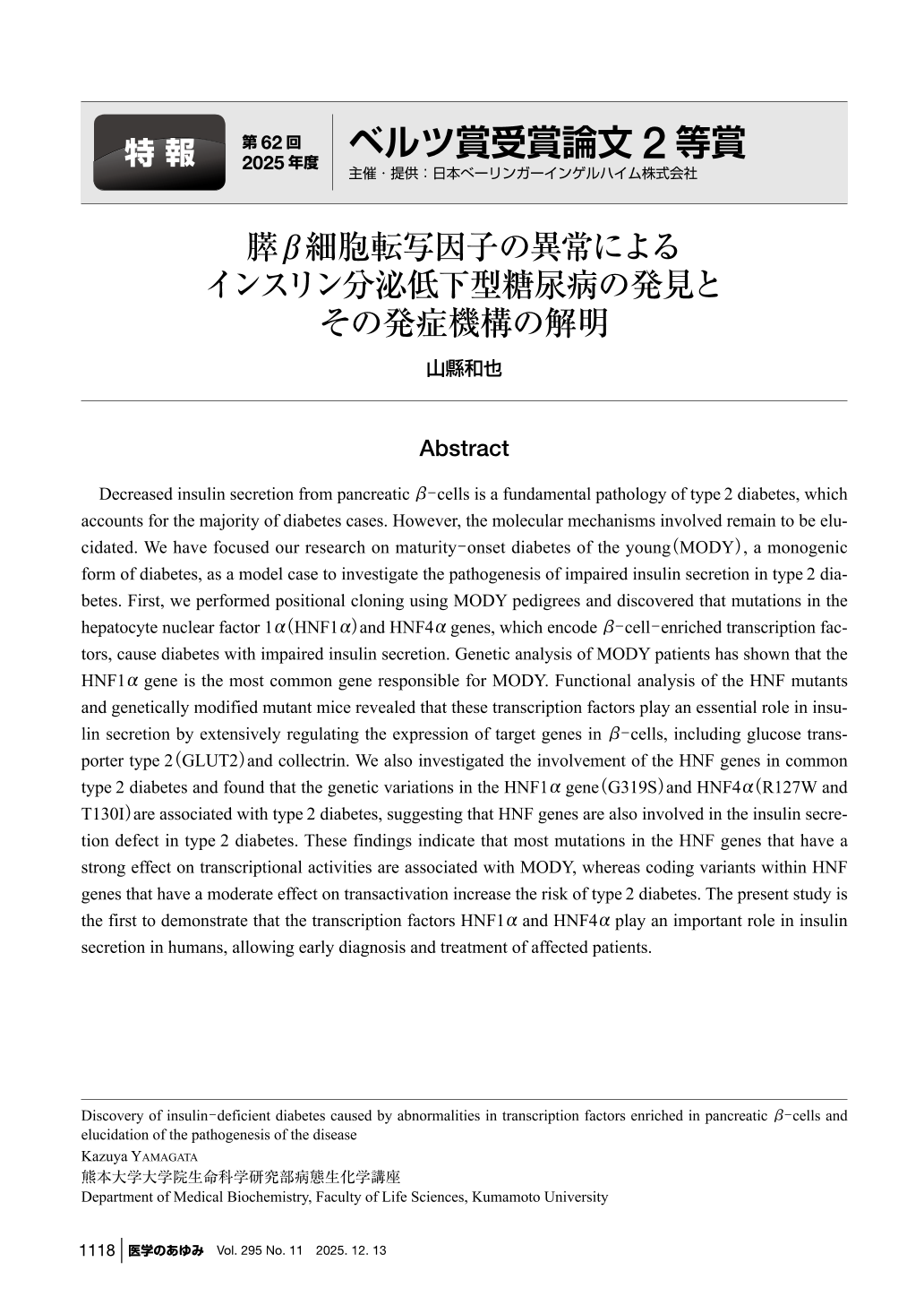
膵β細胞におけるインスリン分泌低下は糖尿病の大部分を占める2型糖尿病の基本的病態であるが,その分子機構は不明である.筆者はMODY(maturity-onset diabetes of the young)とよばれる単一遺伝子異常による糖尿病をモデルケースとすることでインスリン分泌低下の成因についての研究を進めた.まず筆者らはMODY家系を用いたポジショナルクローニングを行い,HNF1α(hepatocyte nuclear factor 1α)およびHNF4αというβ細胞発現転写因子をコードするHNF1AおよびHNF4Aの遺伝子異常によりインスリン分泌低下型の糖尿病が発症することを発見した.MODY患者の遺伝子検索の結果,HNF1A遺伝子は最も頻度の高いMODY原因遺伝子であった.また,患者で同定した変異体や遺伝子改変マウスを用いた検討の結果,HNF転写因子は糖輸送担体GLUT2や開口放出因子コレクトリンなどインスリン分泌に重要な遺伝子の発現を統合的に制御することで,インスリン分泌を正常に保っていることを筆者らは明らかにした.さらに,一般の2型糖尿病におけるHNF遺伝子の関与について検討したところ,HNF1A遺伝子G319S多型やHNF4A遺伝子R127W多型,T130I多型と2型糖尿病の関連が認められた.転写因子活性が大きく低下するHNF遺伝子変異ではMODYが発症し,機能低下が軽度な遺伝子多型の場合は2型糖尿病で認められるインスリン分泌低下の遺伝的リスクになるものと考えられた.本研究はHNF1αやHNF4αという転写因子がヒトのインスリン分泌に必須の役割を担っていることを世界ではじめて明らかにしたものであり,原因遺伝子の同定によりインスリン分泌低下型糖尿病患者の早期発見・早期治療が可能になった.
Abstract
Decreased insulin secretion from pancreatic β-cells is a fundamental pathology of type 2 diabetes, which accounts for the majority of diabetes cases. However, the molecular mechanisms involved remain to be elucidated. We have focused our research on maturity-onset diabetes of the young(MODY), a monogenic form of diabetes, as a model case to investigate the pathogenesis of impaired insulin secretion in type 2 diabetes. First, we performed positional cloning using MODY pedigrees and discovered that mutations in the hepatocyte nuclear factor 1α(HNF1α)and HNF4α genes, which encode β-cell-enriched transcription factors, cause diabetes with impaired insulin secretion. Genetic analysis of MODY patients has shown that the HNF1α gene is the most common gene responsible for MODY. Functional analysis of the HNF mutants and genetically modified mutant mice revealed that these transcription factors play an essential role in insulin secretion by extensively regulating the expression of target genes in β-cells, including glucose transporter type 2(GLUT2)and collectrin. We also investigated the involvement of the HNF genes in common type 2 diabetes and found that the genetic variations in the HNF1α gene(G319S)and HNF4α(R127W and T130I)are associated with type 2 diabetes, suggesting that HNF genes are also involved in the insulin secretion defect in type 2 diabetes. These findings indicate that most mutations in the HNF genes that have a strong effect on transcriptional activities are associated with MODY, whereas coding variants within HNF genes that have a moderate effect on transactivation increase the risk of type 2 diabetes. The present study is the first to demonstrate that the transcription factors HNF1α and HNF4α play an important role in insulin secretion in humans, allowing early diagnosis and treatment of affected patients.
Copyright © 2025 Ishiyaku Pub,Inc. All Rights Reserved.